
HOUSTON — The line that mattered most Monday night at Daikin Park wasn’t in the box score. It came after.
Shohei Ohtani won’t be in the batter’s box Tuesday.
For a Dodgers club that finally looked like itself again in an 8–3 win over the Astros. Ohtani, the hitter, is searching. Ohtani, the pitcher, has been something close to untouchable. For now, the Dodgers are choosing certainty.
And on a night when their offense piled up hits in bunches for the second straight game, they showed they can afford to.
Troy Taormina-Imagn Images
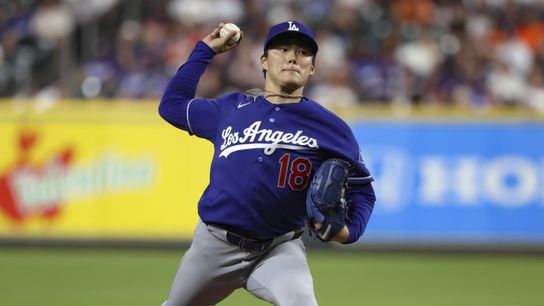
Los Angeles Dodgers starting pitcher Yoshinobu Yamamoto (18) delivers a pitch during the second inning against the Houston Astros at Daikin Park.
The Dodgers arrived and immediately dictated terms. Before Yoshinobu Yamamoto even threw a pitch, they grabbed a 1–0 lead on an RBI single from Kyle Tucker, his first at-bat in Houston as a Dodger, a soft liner that set the tone for a lineup that kept traffic on the bases all night.
Yamamoto didn’t exactly return the favor early. His first inning, 28 pitches, scattered command, continued a trend that’s becoming harder to ignore. Two runs crossed, one on a Jose Altuve single and another when a curveball skipped past Will Smith, allowing Isaac Paredes to score. Of the 15 runs Yamamoto has allowed this season, six have now come in the opening inning.
And yet, like he has more often than not, he adjusted.
From the second inning on, Yamamoto looked like the version the Dodgers are counting on, efficient, precise, and increasingly dominant. He finished six innings with eight strikeouts, allowing three runs on five hits. It wasn’t perfect, but it was controlled. And with this offense, controlled is more than enough.
The second inning brought a small but symbolic breakthrough: Alex Freeland crushed a game-tying home run, snapping a six-game homer drought, the club’s longest since 2014. It didn’t open the floodgates immediately, but it loosened something. You could feel it in the dugout, in the swings, in the way at-bats stretched deeper.
A few batters later, Ohtani walked, one of two free passes in a hitless night, and Will Smith followed with a sharply hit ball that barely eluded a leaping Zach Cole, bringing Ohtani home for a 3–2 lead.
Then came the third inning.
Troy Taormina-Imagn Images
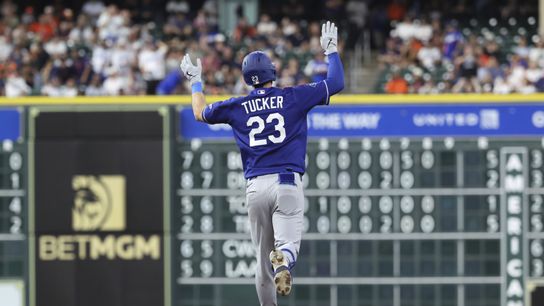
Los Angeles Dodgers right fielder Kyle Tucker (23) celebrates while rounding the bases after hitting a home run during the third inning against the Houston Astros at Daikin Park.
Tucker led off with a solo homer, his first in 13 games. Andy Pages and Hyeseong Kim followed with singles. Freeland worked a walk. Bases loaded, one out, and even Ohtani’s struggles found a way to contribute, a groundout pushing across a run.
Then Freddie Freeman took over.
A two-run single to center. A controlled, professional swing that turned a rally into a rout. Four runs in the inning. Game, effectively, over.
Freeman added another RBI single in the fifth, his first multi-RBI performance since early April, and by then the Dodgers offense had crossed into that familiar territory Dave Roberts alluded to afterward.
“Tonight was a good night,” Roberts said. “It was good to see us look a little bit more normal.”
Normal for this group means relentless pressure. Ten-plus hits in back-to-back games. Contributions up and down the order. Freeland reaching base four times. Tucker collecting multiple hits. Freeman driving in runs in bunches.
And Ohtani?
He walked twice. He didn’t hit.
He also didn’t look right doing it.
Troy Taormina-Imagn Images
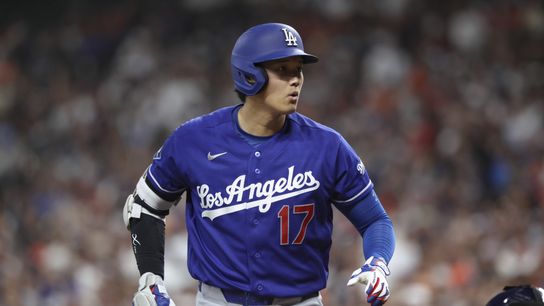
Los Angeles Dodgers designated hitter Shohei Ohtani (17) reacts after a pitch during the second inning against the Houston Astros at Daikin Park.
Roberts acknowledged postgame that he wasn’t thrilled with Ohtani’s body language. The numbers back it up: 0-for-17 over his last five games, his average down to .240. For most players, that’s a slump. For Ohtani, it’s a signal.
So the Dodgers pivoted.
Originally slated to both pitch and DH on Tuesday, Ohtani will now focus solely on the mound. It’s a strategic breather, mental, physical, and perhaps mechanical, for a player carrying two of the sport’s heaviest workloads.
And the timing isn’t accidental.
Because the version of Ohtani they’ll get Tuesday night is the one that has been dominant: 2–1 with a 0.60 ERA across five starts. That version doesn’t search. It attacks.
It also opens the door for a bat like Dalton Rushing’s to slide into the lineup, keeping the offensive momentum intact while Ohtani recalibrates.
They’re now 22–13, 10–7 on the road, and starting to resemble the group many expected, dynamic, dangerous, and deep enough to absorb even a temporary dip from their biggest star.
The Astros saw it firsthand. And on Tuesday, they’ll get a different version of the same problem.