
LOS ANGELES – The first loss of a season always feels louder than it should.
For the Dodgers, Monday night at Uniqlo Field at Dodger Stadium carried that tone, a 4-2 defeat to the Cleveland Guardians.
However, inside the Dodgers clubhouse, there was little sign of concern. The first loss can be difficult, but that night was memorable not because of the defeat.
Roki Sasaki.
A step forward, even in defeat
The “experiment,” as it’s been loosely framed, continued Monday. And for the first time this spring carrying into the regular season, it looked stable.
Sasaki, who spent much of spring training wrestling with his command, found something resembling rhythm. It wasn’t overpowering. It wasn’t dominant. But it was controlled.
Four-plus innings. Four hits. One run. Two walks. Four strikeouts. 78 pitches.
Most importantly—he threw strikes.
Against a lineup anchored by José Ramírez, Sasaki navigated the edges of the zone, inducing swings on pitches that earlier in the spring would’ve missed wildly. There was a first-inning escape, a handful of deep counts, and a growing sense that he was no longer just searching—he was adjusting.
“I really did think that today was a good step in the right direction,” manager Dave Roberts said postgame.
The Dodgers would’ve liked to see him push deeper—Roberts mentioned the 90-pitch threshold as the checkpoint—but context matters. A week ago, simply finding the zone felt like a hurdle.
Monday, Sasaki cleared it.
The mystery pitch, catcher’s role
Slider? Cutter? Something in between?
Even Roberts didn’t have a label.
“I’m not sure,” he admitted.
Behind the plate, Dalton Rushing, who made his first start. Rushing helped guide the approach. And notably, it was Rushing calling for that evolving pitch early and often.
“Today I threw a lot of sliders because it was the catcher’s call,” Sasaki said.
Rushing sees both the intrigue and the issue.
“It’s a new pitch to him,” Rushing said. “It’s a pitch that we’re kind of trying to understand in how we want to use it.”
There’s a clear key to unlocking Sasaki’s ceiling, at least in Rushing’s mind:
“Landing the splitter would change a lot for him.”
That’s the balance right now—experiment versus execution. The Dodgers aren’t just trying to get outs; they’re trying to build a complete pitcher in real time.
And for one night, it worked well enough.
Bullpen bends, then breaks
Once Sasaki exited in the fifth, the game shifted.
Tanner Scott delivered perhaps the most important sequence of the night—escaping a no-out, runners-on-the-corners jam without allowing a run. It was the kind of high-leverage moment that, last season, often spiraled.
This time, it didn’t.
“I think he’s using different parts of the plate,” Roberts said. “The slider is a better pitch this year.”
But the seventh inning told a different story.
Justin Wrobleski was one strike away, literally, from escaping a bases-loaded mess. Instead, a walk to Rhys Hoskins forced in a run, and moments later, a two-run hit from Daniel Schneemann broke the game open.
From escape to unraveling in a matter of pitches. That’s the thin line.
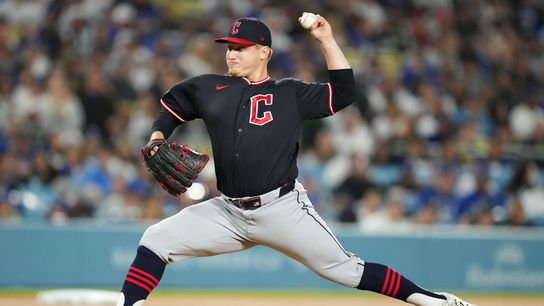
Kirby Lee-Imagn Images
Cleveland Guardians pitcher Parker Messick (77) throws pitch against the Los Angeles Dodgers in the first inning at Dodger Stadium.
An offense that waited too long
For six innings, the Dodgers’ lineup looked unusually human. Credit goes to Cleveland starter Parker Messick, who kept a billion-dollar offense off balance—no walks, five strikeouts, and a steady mix that never let hitters settle.
“They looked very good tonight,” Rushing said. “Sometimes you gotta tip the cap.”
The Dodgers didn’t break through until the ninth.
A rally sparked by Kyle Tucker, finished by a Mookie Betts double and a run-scoring groundout from Freddie Freeman, avoided the shutout—but not the loss.
Too little. Too late.
The bigger picture
So yes, the Dodgers lost. They’re 3-1 now. They won’t go 162-0. But zoom out, and Monday wasn’t about a perfect record.
It was about progress. Sasaki admitted he had “no confidence at all” before the game. By the end, he was talking about mechanics, rhythm, and control. That’s not a small shift—it’s foundational.
“I kind of got my confidence back up,” he said.
For a team thinking in October terms, that matters far more than a game in March. And with Shohei Ohtani set to take the mound Tuesday, yes, while leading off, the Dodgers will move forward quickly.