
CUVER CITY, Calif.––The shot holds. A sprawling window, Los Angeles laid out like a promise. Then a pen. Kenya Barris picks it up—slow, deliberate, as if the ink might bleed secrets.
He scribbles. We initially don't see the words. We don't need to.
We already know the name from what he writes: The Logo.
Not Jerry. Not West.
The way you say Cheyenne or Gettysburg. A place where something was lost.
Barris, the "black-ish" auteur making his documentary directing debut, doesn't open with a jump shot or a trophy case.
He opens with a man trying to catch a ghost. And that's exactly right.
Because "Jerry West: The Logo" is not a sports film.
It is a ghost story.
The ghost is failure; the host is a Hall of Famer––a front page man, who saw himself relegated to the margins.
And the question—the one that hovers over every frame like a half-court heave at the buzzer—is this: What if losing teaches you more than winning? And what if tremendous greatness comes only with immense self-loathing?
Let's be plain: Jerry West was the greatest winner who ever believed he was a loser.
He won an NBA title as a player. He won eight more as an executive.
He is the only man in basketball's Hall of Fame three times over—player, Olympian, contributor.
And yet, as his son Ryan West tells Barris, flat and unflinching: "Can he be happy? No."
That "no" is the film's thesis. That "no" is its eulogy.
Barris knows where pain lives.
He doesn't interview West in a gym or a boardroom. He sits him down in a quiet room, those famous blue eyes shifting from welcoming to wounded in a single cut.
One moment, West smiles—a wry, knowing smile, the kind a man wears when he's outlived his enemies. The next moment, he's somewhere else.
Somewhere 1952. Somewhere in Chelyan, West Virginia.
Darryl Norenberg-Imagn Images
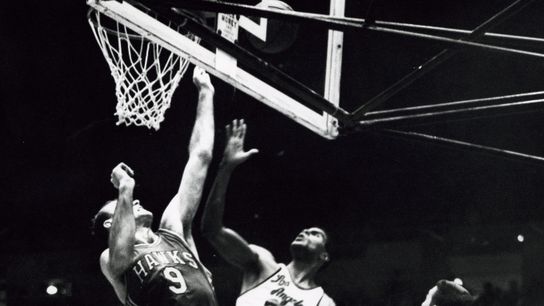
Los Angeles Lakers forward Tom Hawkins (20) scores over St. Louis Hawks forward Bob Pettit (9) in front of Jerry West (44) during game 6 of the 1961 Western Division championship at the Los Angeles Sports Arena.
Chelyan: trailer parks, dilapidated homes, a hoop nailed to a tree.
That tree was West's cathedral.
He taught himself the jump shot there—mechanical, precise, a car designer blueprinting a piston. But the cathedral had a crypt.
His brother David, the only one who truly cared, got drafted to Korea. The body came home in a metal casket. His mother put it next to the Christmas tree.
"I do remember one time I placed my hand on it," West says in the film, his voice a low gravel. "And at night, trying to sleep, knowing my brother, who was my buddy, who was invincible, was laying in a metal box next to the Christmas tree."
West had to walk past that casket.
Every day. To the tree. To the presents.
To the reminder that the only man who loved him was now a sheet of cold steel.
His father? Abusive. Vicious.
West became his little sister's protector. He kept a shotgun by his bed.
"Women are sacred," West said. "That's an absolute no-no."
This is the soil where the Logo grew.
Not grit—don't say grit—but something harder. Something hollowed out.
On the court, West was perfection. The prettiest jump shot ever made.
A technical genius who broke the game into bolts and bearings.
Darryl Norenberg-Imagn Images
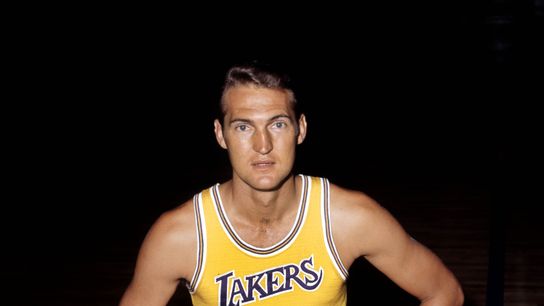
Los Angeles Lakers guard Jerry West (44) in a portrait session at The Forum.
He played for the Lakers on Fridays and Sundays; on Saturdays, he worked at Sears.
Los Angeles—the glitz, the glamour, the Memorial Sports Arena—was an alien planet.
But he adapted.
He grew confident enough to hang with Black players, to earn their trust.
George Raveling wanted to guard him; West dropped thirty on his head.
Raveling scored eleven.
"Sports is not designed to win," Lakers trainer Gary Vitti says. "It's designed to lose."
West lost the Finals nine times. Nine.
He is the only man to win Finals MVP on the losing team—1969, against Boston, the Celtics again, always the Celtics.
And each loss didn't just defeat him. It confirmed him to himself.
Loser.
That's what he heard. That's what he felt.
"I learned a lot from winning," West admitted, "but I learned more from losing."
Here is the documentary's layered, brutal insight: losing taught him everything except how to win.
When victory finally came—1972, a championship—he didn't know what to do with it.
He was so accustomed to the submarine of sullenness, the cold pressure of defeat, that winning felt like a stranger. A thief. It stole his familiar agony.
Barris captures this with an empathy that never curdles into pity.
We see West after a loss, sinking into himself, his shoulders folding like a card table.
We hear him say, "Some days I don't function very well."
His widow, Karen, admitted that she struggled to understand his depression.
That's the truth of it: you can love a man and still not reach the place where he lives.
The second act of West's life—the Midas Touch—is where most documentaries would plant their flag.
Barris glides through it with a wry efficiency.
Kirby Lee-Imagn Images
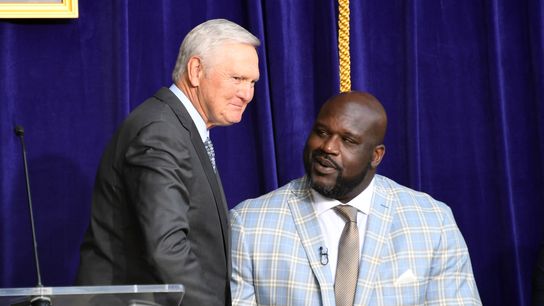
Jerry West (left) shakes hands with Los Angeles Lakers former center Shaquille O'Neal during ceremony to unveil statue of O'Neal at Staples Center.
We get the Shaq pursuit: A phone call at 3 a.m. in Magic City, a popular strip club in Atlanta, West, telling the big man, "You have to sign right now."
We get the Kobe trade, Vlade Divac shipped out, Divac later choosing West to introduce him at his Hall induction because West was "a father figure when you needed it and a friend when you needed it."
We get Michael Cooper marveling: "Jerry had the ability to squash inner-team turmoil."
Magic Johnson, laughing: "I thought Jerry West was from the hood."
But Barris is not interested in hagiography. He's interested in the chasm.
The distance between West's public genius and his private torment.
When Magic told West he had HIV, West sobbed in his office.
They cried together. West hugged him.
"Life after basketball," West said, staring into the middle distance. "What was after ball? The morgue? Business? Life?"
He won everything, he felt nothing. No—reverse that: He felt everything, so winning was never enough.
No critique is honest without a scalpel. "Jerry West: The Logo" has two wounds, self-inflicted.
First, the structure jumps. It leaps from dynasty to death, from Kobe's tragedy—which West says felt like losing David all over again—to the Memphis years, then back to Showtime.
Kirby Lee-Imagn Images
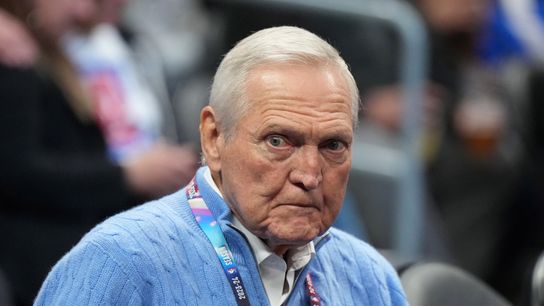
LA Clippers special consultant Jerry West watches in the first half against the Sacramento Kings at Crypto.com Arena. Kirby Lee-Imagn Images LA Clippers special consultant Jerry West watches in the first half against the Sacramento Kings at Crypto.com Arena.
The editing lacks a steady hand.
One moment you're watching West sign Shaquille O'Neal in the dead of night; the next, you're at Kobe's memorial.
The whiplash is real. Barris, a first-time documentary director, sometimes mistakes emotional truth for narrative coherence.
They are not the same.
Second, and more troubling: the feud with the Lakers goes unexplored.
Jeanie Buss appears.
She honors West. She talks legacy.
But she never explains why West felt jilted, why he left, why the stitching of that fabric came undone.
Phil Jackson isn't mentioned. Not once.
Barris said that he "did not want this to be a salacious look at the negative accounts."
Fair enough.
But a documentary that asks what greatness costs and then avoids the bill from one of its most expensive chapters?
That's a hedge. Not a hook.
The film ends where it should: not with a trophy, but with a lap.
West peers over a balcony. His granddaughter, McKenna, hops onto his lap. She's small. He's old.
They don't talk about basketball. They don't talk about losing. They just sit.
Barris holds the shot.
No music swell. No title card.
Just a man who spent eighty-six years running from himself, finally still.
Earlier, West had said: "I love to laugh because I never did a lot of it in my life."
That line—asyndeton, bare and brutal—is the whole documentary in seven words.
He loved to laugh because he never did.
He won because he lost. He built because he broke.
So what lessons can be learned from losing?
"Losing teaches you everything about the game and nothing about yourself," West said.
It teaches you to dissect, to analyze, to become the coach, the referee, the player all at once. But it does not teach you how to stop. It does not teach you how to hold a trophy without seeing the casket.
And does tremendous greatness come with immense self-loathing?
Look at the Logo.
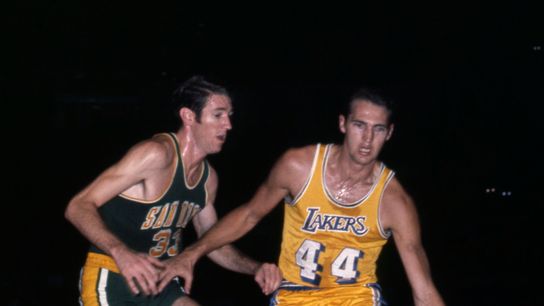
Darryl Norenberg-Imagn Images
Los Angeles Lakers guard Jerry West (44) is defended by San Diego Rockets forward Jim Barnett (33) at the Forum.
The silhouette has no face for a reason.
West gave his form to the league, but he kept his darkness for himself.
"I simply didn't give a f–––," West said of criticism.
But he gave every; he just gave them to the wrong ghosts.
In the end, "Jerry West: The Logo" is not a biography. It's a mirror.
And when you look into it, you don't see a jump shot.
You see a boy running half a mile from a mailbox, haunted by a mother's wail, trying to outrun the only truth that ever mattered: There will never be another like Jerry West.
Thank God. And what a shame.
"Jerry West: The Logo" premieres April 16 on Prime Video.