
NEW ORLEANS –– On Super Bowl Sunday, while millions tuned in for touchdowns and trick plays, Kendrick Lamar turned the halftime stage into his personal proving ground—a realm where he held not just hip-hop but the reins of American culture firmly in the palm of his hand.
The performance was a masterclass in symbolism and strategy, a chess game played out in dazzling visuals and searing lyrics that left no doubt: Kendrick Lamar controls the game.
Every detail of the set design whispered layers of meaning from when the stage lights dimmed. Gone were the bombastic pyrotechnics of past halftime shows; instead, the stage resembled a meticulously crafted tic-tac-toe grid, with PlayStation controller symbols reimagined for a cultural coup. Minimalist yet deliberate, the backdrop evoked a world where every button and movement symbolized power—a nod to the idea that, for Lamar, this was all a game he was born to command.
All week, New Orleans buzzed with anticipation. Conversations in the alleyways of Bourbon Street and along the bayou mused over every potential twist in Lamar's set list—would he take shots at Drake? Would there be Easter eggs, hidden messages woven through the music?
But as the performance unfolded, it became clear that Kendrick was not here to engage in petty feuds but to upend the game entirely. His songs—"Squabble Up," "HUMBLE," "DNA," "Euphoria," "Peek a Boo," "All the Stars," "Luther," "Not Like Us," "TV OFF"—weren't merely a collection of hits. They were coded manifestos, each beat a bullet in his declaration that the rules of American culture were his to rewrite.
The show opened with an interlude in which Samuel L. Jackson stride onto the stage, donning a costume that reflected America's iconography.
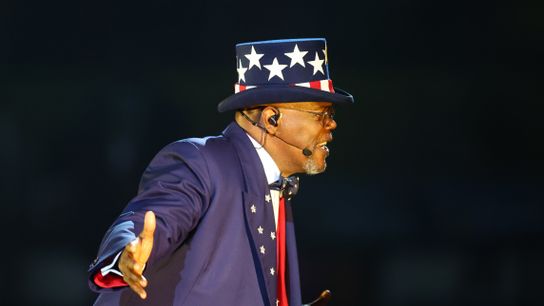
Mark J. Rebilas-Imagn Images
Samuel L. Jackson introduces recording artist Kendrick Lamar performs during the halftime show of Super Bowl LIX between the Philadelphia Eagles and the Kansas City Chiefs at Ceasars Superdome.
Was it Uncle Sam or a more subversive Uncle Sambo? Jackson's character berated Lamar for being "too loud, too reckless, too ghetto!"—a mirror reflecting the perennial criticisms lobbed at Black expression in America.
In that moment, Jackson personified more than a figure; he was the embodiment of a system that has long sought to police Black culture.
In one arresting visual, Kendrick Lamar appeared atop the hood of a black GNX, an icon of urban rebellion. Draped in a red, white, and blue Gloria leather jacket and flared blue jeans, his backward 5+5 baseball cap and a collection of diamond-studded chains told a story of defiance and pride.
Among them, a lowercase "a" hung prominently—a subtle homage to the A minor note, a quiet but potent reminder of his deep musical roots and the minor chords that have scored Black struggle and triumph throughout history.
The visual tableau was as potent as the lyrics. Black dancers, clad in red, white, and blue sweat suits, spilled forth from the black GNX alongside hyphy dancers from Oakland, their movements evoking the raw energy of street corner du-wop—an homage to an era when notes sang under street lights were a call to freedom.
During "HUMBLE," male dancers split an American flag onstage, a stark image that captured the fractured state of American democracy and the ongoing struggle within.
Jackson's challenge—almost rhetorically, asking if Lamar knew how to play the game—only deepened the performance's subversive punch. With his "crew" in tow, Lamar responded by turning that challenge into a cultural cheat code. This move had the symbolic "scorekeeper" deducting a life for Lamar's persistent rebellion.
Even two of Drake's ex-girlfriends found time to contribute to Lamar's performance. SZA sang lyrics on "Luther" and "All the Stars."
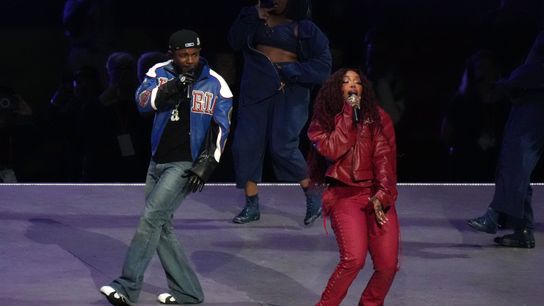
Kirby Lee-Imagn Images
Recording artist SZA and recording artist Kendrick Lamar perform during halftime Super Bowl LIX at Caesars Superdome.
As Lamar teased and ultimately performed "They Not Like Us," he continued to slice the heart and psyche of Drake and his OVO fanbase with a proverbial knife. Serena Williams, the other of Drake's ex-girlfriends, "C-Walked," or "Crip Walked" during the song. Williams, the Compton native, was derided by the media for dancing at the Olympic games.
It came to a collective crescendo when the stadium chanted "a minor" in front of millions of people around the globe.
The crowd wasn't just singing a refrain—they witnessed a reclamation of cultural space, a declaration that the game and its symbols were being remade on Lamar's terms.
Throughout, Lamar's performance radiated a messiah-like authority. He wasn't simply performing for the record but orchestrating a revolution.
The stage was his playground—a place where he could play with the expectations of hip-hop and mainstream America under the peering eyes of President Trump.
With every carefully chosen lyric and deliberately sparse lighting, he sent a clear message: nothing is left to chance, yet everything is open to interpretation.
In his world, the rules are his to write, and the outcome is inevitable.
For some, the Super Bowl was about the spectacle of athletic triumph—a chance to see the Chiefs chase history or to see if the Eagles would uproot a lauded hero or despised villain in Mahomes. But for all of us, it was a moment of cultural reckoning.
While others tuned in to hurl their rivalries at the screen, Kendrick Lamar redefined what it means to be a cultural powerhouse on Sunday night. He showed that he's not just a participant in the game of American culture—he's its ultimate controller.
As the echoes of his performance reverberated throughout the stadium and airwaves worldwide, it was clear that the game would never be the same again.
Game over.