
ST. LOUIS — The line will read as ordinary, maybe even discouraging to anyone skimming a box score in the morning: six innings, three runs, a loss. Another notch on a stat sheet that now shows a 5.97 ERA.
But if you actually watched Roki Sasaki on Saturday night at Busch Stadium, you saw something far more complicated, and far more consequential for where the Dodgers go next.
Because in the middle of a 3-2 loss to the St. Louis Cardinals, a game defined more by offensive stagnation than pitching failure, Sasaki may have quietly delivered his most important start of the season.
Not his cleanest. Not his most dominant. But his most revealing.
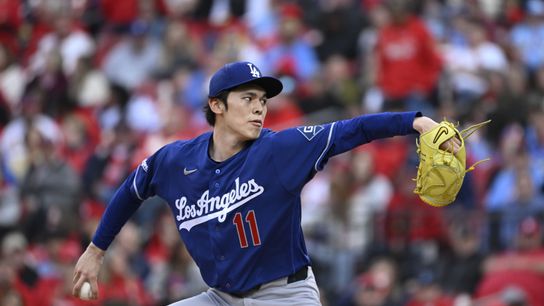
Joe Puetz-Imagn Images
Los Angeles Dodgers starting pitcher Roki Sasaki (11) delivers a pitch against the St. Louis Cardinals in the third inning at Busch Stadium.
A start that told two stories
For two innings, Sasaki looked composed, if not entirely sharp. The command wasn’t pristine, but the stuff played. More intriguing was the evolution: two distinct versions of his splitter, a traditional mid-80s forkball and a firmer, 90-plus variation he’s only recently introduced.
Then came the third inning, and with it, the version of Sasaki that has defined much of his uneven second season in the majors.
Back-to-back doubles. A misplaced pitch. And then a mistake that didn’t miss.
Jordan Walker crushed an 0-2 forkball into left for a two-run homer, moments after Alec Burleson had already done damage. In a blink, it was 3-0, and familiar frustration resurfaced.
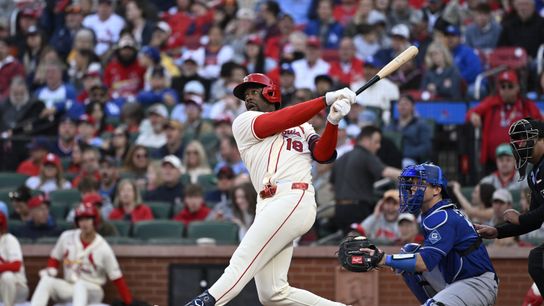
Joe Puetz-Imagn Images
St. Louis Cardinals right fielder Jordan Walker (18) hits a two-run home run against the Los Angeles Dodgers in the third inning at Busch Stadium.
This is the tension with Sasaki right now. The margin for error is thin, and when he loses the feel for his secondary pitches, big league hitters don’t just capitalize, they punish.
The response that matters
What followed may matter more than the damage itself.
Sasaki didn’t unravel. He didn’t spiral into a short outing. Instead, he stabilized, quickly and emphatically.
He retired 10 of the final 11 batters he faced. He navigated the fourth, fifth and sixth innings with increasing efficiency, including a crisp, nine-pitch sixth to finish his night at a career-high 104 pitches.
That ability to reset has quietly become one of his most valuable traits. It showed up again Saturday, and it’s something the Dodgers’ decision-makers will not ignore.
For the first time this season, Sasaki checked both boxes of a traditional quality start: length and damage control. For a pitcher still trying to reconcile his elite stuff with major league consistency, that’s not nothing.
The bigger problem wasn’t on the mound
If anything, the more pressing issue continues to be an offense that has gone ice cold.
The Dodgers have now dropped four straight, falling to 20-13, matching the Cardinals after Saturday’s result. They hit into four double plays in the first five innings. They managed just four hits through seven. Even Shohei Ohtani, the engine of the lineup, went hitless again and is 0-for-11 during the stretch of the four-game skid.
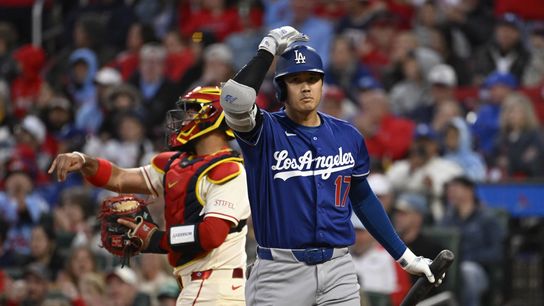
Joe Puetz-Imagn Images
Los Angeles Dodgers designated hitter Shohei Ohtani (17) looks on after striking out against the St. Louis Cardinals in the sixth inning at Busch Stadium.
By the time the lineup showed signs of life, RBI singles from Max Muncy and Andy Pages in a chaotic ninth, it was too late.
Sasaki didn’t lose this game. He just didn’t have the margin to win it.
So… what happens when Snell returns?
This is where the conversation turns from performance to roster math.
Blake Snell is nearing a return, with another rehab start scheduled and activation likely within the next couple weeks. When that happens, the Dodgers won’t carry a seven-man rotation.
Someone has to move.
On paper, Sasaki is the easiest target. The ERA is high. The command has wavered. The results haven’t matched the hype.
But decisions like this aren’t made on ERA alone, not for a team with October ambitions. Because the Dodgers have already seen what Sasaki can be in a different role.
During last year’s postseason, he was dominant out of the bullpen: a 0.84 ERA, three saves, swing-and-miss stuff that played up in shorter bursts. That version of Sasaki, explosive, simplified, overwhelming, still exists. And right now, it might be the version that best fits what this team needs.
Rotation piece or bullpen weapon?
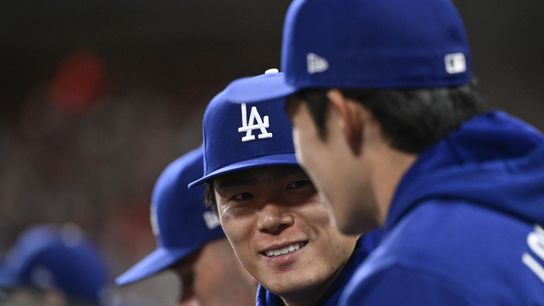
Joe Puetz-Imagn Images
Los Angeles Dodgers pitcher Yoshinobu Yamamoto (18) speaks with a teammate during a game against the St. Louis Cardinals in the third inning at Busch Stadium.
The Dodgers’ rotation picture is crowded, but also layered.
Yoshinobu Yamamoto, Ohtani, and Tyler Glasnow are locked in. Emmet Sheehan and Justin Wrobleski have done enough to justify continued opportunities, even with some inconsistency.
That leaves Sasaki, and a decision that isn’t as straightforward as it might seem.
Because Saturday complicates the narrative.
If Sasaki had been shelled again, the move would feel inevitable. Instead, he showed growth: improved endurance, in-game adjustments, flashes of the arsenal that made him so coveted.
At the same time, the bullpen argument remains strong. The Dodgers are without Edwin Díaz for the foreseeable future, and Sasaki’s swing-and-miss profile could immediately stabilize the late innings.
The Dodgers don’t have to choose what Sasaki is long-term right now. They only have to decide what gives them the best chance to win in the next two months.
And that answer may be both practical and temporary.
A move to the bullpen wouldn’t be a demotion as much as a recalibration, a chance to manage innings, sharpen command, and impact games in higher leverage while the rotation sorts itself out.
Saturday didn’t eliminate that possibility. But it did ensure this: if the Dodgers make that move, it won’t be because Sasaki failed. It’ll be because they know exactly how valuable he can be.