
Soccer is not just a beautiful game. It is a universal language—spoken beyond borders, traversing the many identities humanity assigns itself. It moves through different lenses, carrying a shared meaning to all who are open to it.
In a partnership now in its 4th year, Major League Soccer and Apple TV have embraced that universal language of soccer through their expansive storytelling. The league itself includes players from 78 countries, while its broadcasts—matches, studio shows, and on-demand content—reach over 100 countries and regions.
It takes a particular kind of formula to shape that language for a world that is often divided and disrupted by both logistics like time zones and language as well as cultural nuances.
There is something almost alchemical in the process—voices, perspectives, creative vision, and technical precision blend in real time to translate the game into a symphony for their audience. Differences are not flattened; they are woven together. What unites everyone is this - a love for something within the game whether it is a player, a team, a flag, a storyline, competition, community or something more personal.
AMBER RODRIGUEZ - THE SPORTING TRIBUNE
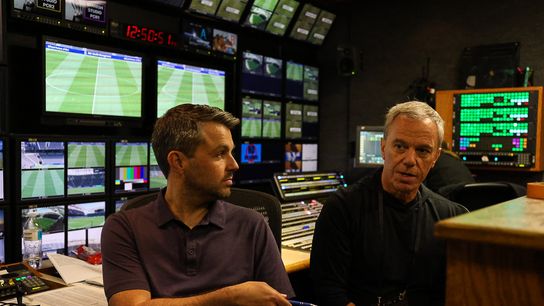
Brad Mertel (Match Producer, MLS on Apple TV) and Jim Daddona (Match Director, MLS on Apple TV).
"Our main goal is to document what's happening on the field," Match Director of MLS on Apple TV, Jim Daddona offered. "That's our most important thing, document it thoroughly and give people at home a great seat to watch what's going on and give them pertinent information. Everyone here is all tied together. We're all one big team that does that."
At the core of it all is trust—the trust viewers place in what they are watching, and the trust the people behind the broadcast place in each other. That trust is the backbone of the production teams behind Sunday Night Soccer.
“We’re like a family,” Production Coordinator Rob Gaertner said as the post-match interviews wrapped up. It’s a phrase that can feel overused—until you see it up close.
Production teams don’t just work together; they move together. Hours are spent in tight windows—preparation, execution, troubleshooting, reset—repeated week after week. They learn each other’s rhythms. They anticipate decisions before they’re spoken because there is often little time to speak when a millisecond can make all the difference in a live broadcast. Each member knows when to step in, when to step back, when to expand and when to let the moment breathe. Theirs is a spoken and silent language.
"Everything gets into a real rhythm," Daddona said.
Trust, in that environment, isn’t an abstract concept. It’s a living multicellular organism.

AMBER RODRIGUEZ - THE SPORTING TRIBUNE
Rob Gaertner (production coordinator), Jillian Sakovits (host and sideline reporter), and Antonella González (host and sideline reporter), MLS on Apple TV pre-game.
It shows up in the small things: a glance across the room, a hand signal, a nod, a decision made without hesitation, a spatial and temporal awareness. It’s built in the in-between moments too—shared meals, travel days, quiet pauses before going live, the laughter that breaks tension after a long sequence.
And when the time comes, this production team family dynamic is thrust into a role of delivering a product that is consistently trustworthy and dynamic. Unlike many families, instead of mayhem and chaos under the pressure of a live setting, it is surprisingly collected and systematic.
The Call Before the Moment Lands
AMBER RODRIGUEZ - THE SPORTING TRIBUNE
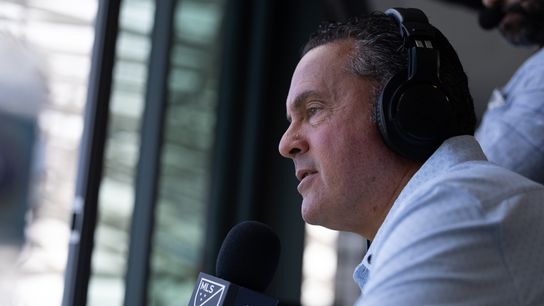
Sammy Sadovnik (Spanish-language Play-By-Play Announcer, MLS on Apple TV).
It’s 13 minutes into the second half of an electric matchup between two top-tier Western Conference rivals. Veteran play-by-play announcer Sammy Sadovnik barely takes a breath. “¡Gol! ¡Gol! ¡Gol! ¡Gol de San José!”
The call stretches and stretches—long past what feels human—his voice refusing to break as the play completes. His face turns a deep reddish purple, the effort visible, physical, almost defiant. He holds it. This is his third such call in the last six minutes, yet each time feels energetically unique.
His language doesn’t wait for completion.
It arrives in waves—“viene el remate, viene el rebote… a ver quién le pega…”—phrases that anticipate the play before it resolves. The sentence is never quite finished because the moment isn’t either—each one flowing into the next, a kind of freestyle form.
There is urgency in his repetition, but also trust. Trust that the listener will follow, that they will feel the sequence even if it is not fully explained. Because the human brain operates in similar emphatic fragments—few of them fully formed sentences.
A perfect cross is not just described—it is remembered in real time. “El centro era perfecto… había ganado la posición… se lo perdió.” The miss carries as much weight as the goal.
Sadovnik does not slow the game down to make it understandable. He speeds language up to meet it.
In that acceleration, something else begins to take shape. By the time the play ends, it already belongs to memory. But the moment a goal resolves—undeniable, complete—language does too.
The game does not wait to become history—it becomes it in real time. Each call, each fragment, each rising cadence begins to hold weight before the moment has even fully resolved. What is unfolding is not simply being described; it is being preserved in motion.
Sadovnik is not just narrating what unfolds. He is curating it as it happens—selecting, emphasizing, imprinting meaning onto moments before they have time to settle.
Amber Rodriguez - The Sporting Tribune
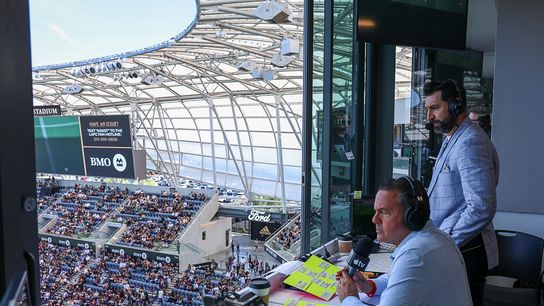
Sammy Sadovnik (Spanish-language Play-by-Play Announcer, MLS on AppleTV) and Diego Valeri (Spanish-language Match Analyst, MLS on AppleTV).
“Each game is different, you know, it depends upon the teams, the player.” Sammy explained. “We have the pleasure to call Messi's goals during the league since two years ago, so it's part of the emotion of the game. But each game and each player have a different sensation with me.”
Just before the ball crosses the line, he taps match analyst Diego Valeri lightly on the elbow—a quick, instinctive signal: this is coming.
Valeri already knows. He glances over while Sadovnik continues his play-by-play, a small smile forming, eyebrows lifting in quiet recognition. There’s no interruption. No rush to speak. He lets the moment crest. A shutout streak has ended and a new era of history for San Jose is unrelentingly made tangible and they will go on to make another declarative win just days later.
Sadovnik finishes the call with a final lift of his hand, the energy still lingering in the air.
Only then does Valeri step in—measured, composed—translating what just happened. An own goal. A defense caught a step late. A San Jose side attacking from everywhere, forcing the moment against an LAFC side that, for the first time at home this season, looks unsettled.
Valeri enters where the moment needs grounding and comes at it from a stance of preparation.
He does not chase the play—he interprets it. Where Sadovnik fragments, Valeri completes context. A missed chance becomes the physics of angle and timing. A hesitation to shoot becomes a story of scheduling fatigue. Even something as fleeting as sunlight in a player’s eyes becomes empathetic explanation, not excuse.
AMBER RODRIGUEZ - THE SPORTING TRIBUNE
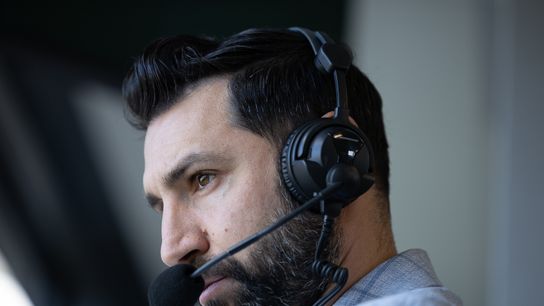
Diego Valeri (Spanish-language Match Analyst, MLS on AppleTV) during MLS match.
His voice does not compete with the moment; it begins to gather it, to arrange what has already unfolded into something the viewer can hold onto.
Valeri, after all, comes from a footballing culture where emotion is not suppressed but amplified. What reads as calm in the booth is not the absence of feeling, but the result of restraint—of choosing when to rise, and when to hold.
“My way to communicate with people in the past, it was playing the game. Now it’s, expressing it.”
Valeri, is a calming presence in the booth, quite unlike the role he played for the Portland Timbers as one of their arguably best midfielders of all-time. He’s deliberate in his movements, collected, and poised, standing beside the seated and vocal Sadovnik.
As San Jose collect on Hollingshead’s error, he softly brings his hand towards his forehead but not in dramatic fashion.
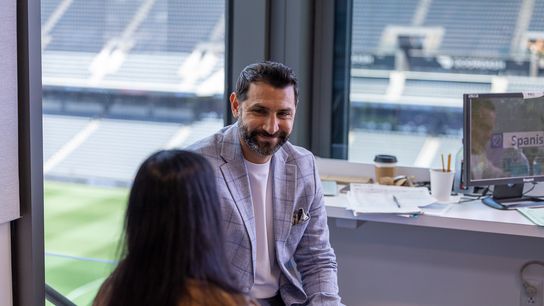
AMBER RODRIGUEZ - THE SPORTING TRIBUNE
Diego Valeri (Spanish-language Match Analyst, MLS on Apple TV) getting interviewed pre-match.
“I gotta manage and balance that adrenaline and that passion with some wise words, with some calm words, right,” he posited. “You can't be always high, always louder, right? And I'm pretty much like that, so I gotta calm myself.”
There is kindness in his analysis, but not indulgence. The moment is not softened—it is understood.
If the audience is listening to the orchestra of the match, Sadovnik is the surge—the rising swell that pulls you into the moment before you can name it. Valeri is the composition beneath it, shaping the movement as it unfolds, giving it structure, giving it meaning.
The central music, though, is the game. Everything else exists to let it play.
San Jose have netted three goals in six minutes. A team who months before looked like they were on the path to being without an owner, were on their way to the top of the Western Conference table, a dark horse candidate led by none other than the most successful manager in MLS history, Bruce Arena.
Reading the Game as It Unfolds

Amber Rodriguez - The Sporting Tribune
Taylor Twellman (Match Analyst, MLS on Apple TV) and Jake Zivin (Play-by-Play Announcer, MLS on Apple TV) before an MLS match on Apple TV.
“The story today is San Jose, not LAFC,” match analyst Taylor Twellman wryly stated hours before kickoff, his trademark blue-grey eyes catching the light in the California sun.
If the Spanish broadcast moves like instinct, the English-language booth moves with intention—structured, layered, deliberate in the way it builds meaning over time.
Play-by-play announcer Jake Zivin starts explaining his role from a place of clarity, almost principle.
“My philosophy of play-by-play is… what’s happening on the field, right? People watching the game—they’re here to watch the game. So that should always be the number one priority of a broadcaster… to document the game,” he said. “That’s kind of where I gravitate to.”
But even that clarity is not rigid—it adjusts to the situation. He is a realist and pragmatist yet his passion for the game he chose to retell is clear.
“If it’s five-nil in the 60th minute, you don’t need to call every touch like it’s the most important touch in the world because it’s not. So maybe you talk about other things,” he continued. “But today we’ve got two versus three in the West. This is a big, big game. To me, the philosophy is give this game what it deserves.”
And he does display passion for soccer in every aspect — without ever losing sight of the baseline.
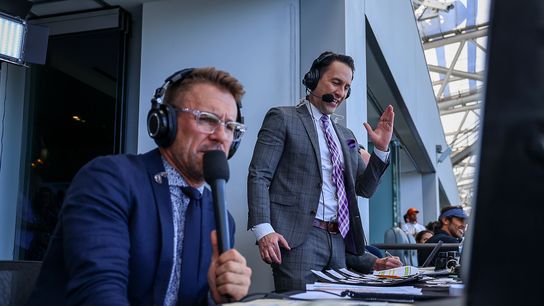
Amber Rodriguez - The Sporting Tribune
Taylor Twellman (Match Analyst, MLS on Apple TV) and Jake Zivan (Play-by-Play Announcer, MLS on Apple TV).
His call builds outward. A goal is not just a flash of action, but an entry point into something larger, something already connected to what came before and what will follow.
“Ousseini Bouda’s third goal of the season… snaps Hugo Lloris’ 593-minute shutout streak to begin the season—the fourth longest shutout streak in the history of Major League Soccer…” Zivin continues, the information unfolding in real time, not interrupting the moment but expanding it. The goal becomes a story—of a player, of a system, of a league finding new shapes.
He doesn’t rush the moment. He situates it and within that moment one can witness the love he feels and the knowledge he holds within.
Beside him, Twellman is tracking something else entirely.
“How quickly this game changes,” he says, almost before the shift has fully registered. Where Zivin constructs the moment, Twellman feels its movement—its tilt, its volatility, the thin line between one outcome and another.
“Just over 590 minutes, it took,” he notes. “Moments before this, it was almost identical… Timo Werner could have put San Jose up 1-0, but he wasted the opportunity. The second bite of the apple, he does not waste it.”
There is no real simplification in his analysis. What he offers instead is translation—an attempt to carry the moment from what is seen into what is understood.
“I’ll never talk down to anyone,” Twellman said. “I always put myself in two shoes. One, the guy or gal that watches every single game. Because the fans—they’re way more intelligent than they were 15 years ago. And they’re exposed to games around the world.”
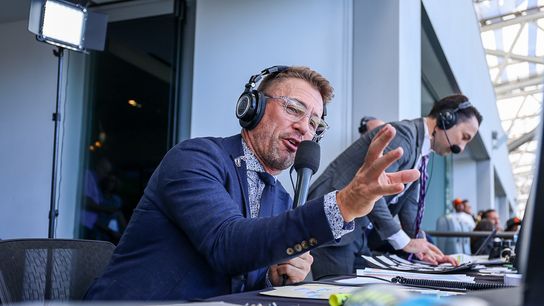
Amber Rodriguez - The Sporting Tribune
Taylor Twellman (match analyst) and Jake Zivan (play-by-play match announcer), MLS on Apple TV.
The responsibility, then, is not to reduce—but to connect. “The other one is, just because I know something, it doesn't mean the viewer necessarily does,” Twellman continues. “So I’ll put together five points… that I can weave in—the why. For instance, no team plays more Americans than San Jose this year.”
The information is there, waiting—not forced, not constant, but available. Deployed when the moment calls for it.
“My job is to call the game. Call the game the best way I can,” Twellman said. “And in essence, that is selling the league and selling the sport by doing that.”
There is a quiet shift in that philosophy. The vociferous Taylor Twellman has been actively storytelling in the world of soccer for over 15 years.
“For so long, soccer was always ‘the sport of the future.’ Now… MLS is the league of now.”
The dynamic between Twellman and Zivin is not just verbal—it shows up physically. But more than that, it’s something felt between them.
“I would say this even if he wasn’t sitting here,” Twellman grinned. “From day one, he kind of knew where I was gonna come in… and I kind of knew.”
There’s a familiarity in that—an understanding that doesn’t need to be negotiated in real time.
“Jake… from the moment he was doing games in Portland, you could tell he watched soccer games as a play-by-play guy,” Twellman continued, “versus watching sports as a play-by-play guy.”
It’s a small distinction on paper, but it changes everything in practice.
“It starts with the play-by-play guy not making the game about himself,” he added. “Call the game… because then it’s easy for me to go, ‘ooh, I’m going to jump in there.’”
And that’s where the trust begins to reveal itself—less in what is said, and more in what is allowed to remain unsaid, in the space that is intentionally left open.
Zivin stands, forward, immersed, his posture aligned with the flow of play. Twellman remains seated, composed, observing, entering the moment with precision rather than urgency.
It is the inverse of the Spanish-language booth—not in energy, but in arrangement. Where Sadovnik’s call erupts and Valeri gathers the meaning after it, Zivin’s play-by-play carries its own animated pulse, while Twellman waits for the turn, then enters with context, consequence, and the “why.”

AMBER RODRIGUEZ - THE SPORTING TRIBUNE
Pre-match interview with Taylor Twellman (match analyst) and Jake Zivan (play-by-play match announcer), MLS on Apple TV.
Zivin carries the live melody of the match, his play-by-play animated by the immediacy of the action as it unfolds. Twellman enters after the crest, not to heighten what has already erupted, but to give it shape—to read the voltage of the moment and begin to explain why it shifted.
And between them, the game is not only seen—it is understood as it unfolds, then carried forward, stitched into something that lasts beyond the final whistle.
“It's a lot more fun to do this now because all the fans are more educated. They're exposed to higher level thinking, higher level games.” Twellman voiced knowingly.
The Stories That Travel Beyond the Pitch

AMBER RODRIGUEZ - THE SPORTING TRIBUNE
Jillian Sakovits, host and sideline reporter for MLS on Apple TV, during halt-time interview.
Pitchside, the work of their production teammates unfolds differently. There is no continuous narration, no sustained presence guiding the viewer through each phase of play.
The rhythm is more selective, the entry points fewer, often arriving in brief windows before the match, at halftime, or in the quiet moments just after something has already happened.
Yet within that constraint, the role expands rather than contracts, because what is being delivered is not the play itself, but everything that allows the audience to understand why it matters.
Antonella González and Jillian Sakovits, along the sidelines, move as transitional phrases within the larger composition—placed with intention, carrying the weight of story in restraint.
González, initiates her craft from something deeply personal. “I try to bring that in every interview… embrace my culture,” she explained. “I’m from Venezuela, and I know that we love football. We love watching football all together.”

Amber Rodriguez - The Sporting Tribune
Antonella González, host and sideline reporter for MLS on Apple TV, is interviewed before an MLS match broadcast.
“So I try to bring that in every thing that I do as a sideline reporter. I think it's special because we live in a kind of fashion that is different. So we try to focus on delivering the message for our Latin American community,” she concludes, her face bright with the same constant enthusiasm for her work that her audience has come to trust.
That sense of collective experience is not something that can be recreated in a broadcasting booth or built through analysis alone. It has to be carried into the production through perspective, through lived understanding, through an awareness that the game is not consumed in isolation but within communities that attach their own histories and identities to it.
Sakovits, her counterpart in the English-language broadcast, approaches that same responsibility from another direction, but toward a similar purpose.
“While the tactics are important, it’s the human connection that is going to make somebody a fan,” she said. “If you think about global superstars, it's the connection that you feel with them. It’s all about community, human connections.”

Amber Rodriguez - The Sporting Tribune
Jillian Sakovits, host and sideline reporter for MLS on Apple TV, is interviewed before an MLS match broadcast.
It is a statement that sits quietly, but reshapes the function of everything around it. The game itself can be broken down endlessly—angles, positioning, decisions made in fractions of a second—but the reason someone returns to it, invests in it, chooses to follow it across weeks and seasons, rarely begins with structure. It begins with recognition. A player’s journey. A moment of resilience. A story that feels close enough to hold onto.
That is where their work lives.
Each week, the assignment is deceptively simple: find the stories that will travel. Not just across the ninety minutes of a match, but across time zones, across languages, across audiences who may be watching for entirely different reasons.
“It’s always about… finding the connection,” Jillian said. “Something somebody can keep their eyes on come World Cup.”
Because the audience itself has changed.
Where Major League Soccer once spoke primarily to a domestic viewership, the structure of the broadcast has shifted alongside its reach. Matches are no longer confined to a single market or even a single country. Families watch from across the world, often at hours that demand a different kind of commitment, a different kind of attention.
“It’s not just about the U.S. audience,” she added. “Apple has the rights in the whole world.”
That reality reshapes the nature of storytelling in subtle ways. A segment that profiles a young player is no longer simply an introduction; it becomes an invitation. A question asked in one language may not be understood by every viewer, yet the response still carries meaning, still reaches the people it is intended for, still reinforces that the game belongs to more than one place at once.
González sees that responsibility in the rise of the players themselves.
“There’s so many players from the academies… 17, 18, 19-year-olds being the rising stars of the team,” she said, reflecting on how development within MLS has begun to reshape the pathway of the global game.
The league is no longer simply a destination at the end of a career. It has become part of the journey—an origin point for some, a bridge for others, a space where players can grow before moving outward again. That evolution changes not only how the league is perceived, but how it must be explained.
Because understanding a player now requires understanding where they came from, where they might go, and what this moment represents in between.
That awareness extends beyond the players and into the structure of the broadcast itself.

Amber Rodriguez - The Sporting Tribune
Jillian Sakovits (left) and Antonella González (right), hosts and sideline reporters for MLS on Apple TV, are interviewed before an MLS match broadcast.
“It’s not about gender, it’s about capacity,” González said when asked about the role of women in the game.
It is not presented as a declaration, but as a reality that has taken shape over time. The sideline is no longer an isolated space; it is part of a broader ecosystem that includes analysts, producers, medical staff, referees, and voices that have expanded alongside the game’s growth.
Sakovits experiences that growth as motion. “Do exactly what you want to do… don’t say no to any opportunity,” she said.
The advice reflects the same principle that defines the broadcast itself—movement, openness, a willingness to step into spaces that may not yet feel fully defined.
Together, their work does not compete with the match, nor does it attempt to explain every moment as it unfolds. Instead, it moves alongside it, adding layers that would otherwise remain unseen.
“We have a segment, that is part of the pregame show, that is dedicated to one or two players, to talk about... A player that is stepping up or doing something great and that's part of the connection, like looking at his background, what he has done, where he comes from,” González emphasizes.
While the broadcast booth captures the immediacy of the game and the production truck shapes how it is delivered, the sideline ensures that what is being watched is also being felt, understood as an event, and as part of a larger global human story. The trust is inherent, intuitive and invoked by independent viewpoints of the story of the game they all love. That trust is transmitted to their global audience by shared inspiration.
Where the Game Becomes Visible
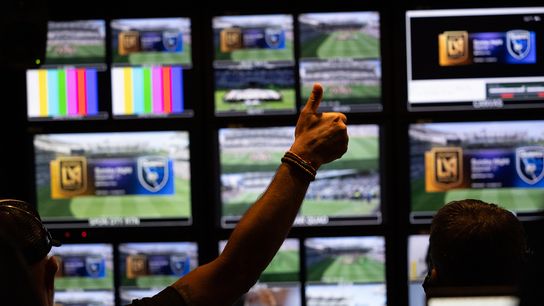
AMBER RODRIGUEZ - THE SPORTING TRIBUNE
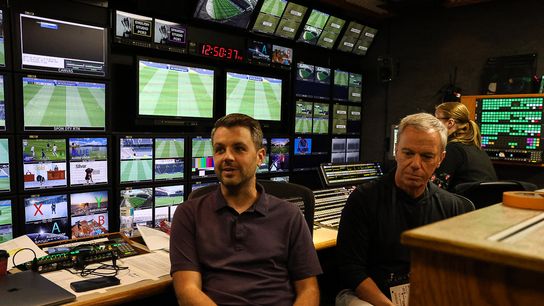
Inside the production truck for Sunday Night Soccer on MLS on Apple TV at Kick-Off.
Inside the production truck, that trust takes on a different form.
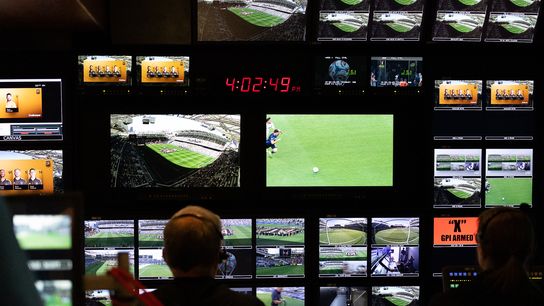
The space compresses. Screens stack on top of one another. Angles flicker in sequence. Audio feeds rise and fall, voices checking levels, cues arriving in quick succession. The game fragments here—camera, replay, timing, signal—yet the vision holds.
Preparation lives alongside instinct.
“It comes from preparation, just being familiar with the teams, what storylines are going into a game beforehand, and also just watching a lot of games,” match producer Brad Mertel explained. “Doing preparation work and then just experience of doing games and kind of being ready for… because no matter how much preparation you do, you know the game’s gonna play out in front of you.”
AMBER RODRIGUEZ - THE SPORTING TRIBUNE
Brad Mertel (Match Producer, MLS on Apple TV) and Jim Daddona (Match Director, MLS on Apple TV).
The plan is there, of course. It has to be. Hours of preparation, familiarity with teams, likely storylines mapped out in advance, the quiet accumulation of watching game after game until patterns begin to reveal themselves. And still, once the match begins, it moves on its own terms.
“So it’s… having experience and dealing with different moments, so that when something comes up, because it will in every single game, that you’re ready to adapt and follow along.”
That adaptability does not sit with one person. It moves across the room, passed from one set of hands to another, decisions building on each other in real time, timing tightening, awareness widening to take in not just what is happening, but what might be about to.
“Once the game starts, it’s live, anything can happen at any moment,” Mertel continued. “Things that are never planned for, sometimes they are planned for. You just have to… have an awareness of the game and what’s going on.”
The work, then, becomes less about control and more about attention—an ability to stay with the game as it unfolds, to recognize the moment as it forms, and to respond without breaking its rhythm.
AMBER RODRIGUEZ - THE SPORTING TRIBUNE
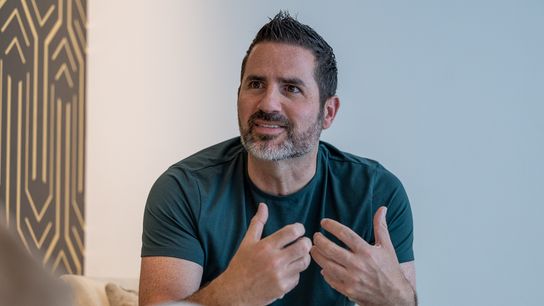
Jason Saghini, VP of Live Productions, MLS on Apple TV.
Jason Saghini has watched the league grow long enough to remember when the conversation around it was smaller, when access was limited, when the idea of MLS as part of a global ecosystem still felt distant. Now, sitting in the middle of it as VP of Live Productions, he understands the game with the perspective of someone who has seen both versions exist, and understands what has changed in between.
“Because you just look at quality of play, you look at the ability to be part of the transfer market on both sides,” he said. “We want to sell our young players, but we also want to be able to buy players in their prime.”
The shift reveals itself gradually. It shows up in the players, in the tempo of the game, in the kinds of conversations fans are having before kickoff and long after the final whistle. It shows up in who walks through the gates.
“We want that fan to say it’s worth it to me to go to a game,” he continued. “Because what MLS… the best thing that we can sell is the in-game experience.”
That experience carries its own momentum, one that extends beyond a single night.
“We’ve seen tons of people who, you know, they came to a game… a celebrity came to a game, and next thing you know, they’re here every week,” he explained. “You’re starting to see it in the non-glamour cities too. It’s just… it’s been amazing. And the hope is this sort of sampling of our league is just continuing to open that door to more and more people who maybe were interested but take that extra step.”
The fan, in many ways, has evolved alongside the league.
“I think one of the biggest things that I’ve seen over the course of 24 years now is the fan is a lot smarter,” he reiterated. “They understand the sport more. They are interested in different aspects of it. It’s not just—David Beckham is here, so I want to go to the game. These are two really good teams. These are teams that play an exciting style of football.”
Access has changed the relationship entirely.
“You have the ability to watch soccer from all over the world,” he continued. “Kids now… maybe they don’t watch full games as much as they once did, but they’re consuming soccer stories, player stories, game highlights from so many different places. They just understand the dynamics of the sport.”
That understanding widens the lens through which MLS is experienced. It no longer exists in isolation. It connects, feeds, contributes.
“You still have everything laddering up to the World Cup,” he said. “As our league does better, our player pool is better. We have more players playing in top leagues in Europe because they started here in academies. That all feeds into the national team. That’s what people get excited about in the end.”
Growth, though, introduces its own set of more advanced questions. “The challenge… it gets easier to watch a game from England or Germany,” he said. “Kids now often are fans of a player. What happens when Messi goes? Are they going to be Miami fans? Or do they have a local team?”
The answer, for him, lives in moments that feel tangible.
“In Colorado, 75,000 people came to see the Rapids,” he said. “There were a ton of Rapids jerseys. There were a ton of Miami jerseys and Messi fans. It was an amazing game. You hope that some of those people saw that and said, ‘You know what? This is our local team. They’re fun to watch. I can go to a game.’”
The intention sits quietly beneath it all, steady, consistent.
“You want to bring those people into the tent,” he said. “Create that inclusiveness that says, ‘Hey, you’ve got a team in your backyard.’ You can like Chelsea, you can like AC Milan… but you’ve got a team here that you can support and enjoy that game day atmosphere every other weekend.”
AMBER RODRIGUEZ - THE SPORTING TRIBUNE
Inside look at the Production Truck of MLS on Apple TV during Sunday Night Soccer.
Within the production itself, that same sense of connection takes on a different form. Daddona, working from the director’s chair, sees it in the structure, in the way the broadcast has had to evolve to meet the scale of what it now carries.
“With MLS, it is Apple TV. I know every single game will be on Apple. I know right where to go,” he said. “It’s been an interesting partnership. It’s just different than pretty much any other project I’ve ever worked on.”
The difference lies in the details, in the mechanics that shape what the viewer eventually receives.
“We do one feed for two languages, which is… we’ve never done that before,” Mertel explained. “It presents its challenges. We get to be exposed to the Spanish broadcast more than we would in our old lives where we were just doing a local broadcast or a U.S. broadcast.”
Two languages sharing the same visual story. Two rhythms moving through a single structure. Distinct, yet aligned.
What takes shape there is less about the equipment and more about the exchange. A call is made and immediately trusted. A choice is taken and carried forward without pause. No one stops to confirm what the other already understands. The rhythm holds because everyone inside it recognizes the same moment at the same time, even if they are looking at it from different screens, different angles, different responsibilities. No one holds the entire picture. Everyone holds enough.
What reaches the audience feels seamless, almost inevitable, as if the game arrived exactly as it was meant to be seen.
Beneath that surface, everything is layered. Built. Adjusted in real time. Held together by something that does not announce itself, yet exists in every exchange, every glance, every moment where one person lets go because they know someone else will step in.
Trust.
----