
PORTLAND, Ore.––Larry Miller is the personification of cool. He oozes charisma and calm.
Round, black-and-gold frames sit on the bridge of his nose, milk-chocolate skin aged by time.
On his head is a brown paperboy cap that matches his brown turtleneck sweater.
His beard is full, salt-colored, distinguished.
In another life, he could have been a jazz musician, an artist, a lecturer—but he's the former Nike executive and president of the Portland Trail Blazers.
Don't let the smooth taste fool you; Larry Miller has more depth than you would imagine.
In front of a sprawling window that lets the sun’s rays paint his office, his aura oozing like lava, Miller sits behind a desk that screams business.
The golden bezel on his wristwatch is peeking from beneath the long sleeve, spooned next to the brown bead wristlet. He's a full human, a paradox of triumph and tragedy. He's experienced the highest of highs and the lowest of lows. His head has been bloodied, but it is unbowed.

Soobum Im-Imagn Images
Larry Miller, president of Jordan Bran and New York Knicks head coach Tom Thibodeau (right) share a smile before the game against the Portland Trail Blazers at Moda Center.
I keep staring at that watch.
Time.
It's the one thing he's had too much and never enough of. It's the thing that tried to bury him and the thing he learned to bend.
Clocks don’t measure moments—they excavate them, leaving hollows where presence once stood.
We are all archaeologists of our own yesterdays, living in spaces between what we remember and what we hope for, brushing dust from bones that will never reassemble. We are all borrowers who forget the loan comes due in a currency we cannot earn twice.
Time is the only finite commodity that cannot be recouped or replaced; it is the only thief that announces itself, gives you every chance to hide your valuables, and still manages to rob you blind; it is the only creditor who never sends warnings before foreclosure.
With it, we erect bridges built from the lumber of futures we’ve already chopped. Its gravity pulls us upward, stretching us thin against the atmosphere of mortality.
There are no insurance policies to claim, no pawn shops to peruse or technology to track to create more of it.
If we are wise, we learn that the most radical act is not to seize the day, but to notice it seizing you.
Leaning back in his chair, Miller utters words that are equally poignant and profound: "I remember the last line of the speech: Let's not serve time. Let's let time serve us."
He was 16 when he first heard the steel doors clang shut. Sixteen, when he pleaded guilty to second-degree murder for the death of David White, a young man with no gang ties who was simply in the wrong place on a drunken, angry night, that would alter and define the trajectory of Miller’s life. He served four and a half years in prison, got out, fell back into the streets and landed back in with five armed robbery charges.

© Photo courtesy of Miller family
The gravity of his actions and life came to an epoch when an older guy in county jail told him not to worry about his record.
"Your record? The f— you care about your record? You ain't gonna be s— where that matters anyway," the man said.
And Miller bought it. He bought it for years. The system is designed to make you buy it.
The system was doing what it was designed to do: warehouse him.
Miller is the man whom Phil Knight tapped to run the newly formed Jordan Brand after Michael Jordan's second retirement. The man who turned an idea into a $4 billion global phenomenon, and later left to become president of the Portland Trail Blazers, one of the first African Americans to lead an NBA franchise, overseeing three straight playoff appearances and 159 consecutive sellouts, and hid his past for 40 years, revealed that inside Pennsylvania’s Graterford State Prison, something shifted within him.
His daughter Laila had been born. He joined the Nation of Islam. And he found a program that let him take college courses, live in trailers outside the stodgy, sullen prison walls, and walk out each day to class, before returning to the crestfallen cage that housed him.
The program was eliminated in the mid-1990s, which means the Larry Miller of today would not exist if he were now incarcerated.
This is not hyperbole. This is arithmetic.
"I wouldn't have been able to do what I've been able to do had I not had access to this program," Miller acknowledged. "If people were able to learn a skill set, or some type of marketable skill set, get an education, that 77 percent [recidivism rate] dropped to 30 percent... with a bachelor's degree, it was 6 percent... with a master's degree, it was at zero."
He initially targeted the program because it seemed like an easier way to serve his time. But then time began to serve him, with his daughter's encouragement, and he began to leverage it into a movement.
The fullness of Miller’s story requires the nuance that only time—properly served—can provide.
He earned his associate degree, transferred credits to Temple University, walked into North Philadelphia halfway house and onto campus as a junior accounting major.

© Photo courtesy of Miller family
"I think as a criminal, that seems like something that doesn't quite click," Miller said, a wry smile tugging at his mouth. "But accounting is based on balancing what goes in and what comes out. I think that's what attracted me."
Balance.
In and out. Debit and credit. Freedom and captivity.
The scales of balance was something he couldn't yet see.
The statistics tell the story that society refuses to hear: talent is distributed equally, but opportunity is not. Miller's life proves this theorem. His life also disproves the corollary that those who commit crimes are defined permanently by their worst moments.
"Let's not serve time," Miller told his fellow graduates at his GED ceremony, words he composed with his crew, delivered as valedictorian despite his initial reluctance. "Let's let time serve us."
The chiasmus—reversing the expected order, transforming subject into object, prisoner into protagonist—would become his life's organizing principle.
In 1982, he sat across from a hiring manager at Arthur Andersen, one of the Big Eight accounting firms.
He'd spent the whole day interviewing, felt the connection, and in a moment of altruism and honesty, shared his soul’s secret with the executive.
Miller wanted to be forthcoming.
He wanted to be honest.
He wanted to be above reproach.
He wanted to be seen as a human.
His desire to be acknowledged and valued as more than his prison number was within reach.
Miller watched the white man reach into the pocket of his grey suit and pull out an envelope.
"I have an offer letter here that I was all prepared to give you," the man said. "But I can't give it to you now."
Larry was crushed.
That rejection could have ended him. It almost did.
For a moment, he thought: go back to what I know, go back to the streets.
That notion is what over 70 percent of those who experience incarceration face within five years––a return to the stale, cold, concrete cells that embed their code into your DNA.
Instead, he made a calculation that would define the next 40 years: he wouldn't volunteer the information again.
He wouldn't lie if asked, but he wouldn't offer it up.
He buried his past so deep that even he started to forget.
In the 40 years of hiding that prevented him from being his full self, Miller would serve time in the nightmares that woke him in cold sweats, and migraines that sent him to the ER.
Then he would let time serve him.
He would let it transform him from an accountant to an executive, from a secret-keeper to a truth-teller, from individual success to systemic change.
"I used to feel like I was cheating audiences," Miller said. "Especially young people. I'd talk about my career, but I never talked about how I got there."
His daughter Laila kept pushing.
© PHOTO COURTESY OF MILLER FAMILY
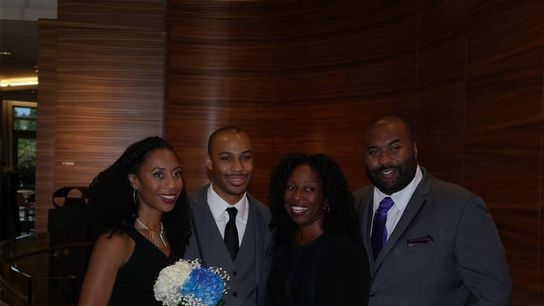
Miller's children, Amissa, Jamal, Laila and Patren enjoy a photo.
For 10 years, she asked questions, recorded stories and transcribed conversations.
Together, they birthed, as Miller wrote, "JUMP: My Secret Journey from the Streets to the Boardroom.
Before it was published, Larry made two phone calls during the pandemic.
First, he called Phil Knight. Took him through the whole story. When he finished, Knight said, "When you said something personal, I didn't know what to expect. But I can absolutely tell you it wasn't this. Your story is not only inspirational, but aspirational."
The next day, he called Michael Jordan. Silence on the other end for what felt like an hour—probably two or three seconds. Jordan then said, "I agree with your daughter. You need to share this story."
In 2021, the moral center of Miller’s transformation. Larry met and spoke with the family of David White, the young man he'd killed 56 years earlier.
In the conversation, Miller was offered a freedom no open cell could contain, no money could buy, no success could deodorize.
They gathered in a room, and each of them spoke about how that night had affected them, how it had rippled through their lives. And then, one by one, they said: "I forgive you."
"The most impactful thing I could have heard," Miller recounted.
Although it could not and does not erase the harm, it locates the harm in a larger context, one where the worst act does not define the entire life, where the possibility of redemption remains real even when the possibility of reversal does not.
"They each talked about how what happened affected them and impacted them," Miller recounted, "but at the end of each one of them speaking, they said, 'But I forgive you.' That was probably the most impactful thing that I could have heard."
The impact extends in both directions. Miller's public revelation of his past—facilitated by his daughter, Laila Lacy, and developed over a decade of recorded conversations, culminating in the book JUMP: My Secret Journey from the Streets to the Boardroom—has liberated him from the anxiety that once defined his existence.
But forgiveness, he learned, is not the same as justice. Miller discovered that more than 80 million people in this country have arrest records and are blocked from employment, housing, education and professional licenses. More than 44,000 federal, state and local laws create a lifelong sentence of exclusion and a subclass of lumpenproletariats.
He saw that he succeeded largely because he wasn't forced to share his past. Millions don't have that choice.
"I used to feel that I was cheating audiences," Miller admitted, "especially when I would talk to young people about my career. I always felt like I was cheating them, because I would talk about my career stuff, but I never talked about how I got there, and the things I had to go through and overcome to get to where I was."
Now he can tell the complete story. Now he can bring his full self to the table.
Now he can answer questions about high school without circumlocution, can discuss his past without fear, can embody the possibility that his life represents rather than hiding the pathology that produced it.
Now, he can be fully human.
"It feels amazing," Miller said of this liberation. "It really is liberating."
"Talent is distributed equally," Miller said, "but opportunity is not."
Miller met Ken Oliver, who'd spent nearly a quarter-century in California prisons and had risen to become a national leader in second-chance hiring.
Their stories mirrored.
In 2024, they formed the Justice & Upward Mobility Project—JUMP—with a $5 million seed grant from Ana Zamora’s The Just Trust.
JUMP exists to "reshape the narrative about people who have experienced justice involvement, and to provide career opportunities to livable wage employment and economic mobility for youth and adults impacted by the justice system."
The duo officially launched at NBA All-Star Weekend in San Francisco, gathering changemakers from sports, business, entertainment, and philanthropy. Miller led a contingent of speakers to visit individuals experiencing incarceration with the San Francisco 49ers, with a dozen players showing up on their day off and ownership, too, to show people behind the walls that somebody cares.
“The math is simple,” Miller preached. “Recidivism sits at 77 percent for those coming home with nothing. Learn a skill, it drops to 30 percent. Earn a bachelor's degree, it falls to 6 percent. A master's degree: zero. People who can build a life don't go back to jail."
But the work—the real work—happens in the connections between stories, in the translation of individual transformation into collective opportunity.
"I truly believe that there's an incredible amount of wasted talent inside the prisons," Miller said. "Some of the most intelligent, creative people I ever met are people I met while I was incarcerated."
This belief—that the carceral system functions not as rehabilitation but as waste management, not as transformation but as warehousing—drives JUMP's mission. The organization does not ask for charity. It demands meritocracy.
Miller points to Lowe's Corporation, which has hired over 52,000 formerly justice-impacted employees who, as he boasts, "outperforms the rest of their population hands down." He points to JPMorgan Chase, where Jamie Dimon's commitment to second-chance hiring has created opportunities for over 21,000 people.
"These folks see it as a privilege," Miller noted. "If you have people working for you who see it as a privilege to be there, they're going to give you everything that they've got."
The privilege, of course, is mutual. Miller knows what the alternative is—"walking the penitentiary yard, playing cards on the block"—and he knows that the distance between that reality and his current position is measured not in merit but in opportunity, not in talent but in timing, not in individual virtue but in systemic accident.
He learned invaluable lessons walking the yard in various Pennsylvania prisons that Harvard and Wharton Business Schools cannot teach. “Inside,” Miller said, “you learn to read rooms, read people, never show weakness. If you show fear, that's what gets taken advantage of."
That muscle memory served him in boardrooms, but it also cost him decades of peace.

© PHOTO COURTESY OF MILLER FAMILY
After the book came out, Todd Leiweke, who'd hired him at the Trail Blazers, took him to breakfast in Seattle.
He revealed that the NFL security background check had found Larry's old records in some back room of Philadelphia City Hall.
They knew everything before they hired him.
Paul Allen's response when told: "How long ago was this? Twenty-five years? Don't worry about it then."
They hired him anyway, based on who he had become, not who he had been. And they never told him, leaving him to carry the weight for years longer than necessary.
Both Allen and former NBA commissioner David Stern passed away before Larry could thank them.
The wristwatch with its golden bezel serves as a synecdoche for the larger story.
Time, measured and managed, transformed from enemy into ally.
Time, which could have been merely served, instead served him.
The watch keeps its regular rhythm, but the life it measures has become irregular, exceptional, alchemical.
Miller's advice to his 16-year-old self, entering prison with no conception of the life ahead, returns to the theme that has organized his existence: "Let's not serve time. Let's let time serve us." The repetition—reinforces the resolve—it suggests not mere advice but methodology, not mere philosophy but practice.
"Learn as much as you can," Miller would tell that younger self. "I'd say: ‘Read everything.’ I read Malcolm X's autobiography in my cell, standing at the bars when the lights went out, reading from the light in the hallway. Just like he did. I'd say: ‘Believe you can change your life.’ That's the biggest thing. Believing."
The belief was not always present.
The old friend's dismissal—"You ain't gonna be s— where that matters anyway"—represented the dominant narrative, the expected outcome, the statistical probability.
The probability of spending decades in incarceration to reach the helm of a billion-dollar brand is less likely than winning the lotto.
But not for Miller. He got out with a plan. He exited his cell with a purpose.
"But I got out with a goal this time," Miller said. "Not just 'I'm out, let me see what's happening.' I had a plan. I wanted to build something."
Time. He's thought about it more than most.
The weight of it in a cell.
The scarcity of it outside.
How he used scarcity to build the Jordan Brand, creating fewer products than the market wanted, making people aspire to something. How his understanding of scarcity—from watching friends go without, from knowing what it means to have nothing—shaped a business strategy that conquered the world.

© PHOTO COURTESY OF MILLER FAMILY
"I know what the alternative is," Miller said. "I know where I could be. Walking the penitentiary yard. Playing cards on the block. The fact that I'm able to do what I'm doing now is a privilege."
Miller's life defies this narrative not through exceptional individual virtue but through exceptional individual opportunity, the education release program that no longer exists, the hiring manager who looked past his record and the sports industry that provided a platform for transformation.
His stepson's name is Patren. His youngest daughter is Amissa. His oldest, Laila, is the one who pushed him into the light. His son Jamal rounds out four children who now watch their father move through the world unburdened.
"It feels liberating," he says. "To bring my full self to the table. To not be worried that I'm going to somehow mess up everything I've done by this story coming out. I don't have to worry about that anymore."
The watch on his wrist keeps ticking. Time is still serving him. But now he's using it to serve others. The JUMP nonprofit is changing narratives, telling stories of people coming home and doing amazing things.
He's working with the Players Coalition, a group of 1,500 professional athletes using their platforms to push second-chance hiring. He's advocating for programs like the one that saved him—education release, college in prison, anything that lets people come home better than they went in.
"The goal of prisons should be that people come home better people than they were when they went in," Miller said. "Ninety-plus percent are coming home eventually. The only question is: what kind of person will they be?"
He is proof that the answer can be anything.
That a man can be forged in the crucible of city and cell blocks in state penitentiaries, and polished in the corporate boardrooms of Nike.
That the same skills that keep you alive inside—reading rooms, masking fear, calculating odds—can build billion-dollar brands outside.
His hope now is that JUMP can create such opportunities systematically, can transform individual catastrophes into institutional practice, can allow time to serve not just the lucky few but the many who remain incarcerated, remain excluded, remain defined by their worst moments rather than their latent potential.

© PHOTO COURTESY OF MILLER FAMILY
"I hope that they could see themselves in me today," Miller said of the young people in juvenile prison, the ones sitting in the same chairs he occupied. "If they're willing to take advantage and if those opportunities are provided for them."
The condition is crucial.
Willingness without opportunity is desire without fulfillment; opportunity without willingness is waste.
The alchemy requires both—the individual commitment to transformation and the systemic commitment to facilitating it.
Larry Miller is the personification of something rare: a man who let time serve him. Who bent seconds into a metamorphosis, transforming raw material into something majestic. Who carried a secret for four decades and emerged not broken but whole.
One can see through those round, black and gold frames, see the full salt-colored beard catching the light, and realize he's not just telling his story.
He's offering a challenge. To see people not for their worst act but for their latent potential. To understand that talent is distributed equally, even if opportunity is not.
To recognize that the distance between a person's lowest moment and their highest achievement is not as far as we think.
The question that remains—the question that JUMP exists to answer—is whether this transformation can be replicated, scaled, systematized.
Whether time can be made to serve not just the exceptional individual but the excluded many. Whether the alchemy of one life can become the architecture of many.
Time does not heal—it erases the sharpness of wounds, leaving only the dull ache of forgetting what hurt.
The watch keeps ticking. The time keeps serving. The possibility—fragile, contingent, revolutionary—remains.
It's just time. And time, Larry Miller will tell you, can serve anyone willing to allow it.
