
‘AIEA — After talks of a new aloha stadium in Hawai’i being on the proverbial 10-yard line and at first-and-goal, points are now on the scoreboard.
Now were those points a touchdown or a field goal? That depends on perspective.
Wednesday morning marked a momentous step forward for construction for the New Aloha Stadium Entertainment District (NASED) as the Stadium Authority board voted unanimously in a special session to finalize terms of a new stadium agreement with master developer Aloha Halawa District Partners (AHDP).
Demolition of the existing structure that was condemned is still on track to take place by the end of August with the final permits expected to be approved next week.
But officials say the stadium’s timeline has been pushed back from August 2028 to March 2029 and that the seating capacity in the current plans have been reduced from 25,000 to 22,500.
Former Stadium Authority Board chair Brennon Morioka — and current senior advisor to Gov. Josh Green for the NASED project — has always maintained that there will be transparency in the project’s developmental progress.
When he addressed the media after the board’s special session, Morioka said that entails “the good news as well as some of the not so good news.”
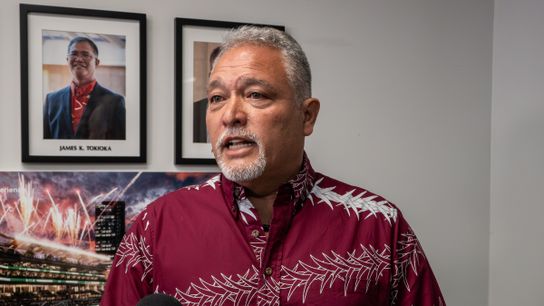
Brennon Morioka addresses the media following the stadium authority board special session.
THE GOOD NEWS
The conclusion of Wednesday’s special session resulted in a milestone achievement that was put into motion over two decades ago. It should be celebrated.
Current board chair Eric Fujimoto said the conversation of building a new aloha stadium started in 2002 when Charlie Taguchi was leading the board. Then during Ross Yamasaki’s leadership, the board was able to get deed restrictions and approach the state legislature for funding for a new structure which then was secured during Morioka’s time as chair.
The unanimous vote by the board on Wednesday authorizes interim stadium manager Chris Sadayasu permission to finalize the ground lease agreement and operations agreement with AHDP, stadium leadership and the state’s Department of Accounting and General Services.
The state of Hawai’i has never reached this point in its many attempts to rebuild aloha stadium, even before it was condemned at the end of 2020. There were plans to build a new stadium while the old one was still operational during David Ige’s time as governor while current Gov. Josh Green switched gears on the project during the 2023 legislative session before restarting the project in December 2023.
Demolition of the existing structure will begin in the coming weeks. There will be physical signs of the old stadium being taken down to make way for the new.
The final permits needed for a piece-by-piece demolition is expected to take be approved next week, stadium officials said.
It was a permitting process put into motion by AHDP a few months ago — before any agreement by parties involved had been reached. This was done ahead of time so that demolition could start almost immediately when contracts are actually signed.
“As a local guy that lives in the Pearl City-Aiea area, to see demolition occur is just going to be a huge psychologically for our community,” Fujimoto said.
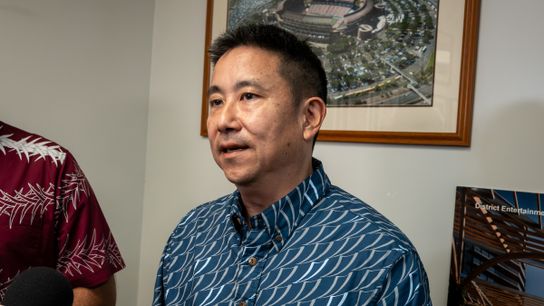
Stadium Authority Chair Eric Fujimoto addresses the media.
While the state and AHDP still need to agree on two aspects of the full contract — a mater development agreement and a shared infrastructure agreement — the board’s vote to approve of the ground lease agreement ensures that demolition can begin.
The terms of the stadium contract that is being agreed upon do not have any future burden on taxpayers — unlike other state projects.
During Ige’s time as governor of Hawai’i, he signed Act 248 into law, which allocated approximately $400 million towards the NASED project — specifically $350 million in general obligation bond funds for the Capital Improvement Project related to the new stadium.
Those monies will not completely cover the price tag of a new stadium, so the expectation is that AHDP has to fund the difference needed.
“It’s important for the public to understand and make sure that they know the state right now is only committed to $350 million dollars,” Morioka said.
“Not only is the state making a significant investment, but AHDP is making a significant investment in this stadium as well.”
The new stadium will be constructed in a way that can be expanded upon without halting operations. If there is a need and resources to increase capacity, there is the option to.
While the state is currently not committing more than the $350 million towards the current stadium plans, there is a possibility that additional external monies come in that can help support a bigger, better stadium, Morioka said.
If those additional funds from other parties become a reality, Morioka said expanding on the stadium’s seating capacity can take place. Morioka, who is the Dean of College for Engineering at the University of Hawai’i, said the current stadium plans will use an additive type of construction.
“Everything that might come in the future, even if it’s near term or long term, it’s additive that they can just build onto the current stadium that they’re going to be building so that there’s not as much disruption towards the use of the stadium should we start adding on, which we do have a high level of confidence that we’ll be able to do so in the future,” Morioka said.
THE NOT SO GOOD NEWS
The 22,500 seating capacity in the current plans that was agreed upon by the stadium authority board is below the minimum amount of seats that was required.
The current attempt at building a new stadium began in December 2023 when the state published a Request for Proposals (RFP) that outlined a three-stage procurement process in hopes of finding a private developer entity to serve as the master developer for NASED.
One of the key features of the RFP states that “the master developer will be responsible for designing, building, operating, and maintaining the new Aloha Stadium with a minimum of 25,000 seats.”
There were two priority-listed offers that were selected in March 2024 as finalists to bid for the NASED contract but one of the two developmental teams withdrew its name a few months later and AHDP was the only option for the state to continue negotiations with.
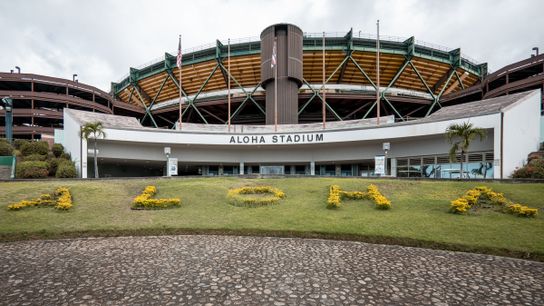
The timeline of construction completion of the new stadium was pushed back from August 2028 to March 2029, partially because of factors that are outside of the state’s control.
The projected completion of August 2028 for the new stadium was a timeline set in place in December 2023. Morioka hinted at the previous stadium authority board meeting that timeline could become “end of 2028” before announcing of its current projected finish on Wednesday.
Morioka told the media after the special session that August 2028 was an “aggressive date to target” while March 2029 is a “very realistic date, very achievable date.”
Morioka says other parties that include Gov. Josh Green are still trying to find additional external $$ for a bigger, better stadium that can improve on the plans for a 22,500-seat new stadium in what he describes as additive construction where capacity can grow after March 2029. https://t.co/mfAuSqW5xW pic.twitter.com/MD51LWIeYP
— Michael Lasquero (@MichaelLasquero) August 14, 2025
He said that conversations with AHDP and their contractors — such as Hawaiian Dredging — and the current environment of tariffs and material supply chains led to the new timeline.
China is the world’s biggest producer of steel, but the United States increased the tariffs on steel from 25% to 50% in June 2025.
Brennon Morioka chats with the media about why the new Aloha Stadium's new target timeline of construction completion is March 2029 instead of August 2028.
— Michael Lasquero (@MichaelLasquero) August 14, 2025
AHDP's contractors' schedule and things like tariffs and supply chain affected the scheduling pushback. pic.twitter.com/zES4hI6xkp
The final price tag of the new stadium is not set in stone. There is a limit to how much AHDP wants to spend, which could affect quality of final product.
When Morioka said that the state is only committed to $350 million dollars towards the stadium, he also said: “we’re probably looking at AHDP putting in upwards of $475 million dollars total for a new stadium.”
However, a NASED official later clarified to HSRN that the $475 million amount only relates to the total cost of the stadium, not how much AHDP is giving to the project.
AHDP is also in charge of the demolition process and costs, with plans to preserve the existing cement foundations of the end zones of the former stadium to help save nearly $90 million.
