
NEW YORK –– Every true hustler lives for a moment of solitude, and it is never the money.
Money is just paper with dead men's faces on it.
The moment is quieter than that, and stranger. It's the moment the buyer and the seller become the same person — when the man holding the product realizes, with something like religious calm, that he is the product.
That the mask he's been wearing so long has fused to the skin underneath, that there is no underneath anymore.
Most people never reach that moment; they flinch from it. They build a self and a brand and keep the two at a careful distance, like estranged relatives at a funeral.
Shawn Carter reached it.
He looked into the mirror, saw the mask, smiled at it — and then hired it to perform at the Super Bowl.
On Monday, Apple Music, the NFL and Roc Nation announced that Jay-Z will headline the Apple Music Super Bowl LXI Halftime Show at SoFi Stadium in Los Angeles on Sunday, February 14, 2027 — an audience somewhere north of 120 million people, the largest captive congregation in American life, broadcast on ESPN, ABC, Disney+, Univision and NFL+.
Carter will stand at midfield in the city where he just closed out the 30th anniversary of Reasonable Doubt, and Roc Nation will executive produce the show.
His company.
The company that advises the NFL on entertainment. The company that, through a multiyear partnership with Apple Music, helps select who gets this stage.
He doesn't just get the gig. He signs the check on the gig. He picks the director. He owns the mirror and the reflection.
"From Reasonable Doubt to standing on the Super Bowl Halftime stage, this has been a journey," Carter said in the announcement. "Thirty years of music, work, and culture on the world's biggest stage. This run continues to be a dream come true."
A journey. Sure.
A journey implies a destination somebody else built.
This is a corridor in a house he owns, and he just walked to the end of it.
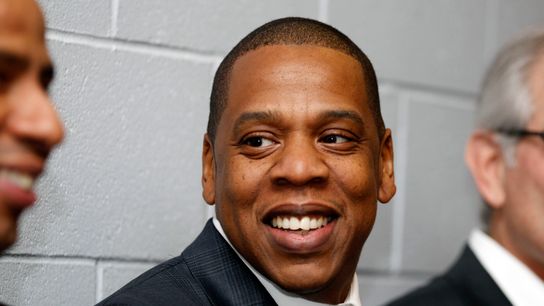
Joe Nicholson-USA TODAY Sports
Jay-Z speaks with an acquaintance before a press conference to introduce new Seattle Mariners second baseman Robinson Cano (not pictured) at Safeco Field.
"I sell ice in the winter, I sell fire in hell / I am a hustler baby, I'll sell water to a well."
He told us. In 1996, on his debut album, before the billions, before the stadiums, before the NFL knew his name — he handed us the instruction manual and the warning label in the same breath. Nobody can say the fine print wasn't visible.
Let me put my card on the table.
Before any of this gets cynical — because it will, it has to — I owe the man something more honest than a hot take.
Jay-Z's music was the soundtrack of my high school years and early adulthood.
His music kept me inspired as a teen, kept me alive while fighting in Iraq, and gave me the blueprint when I, too, answered the hustler's call.
Every person who has ever used a scale to weigh and bag a product can hear their own heartbeat in those records.
That sentence shouldn't be romantic, and it isn't. It's just true.
There were kids in my neighborhood who learned fractions from drug math before they learned them from teachers, and Jay-Z was the only famous voice that sounded like it knew that.
While my contemporaries and I hopped off the porch, some of us onto the curb, others into the streets, they blared NWA, DJ Quik, Suga Free and Snoop Dogg; I was looking for music that took me somewhere past the crazed environment Watts provided me — Outkast, Common, Wu-Tang, Blackstar, Mos Def, Public Enemy, The Roots, Brand Nubian, X Clan.
Conscious rap was my refuge.
But Jay-Z was something else.
He wasn't refuge; he was evidence.
Evidence that a project baby from the Marcy Projects could make it out alive — not just alive but sovereign.
Not a cautionary statistic, not a toe-tagged body on the evening news, not a name on a prison ledger.
The anomaly.
The hustler who amassed wealth and power and lived to tell the tale, not locked in a cage. Rich, influential, a mogul, powerful. The home, the wife, the children, the career.
On every account, he made it.
Born outside the stadium, and somehow he hit the walk-off grand slam in Game 7.
For a generation of young men from impoverished communities being told to lower their eyes, that matters.
It will always matter. I value what he means. I need to say that plainly, because the rest of this won't sound like it.
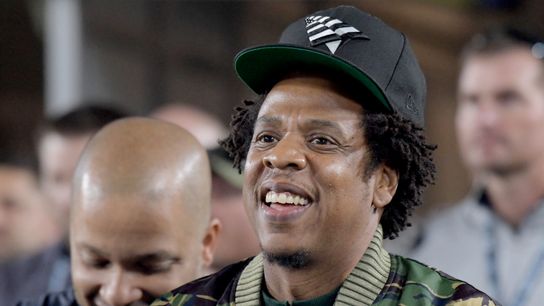
Kirby Lee-USA TODAY Sports
Recording artist Jay-Z attends the between the Kansas City Chiefs and the Los Angeles Rams at the Los Angeles Memorial Coliseum.
"We used to fight for building blocks, now we fight for blocks with buildings that make a killing."
He wrote that on "D'Evils."
You don't write that from a writing program; you write it from a window.
And that raises the question this whole piece keeps circling back to, the excogitative itch I can't scratch: is Shawn Carter the author of all this — or just its most talented sentence?
Is he a product of his environment? A product of the music industry? Is he, at this point, nothing more than a glorified commodity — a billion-dollar asset whose primary function is appreciating?
The answer, I suspect, is the least satisfying one available. He's all three, and the alchemy is the point.
Now to the part that stings.
Through Roc Nation, Carter helps select the halftime performers.
He is the gatekeeper, the entertainment advisor, the man whose taste the NFL rents. And the gatekeeper has walked through the gate, taken the stage and announced — via press release, in the third person, with a tasteful umlaut — that the gate was never really a gate at all.
It was a mirror; it was all a dream.
Listen to how the most powerful sports league on earth framed it.
"When we first reached an agreement with Roc Nation to produce the show, I had just one request: that JAŸ-Z take the stage himself one day, whenever the moment felt right to him," Roger Goodell said. "I couldn't be more excited for fans around the world to experience the artistry, creativity and cultural impact he will bring."
One request.
They asked him.
Whether you believe that framing or not tells me everything about how you think power works once it stops pretending to be polite. The NFL commissioner, begging up.
The empire asking the court jester for permission.
Apple's Oliver Schusser piled on the incense: "JAŸ-Z's impact on global music culture is as profound as it is undeniable."
Undeniable is doing a lot of work in that sentence.
Because here's what the résumé can't hide: the résumé is thirty years old.
25 Grammys. Four Emmys. First hip-hop artist in the Songwriters Hall of Fame. 2021 Rock and Roll Hall of Fame. Fourteen No. 1 albums. A $2.5 billion fortune, per Forbes.
A "Reasonable Doubt 30" campaign that broke attendance records with three sold-out Yankee Stadium shows plus London, Paris and Los Angeles.
All real. All earned.
And yet.
When tickets to his Los Angeles show were floating around for $16, the market whispered something the press release won't: the draw isn't what the myth insists.
Kendrick Lamar just staged the most-watched halftime show in history.
Bad Bunny's took home a record seven Emmys.
Rihanna's pulled five nominations and made directing history.
The chair Carter sits in could have reached for the moment — for the artist currently bending the culture.
Instead it reached for the mirror, thirty years deep into a victory lap.
Some folks feel like hip hop has run its course at the Super Bowl anyway — that Foo Fighters or Metallica or Journey could unify across the political and religious and economic lines this country keeps carving into itself, that we're all tired of the genre's recycled coronations.
There's something to that, and nothing to it.
Because the people making that argument were never the people the halftime show was finally, belatedly for.
The contradiction sits right there, unresolved, as it lives here now.
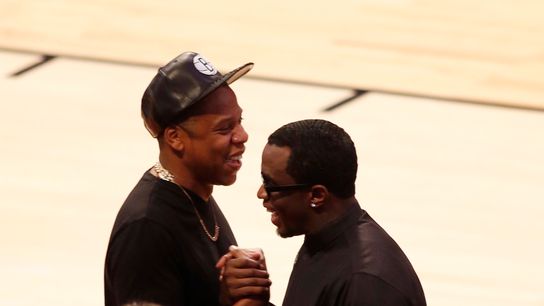
Brett Davis-USA TODAY Sports
Recording artists Jay-Z (left) Sean Combs shake hands before the 2013 NBA All-Star Game at the Toyota Center.
"If skills sold, truth be told, I'd probably be lyrically Talib Kweli / Truthfully I wanna rhyme like Common Sense / But I did five mil, I ain't been rhyming like Common since."
That is the most honest sentence in mainstream rap history, and it hides in plain sight on "Moment of Clarity."
He told you the war was happening; he told you which side was winning.
He made the confession over a triumphant beat so you'd dance to it.
And that's the captious heart of all of this: I see the problematic elements.
I can't unsee them.
The catalog that sometimes celebrated the very death and degradation it was born from — Black death as content, the destruction of our communities as backdrop, the oversexualization and degradation of Black women threaded through club anthems like it's punctuation.
Has the most popular genre on earth run its course?
Maybe. Maybe not.
But the question isn't absurd anymore, and no one epitomizes the tension more completely than Sean Carter, because no one documented it more brilliantly while profiting from it more completely.
He's not too political, until he is. He speaks out of both sides of his mouth.
He left Colin Kaepernick out to dry with his NFL partnership comments — "we're past kneeling," Carter said, while standing next to the league that blackballed the kneeling — and then turned around and cut bail funds for arrested protesters and built schools in Brooklyn.
Jay-Z will do whatever, for power.
For a dollar. For fame.
He is the poster child of what America actually lauds — an opportunist, a capitalist, a hustler — and the reason that sentence lands like an insult is that the insult became a business model somewhere around the second billion.
The environment made the man; the industry made the product.
Is he the corner boy, turned kingpin who commercialized his exploits over beats that will stand at midfield in February?
Both. Neither.
The mask and the face stopped being two things a long time ago.
None of this happens in a vacuum, and writing as if it does would make me everything I despise about modern criticism.
Carter was named in an unverified 2019 anonymous FBI tip released in January 2026 under the Epstein Files Transparency Act — a claim he was present during an alleged 1996 incident involving Harvey Weinstein.
The Justice Department itself cautioned that the sweeping transparency law meant everything the public sent the FBI was slated for release, including accusations that could be "fake or falsely submitted."
The tip came from neither Epstein's personal records nor law enforcement corroboration. Carter has not been charged. He is not a defendant.
A mention in an unverified tip is evidence of nothing but the internet's bottomless appetite for kindling. Rep. Nancy Mace has called for House Oversight questioning; Roc Nation has offered no comment.
The heavier matter is the civil suit.
Carter was added in December 2024 to a New York federal lawsuit alongside Sean Combs — the Combs now serving a 50-month federal prison sentence on federal racketeering and sex trafficking charges — alleging an assault on a 13-year-old girl after the 2000 MTV Video Music Awards.
Carter called the allegations "idiotic."
"I'm not from your world," Carter said in his statement. "I'm a young man who made it out of the project of Brooklyn. We don't play these types of games. We have very strict codes and honor. We protect children, you seem to exploit people for personal gain."
His lawyers call it extortion, demanding the plaintiff's identity or dismissal. The plaintiff's attorney says there was no money demand, only a request for confidential mediation, and accuses Carter of orchestrating "a conspiracy of harassment, bullying and intimidation" to silence the naming.
I don't know what happened in 2000. Neither do you.
What I know is that a man built an empire on the story of where he came from, and now that story is the shield he's holding up against the story he's being told.
Both things can be strategically true.
The code of the projects — protect children, never exploit — can be genuine and deployed.
That's not a contradiction.
That's leverage with a conscience attached, and it might be the most Jay-Z sentence ever written without him writing it.
And the NFL — an institution with a long, flexible memory about which scandals merit consequences and which merit patience — has decided this constellation of unverified mentions and fiercely denied allegations is compatible with a coronation before the largest audience on earth.
That's a choice. It might even be a bet.
Just don't call it courage.
Here's the quiet disappointment under all of it.
Will Beyoncé grace the stage? Maybe.
Rihanna? Possibly.
But there's only one artist anybody truly aches to see beside him — the one whose genius and madness were his only real peer, the one he carried on "Never Change," the one the culture keeps mourning in present tense.
Kanye should have been the pick. Kanye was the pick, in the imaginary Super Bowl that exists in every fan's head. And it will never happen, because the backlash would eat the broadcast alive, and Carter — whatever else he is, whatever codes he honors — has never once mistaken nerve for leverage.
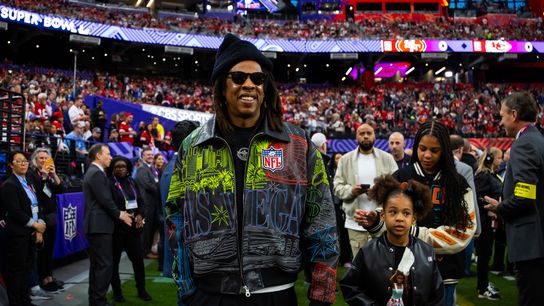
Mark J. Rebilas-USA TODAY Sports
Recording artist Jay-Z walks on the field with daughter Rumi Carter before Super Bowl LVIII between the San Francisco 49ers and the Kansas City Chiefs at Allegiant Stadium.
"I'd rather die enormous than live dormant."
He meant it when he said it.
The question is whether a man who chose enormous in every room will ever again choose the thing that made the music matter in the first place — the risk, the brotherhood, the beautiful recklessness of "Dead Presidents" instead of the immaculate arithmetic of a holding company.
So here is where I land.
Uneasy. Unresolved.
Where honest landings usually end up.
I value what he means; I always will.
The evidence. The anomaly.
The standing rebuttal to every voice that told poor Black boys to lower their eyes.
He is capitalism — triumphant, Black, grinning — and I genuinely do not know whether to salute that or to grieve it, and I've stopped pretending the confusion is a failure of analysis.
The confusion is the analysis.
He's a hustler. He's told us so.
Ask about him — he'll tell you himself, and has, for thirty years, on platinum records, in boardrooms, into every microphone the culture owns.
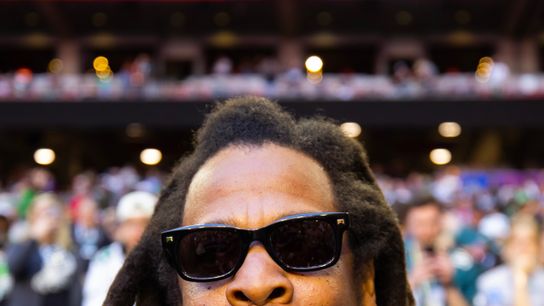
Mark J. Rebilas-USA TODAY Sports
Recording artist Jay-Z on the sideline before Super Bowl LVII at State Farm Stadium.
"Men lie, women lie, numbers don't."
The numbers say 25 Grammys, four Emmys, 14 No. 1 albums, $2.5 billion, three sold-out Yankee Stadium shows.
The numbers say Kendrick out-rated him, Bad Bunny out-Emmyed the format, and the $16 ticket exists.
The numbers say the gatekeeper walked through his own gate and the gate was never a gate.
All of it true. All of it at once.
On February 14, 2027, a 57-year-old, complex billionaire will stand at midfield under the Los Angeles lights and perform the music of a version of himself that died somewhere between the second and third fortune — and we will watch.
Admiring. Captious.
Both.
Because that's what we do with men who make it out.
We argue about whether they carried the culture on their backs or sold it at the gate, and the argument outlives everybody who starts it.
He didn't make the game; he didn't make the rules. He made the mirror.
And when the lights come up at SoFi, the mirror finally does the only thing a mirror can do.
It looks back.
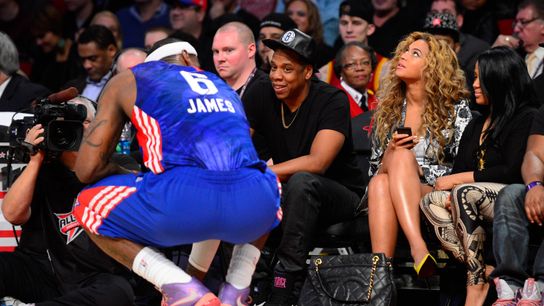
Bob Donnan-Imagn Images
Eastern Conference forward LeBron James (6) of the Miami Heat looks towards recording artists Jay-Z (middle) and Beyonce (right) in the second quarter of the 2013 NBA all star game at the Toyota Center.
"I'm not a businessman, I'm a business, man."
He told us in 2005. The only question left is the one the mirror asks, silent, over a hundred million watching faces: when the business is the man and the man is the product, what exactly did we just watch him buy — and what did it cost the boy from Marcy who only ever wanted out?