
LOS ANGELES — The Los Angeles Dodgers are running out of answers, and Dave Roberts is running out of room for error.
For the second straight postseason, the Dodgers entered October with championship expectations. They are the back-to-back defending champions, a team built to withstand the pressure of October baseball. But after Wednesday night’s 6-2 loss to the Milwaukee Brewers in Game 3 of the National League Championship Series, the Dodgers are staring at a 0-3 series deficit and the possibility of watching its season end far sooner than anyone anticipated.
The Brewers are one win away from their first World Series appearance in 44 years. The Dodgers, meanwhile, are left trying to understand how a game they led entering the seventh inning slipped away, and why so many of the decisions made by Dave Roberts seemed to push them closer to elimination.
Roberts had his reasoning for each move. The problem was that nearly every one of them backfired.
It started with a familiar reminder of how little margin for error the Dodgers have against this Milwaukee team. Jackson Chourio looked at a 97 mph fastball on the first pitch of the game and sent it soaring over the right-field wall for a leadoff home run. One pitch. One swing. The Dodgers were already behind.
They managed to respond.
The Dodgers scratched across two runs in the sixth inning, with Will Smith delivering a two-run double to give the Dodgers a 2-1 lead. For a brief moment, the defending champions had wrestled control of a game they desperately needed to win.
Then came the seventh inning, and with it, another collapse.
JAKE BAUERS PUTS THE BREWERS BACK IN FRONT! pic.twitter.com/KK8xCFd7j1
— MLB (@MLB) October 15, 2026
Jake Bauers worked Blake Snell through an 11-pitch at-bat, reminiscent of the battle he won against the Dodgers in Game 2 in Milwaukee. Snell had spent much of the evening overpowering the Brewers, but Bauers refused to go away. When Snell finally left a pitch he could handle, Bauers made him pay, launching a two-run home run to put Milwaukee back in front, 3-2.
Before the Dodgers could even process the damage, Garrett Mitchell followed with a solo shot to make it back-to-back home runs and a 4-2 Brewers lead.
Roberts jumped up from the dugout, visibly frustrated. He began walking out before stopping himself as Mitchell rounded second base. The moment captured the frustration of a manager watching his decisions unravel in real time, with his team now facing a deficit that could define its season.
The Dodgers had entered the seventh inning with a remarkable streak on their side: They had won their previous 18 postseason games when leading after six innings.
That streak is over.
And the manner in which it ended will invite plenty of questions about Roberts' handling of the game.
A seventh inning that changed everything
Snell had been excellent for much of the night, retiring 14 consecutive batters through the middle innings and striking out nine in six innings of work. He allowed four hits, walked two and threw 101 pitches, but the seventh inning proved costly as Milwaukee struck for three runs and eventually pulled away.
Snell became the second pitcher in MLB history to allow a home run on the first pitch he threw and the last pitch he threw in a postseason start. The other was John Smoltz, who did it in Game 3 of the 1991 NLCS.
Snell, who took the loss, was understandably frustrated.
“I didn’t give up one the whole year so to have three in a game is pretty frustrating,” Snell said of surrendering three home runs.
Kiyoshi Mio-Imagn Images
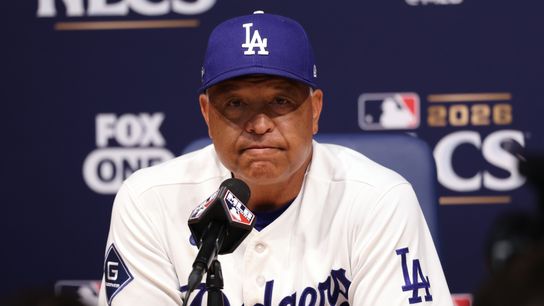
Oct 14, 2026; Los Angeles, California, USA; Los Angeles Dodgers manager Dave Roberts speaks in a press conference after game three of the NLCS for the 2026 MLB Playoffs against the Milwaukee Brewers at Uniqlo Field at Dodger Stadium.
Roberts defended his decision to leave the left-hander in for the seventh, explaining that Snell's dominant stretch through the sixth inning convinced him the pitcher still had enough to get through the heart of Milwaukee's lineup.
“I just saw that through the sixth inning, he retired 13 or 14 in a row, and his stuff was really good,” Roberts said. “I don’t think they were seeing him well, and I was trying to get him three more hitters.”
It was a defensible thought process. Snell had been dominant, and pulling a starter who had found a rhythm is never an automatic decision. But once Bauers worked the long at-bat and launched the go-ahead home run, the calculus changed. The Dodgers needed a response, and Roberts never got the chance to make one before Mitchell deposited another ball over the fence.
Snell acknowledged the frustration of the opening pitch, too.
“To give up a leadoff home run to start the game is frustrating, but I’ll learn from it,” Snell said.
Learning from it will be important. The Dodgers no longer have the luxury of treating these mistakes as isolated disappointments.
Roberts' other decisions compounded the damage
The seventh-inning collapse was the most obvious turning point, but it was hardly the only questionable decision from the Dodgers' dugout.
The Dodgers had opportunities to create separation offensively and failed to capitalize. At several points, Roberts' moves appeared to disrupt those chances rather than improve them.
Andy Pages, one of the Dodgers' best hitters this season, was removed in favor of Max Muncy in a leverage situation against a right-handed pitcher. Roberts explained that Abner Uribe was particularly effective against right-handed hitters and that he wanted Muncy in that spot.
Muncy struck out.
The decision to pinch-hit for Josue De Paula also backfired. Roberts turned to Kiké Hernández before Milwaukee made its pitching change, leaving the Dodgers committed to a matchup that changed when the Brewers brought in a different arm. Roberts said he preferred Hernández against Hall and valued the veteran's postseason experience.
Hernández struck out, too.
Meanwhile, Tommy Edman continued to struggle, but Roberts did not turn to a pinch-hitter for him. Those decisions became even more glaring as the Dodgers' offense repeatedly failed to turn opportunities into the kind of commanding lead that might have insulated them from another late-inning disaster.
None of these moves alone explains the loss. Baseball rarely works that way. But when a manager's lineup decisions repeatedly fail, and his team then surrenders the lead in the inning where his handling of the pitching staff becomes decisive, the scrutiny is unavoidable.
Roberts had reasons for his choices. He was looking for favorable matchups, trying to maximize leverage and trusting players with postseason experience.
The execution did not follow.
And now the Dodgers are one game from elimination.
While the Dodgers search for answers, the Brewers continue to look like the more complete team.
Through its first six games of this postseason, Milwaukee's bullpen had allowed just a 0.31 ERA over 28⅔ innings. That was the lowest bullpen ERA across any six-game span in MLB postseason history involving at least 25 innings, dating back to when earned runs were first tracked in 1913.
The Brewers are not simply benefiting from the Dodgers' mistakes. They are forcing them.
Their pitchers have limited the damage when the Dodgers threaten, their hitters have delivered in crucial moments, and their ability to turn a narrow deficit into a commanding advantage has become the defining feature of this series.
After the Dodgers took a 2-1 lead in the sixth, Milwaukee scored five runs over the final three innings to turn a competitive game into a 6-2 victory.
That is what good postseason teams do. They wait for an opening, and when it arrives, they make the opponent pay.
“We're playing like shit. They're playing great.”
Jayne Kamin-Oncea-Imagn Images
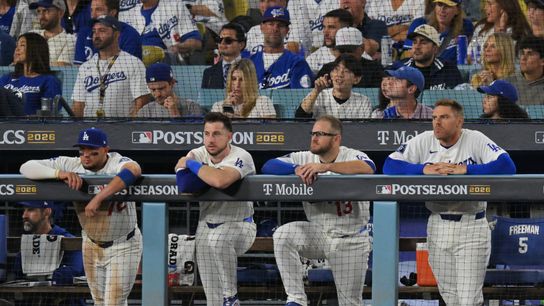
Oct 14, 2026; Los Angeles, California, USA; Los Angeles Dodgers second baseman Miguel Rojas (72) and outfielder Kyle Tucker (23) and third baseman Max Muncy (13) and first baseman Freddie Freeman (5) look on from the dugout during the eighth inning against the Milwaukee Brewers in game three of the NLCS for the 2026 MLB Playoffs at Uniqlo Field at Dodger Stadium.
If anyone needed a blunt assessment of where things stand, Max Muncy provided one.
“It’s a pretty simple answer. We’re playing like shit. They’re playing great,” Muncy said of the Dodgers' offensive struggles.
There was little need to dress it up.
The Dodgers have not done enough with their opportunities, have failed to deliver the timely hits needed to break games open, and have repeatedly allowed Milwaukee to dictate the most important moments. Against a team pitching this well, those shortcomings become magnified.
The Dodgers cannot expect to win four consecutive games against the Brewers by continuing to leave runners stranded and allowing small mistakes to snowball. The offense needs to produce earlier, the pitching staff must limit the damaging innings, and Roberts must find a way to put his players in positions to succeed without overmanaging the moment.
The margin for error is gone.
The impossible task facing the defending champions
History offers little comfort.
In best-of-seven postseason series, teams that take a 3-0 lead have gone on to win 41 of 42 times, a 98% success rate. Thirty-two of those series ended in sweeps.
Only one team in MLB history has come back from a 3-0 deficit to win a best-of-seven postseason series: the 2004 Boston Red Sox, who rallied against the New York Yankees in the American League Championship Series.
Bob DeChiara-USA TODAY Sports
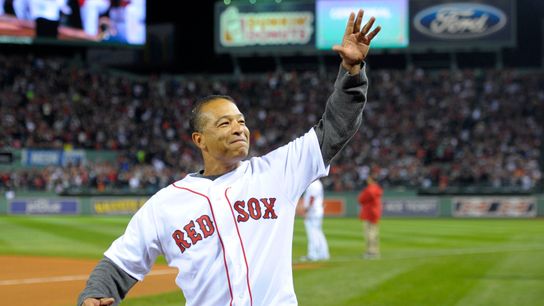
Oct 13, 2013; Boston, MA, USA; Boston Red Sox former player Dave Roberts is introduced prior to throwing out the first pitch in game two of the American League Championship Series baseball game against the Detroit Tigers at Fenway Park.
Roberts was part of that Boston team as a player, famously stealing second base in the ninth inning of Game 4 to help spark the Red Sox's comeback. Now, more than two decades later, he is managing a Dodgers team that must accomplish the same feat to keep its season alive.
The irony is impossible to ignore.
The player who helped make baseball history in 2004 is now tasked with guiding a team through the most daunting situation the sport can offer. The Dodgers must win four consecutive games against a Milwaukee club that has controlled this series and shown little reason to believe it will suddenly fall apart.
There is no margin for another managerial misstep, no room for another wasted offensive opportunity and no guarantee that the Dodgers will get another chance to correct their mistakes.
But the clubhouse is not conceding anything yet.
“If there’s a team to do it, it’s this team,” Kyle Tucker said of the Dodgers' chances of coming back from a 3-0 deficit.
Miguel Rojas offered a similarly straightforward message.
“There’s nothing for us to do or say,” Rojas said. “It’s more of come here tomorrow, we have another opportunity to have a baseball game and believe we have the potential to win four games in a row.”
Will Smith echoed that sentiment.
“One game at a time, we gotta win four games. That’s what we’re gonna do tomorrow,” Smith said.
Muncy framed the challenge in terms of the historic ambition the Dodgers carried into the season.
“Beginning of this year we set out to do something historic, looks like we’re going to have to make a little more history if we want to accomplish that,” he said.
Roberts knows the task ahead.
“We just gotta get a win and we gotta find a way to build some momentum,” he said.
That is the only objective now. Not four wins. Not a comeback for the history books. Not the possibility of reaching another World Series.
Just one win.
The Dodgers have no more room to wait
The Dodgers' season is not over.
They have the talent to make a run. They have championship experience throughout the clubhouse. They have players who have been through October pressure and know what it takes to win when the stakes are highest.
What they do not have is time.
Game 3 was a chance to cut Milwaukee's series lead to 2-1, regain momentum and remind the Brewers that the defending champions would not go quietly. Instead, the Dodgers watched a one-run lead disappear in the seventh inning, saw its manager's decisions come under intense scrutiny and walked away facing a deficit that only one team in baseball history has overcome.
Roberts will be judged by how he responds. His explanations for Wednesday's decisions may be understandable, but explanations do not change the scoreboard. The Dodgers needed better execution from their players and better decisions from their dugout. They did not get either when the game was on the line.
The Brewers, meanwhile, is one victory away from the World Series for the first time in 44 years.
The Dodgers must now find a way to stop the bleeding before the Brewers finish the job.
Thursday is no longer about protecting a title or chasing a dynasty. It is about survival.