
LOS ANGELES –– A particular cruelty is reserved for those who tell the truth too well.
It doesn't announce itself. It doesn't knock. It moves like a thief in a locked house — quiet, methodical, patient. It lets you keep the rings, the trophies, the jump shot that once fell through the same net as perfection itself.
Then it takes the one thing that matters more than all of it combined: the right to keep playing.
Craig Hodges knows this cruelty by name.
He has lived with it for three decades, carried it like a second skin across the playgrounds of Chicago, the locker rooms of two championship Bulls teams and the cold exile that followed the moment he decided his conscience was not for sale.
"All that glitters ain't gold, son," Hodges said.
His voice carried the weight of a man who learned it the hard way — not from a book, though he read plenty of those, but from watching a $40,000 rookie contract shrink against his mother's legal secretary salary and understanding, right then, what the game was actually paying for.
Before Colin Kaepernick ever bent a knee, before the world had a word for athlete activism, Hodges stood in the White House in African garb and handed George H.W. Bush a letter — eight pages, handwritten the night before on the steps of his home, born out of a ping-pong game and a sudden, holy clarity.
"I ain't have no expectation, bro," Hodges told Mykell Mathieu and me on our podcast, "Tha Misfits Live." "None. I was delivering this on behalf of my mama and all of them other people that had inspired me."
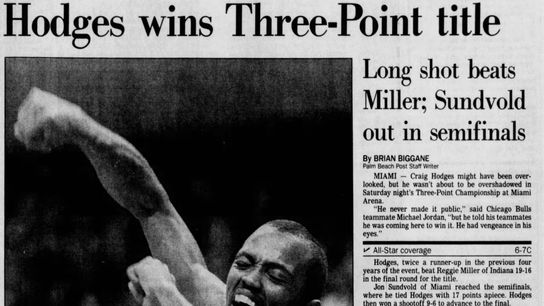
Palm Beach Post-USA TODAY NETWORK
A clipping of the Palm Beach Post. Headlining a story about Craig Hodges.
He was 32 years old. A two-time champion. A three-time, back-to-back-to-back winner of the NBA's 3-point contest — a feat that, for years, belonged to him and Larry Bird alone in the same breath of reverence. A career 40% shooter from beyond the arc, a feat most players of his era treated like a rumor.
And then he was gone.
Not hurt. Not washed.
Gone.
A letter ended a career.
Well, perhaps that isn't accurate. Perhaps the letter didn't end anything.
The fear did.
The fear that a man with a jumper this pure might also have a mind this unbothered.
To understand what was stolen, you have to understand what Hodges was building before America decided it had heard enough.
He was a baseball kid first — a catcher at age 6, gear handed down by a grandfather who ran the park. But the uncles came through like a basketball inheritance: one the nation's top college player, the other its top shortstop. The aunties and his sister taught him to read before kindergarten. And around the dinner table, the family kept a different kind of score.
"We were always taught about those athletes who I should look at," Hodges recalls. "Whether it would be Curt Flood, whether it was Muhammad Ali, whether it was Jim Brown — it was always a conscious measure around the table."
Conscious measure. Sit with that phrase. It means somebody, somewhere, decided a boy could be both artist and architect — that the jumper and the justice were never meant to be separate crafts.
By the time Hodges reached Long Beach State — "the greatest university in California," he declared on the pod, to delights and groans — he had Tex Winter remodeling a shot he describes with a laugh: "I shot arrows at the basket. I was shooting straight up. There was so little room for error."
What Winter gave him instead was arc, angle, and a philosophy that Hodges now passes to the kids he trains at 66 —kids who chase "bag moments" (deep threes hoisted for the highlight) instead of what he calls the practical value of a shot earned inside the offense.
His formula is three words long, and it belongs on a wall somewhere: foundation, form, follow-through.
"Foundation, form and follow-through," Hodges said. "We want to make sure that we're in our triple-threat position, ready to carry the threat to shoot the ball."
Ninety percent of his jump shots since age 17 came off a two-foot jump stop — either foot a pivot, either direction an escape.
He once rewound tape of a money-ball release in a 3-point contest and watched the ball pass through the rim with daylight visible all the way around it.
Same space, every side.
A perfect shot, scientifically confirmed by his own eye.
"When it comes to that little extra spiritual help from the creators and the ancestors," Hodges says of those Long Beach days, reading "The Black Man of the Nile Valley" all summer while his game sharpened nightly, "I got one up on you."
The spiritual and the mechanical, entwined — that was the shooter. But the league, it turned out, only wanted the mechanical.
Here is a statistic that should be printed on the wall of every analytics department in the NBA: in the 1991 Finals against the Lakers, the Chicago Bulls attempted two 3-pointers.
Total.
Both games' worth of spacing, and the entire distance-shooting output of a championship offense belonged to Hodges and Scottie Pippen.
"I look back — it probably took me to get 15 threes damn near three weeks," Hodges said. He laughed at the modern game where guards launch 14 in a single night.
He doesn't hate the evolution; he helped author it. He reminds anyone who'll listen that Don Nelson's Milwaukee teams, with Paul Pressey at point forward, slid Hodges from wing to corner based on defensive tilts — "the beginning of three-point shooting mattering within basketball," he said.
From that geometry came the spacing era, the analytics era, the era where Steph Curry pulls from the logo and teenagers count makes like currency.
What grieves him isn't the distance. It's the disappearing discipline.
"Systems win," Hodges said flatly. "The triangle was so effective because your abilities coincided with what we did. The same shots we shot in practice, we shot in game situations."
He watched a playoff team blow a 30-point lead — he won't name it, but he describes the coach "like a deer in headlights" — and heard the postgame excuse: we got away from what we did early.
"No, you didn't," Hodges countered, his old fire audible. "You still shot threes. You just didn't make them."
Then he diagnoses Jalen Brunson and the Knicks the way a surgeon reads an X-ray: deny the point guard, force the second decision, make somebody else create.
It's tactical wisdom, free of charge, delivered into a microphone because the game keeps insisting it doesn't need him.
The game is wrong.
Blackballing, when it works, is never called blackballing.
It's called defense. It's called culture. It's called, in the neat little phrase they hung on Hodges, being a "locker room lawyer" — as though counsel itself were a crime.
"Everybody talking about, 'Oh, Hodg can't play no defense,'" Hodges said, dragging the lie into the light. "Come on, man. You know that team defense is what's happening in the NBA. That ain't even the discussion. The discussion becomes, what happens if Craig is in somebody else's locker room?"
There it is — synecdoche in reverse, a man reduced to the threat he poses.
Not his jumper. Not his championships. His voice.
When the Bulls cut him in 1992, no team called. The shooting savant who had led the league in 3-point percentage, who had buried 19 straight in a contest round before Curry was out of grade school, became unemployable with the speed of a slammed door.
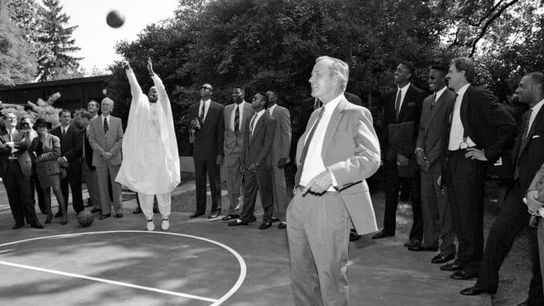
Courtesy of George Bush Presidential Library and Museum
Craig Hodges shoots on the White House basketball court.
But the state had one more trick, a detail so petty it circles back to sinister: the Bush White House wrote him back — 10 or 20 days after delivery, research later uncovered — and the Bulls simply never gave Hodges his letter.
"I would have been a pen pal with George Bush," Hodges said, and the laugh that follows is the sound of a man laughing so he doesn't do something worse.
Decades later, a reporter named Jack Silverstein tracked the correspondence down for a Mother's Day 2025 story.
The letter survived; the blackballing didn't.
You can hold proof of both in the same hand now, and that, Hodges said, is the point of telling it.
If you are a young hooper reading this, stop scrolling for one paragraph.
Hodges has homework.
He came into the league on a $40,000 make-good deal — four consecutive years needing to survive until Christmas Day just to guarantee the contract.
His mother out-earned him. His aunt, the principal, out-earned him. The psychologist aunt, the unemployment office aunt — all of them.
"So all that glitters ain't gold," Hodges said. "I was trying to hoop because I came in on a $40,000 make-good contract. I didn't have time to do nothing but think about making the next play in front of me."
Contrast that with a rookie today collecting nearly $400,000 in college and the lesson gets sharper: he is writing a book about the difference between a hooper and an independent contractor.
High school, he believes, is the last bastion of purity in the sport — and even that he's tempted to demote to junior high, because the kids he trains now spend their empty hours staring at follower counts instead of empty gyms.
His cautions arrive like a coach's hand on your shoulder:
Talent is a value. Assign it the right worth — and know that athletic gifts do not make you more important than anyone else.
Humility is a magnet.
"It's only through being humble that you're going to get the teachers to come into your life," Hodges said.
Education precedes elevation. Tex Winter's first-day rule at practice: pass first in class, then on the court. Train above game speed.
"If I'm not working in my drill work at a rate of speed higher than it was yesterday, it's gonna be even higher tomorrow," Hodges said.
And above all: put in the lonely work. "At some point in time, you gonna have to take what I gave you, blend it into who you are and make it authentic to you."
He watched Michael Jordan and Kobe Bryant lead differently — Jordan the flame, Bryant the furnace-tender.
"If I can get everybody to play to their level best, not Kobe best," Kobe told him, "ain't nobody gonna beat us."
Two styles, one law: you don't win six rings, or five, on talent alone. You win them on standards.
Near the end of the interview — past the Chicago of December 1969, when 9-year-old Craig watched Fred Hampton's blood on the evening news broadcast deliberately to scare a generation; past the hedge funds buying the Lakers; past the observation that hedge funds and hardwood now share a vocabulary — Hodges was asked the question the whole show was built for.
What does it mean to be a misfit?
Hodges answers like a man reading from a scripture he wrote in exile.
"Being a misfit to me is seeing this for what it really is," Hodges said. "Not having blinders on to the oppressive side of this thing called Western society. Not having your earmuffs on when you hear oppression. Not having your mouth closed when you can speak about it."
He invokes Dick Gregory's magic glasses — the ones that let you see through the nonsense, earned, never borrowed, and impossible to un-see.
"Before I got to Long Beach State, I was an All-American boy," he admitted.
Pledge of allegiance, all of it. Then history, ancestors and a mother's movement work peeled the blinders away. He never put them back on.
That's why the league couldn't keep him, and why the league couldn't erase him either, no matter how thoroughly it tried.
"We ain't supposed to fit," Hodges said.
His words land like a benediction off the lips of El-Hajj Malik el-Shabazz or Dr. Martin Luther King, Jr.
"If, like Mahmoud [Abdul-Rauf] was saying — if they telling you I'm with them, I know I'm on the wrong side of it. Come grab me. As long as they are against you, God is with you."
Then the last word, the one that turns a blackballing into a birthright: "On the real side, we're the angelic realm."
So what does Craig Hodges mean to the game of basketball, to America, to Black history?
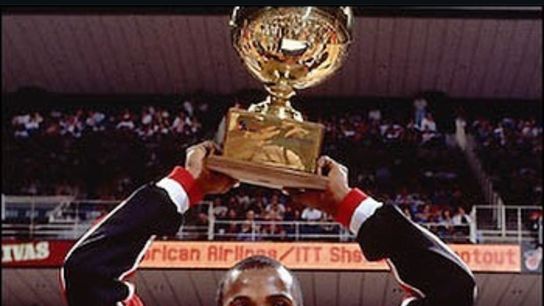
Craig Hodges Instagram
Craig Hodges wins the 1991 3-point contest at the Charlotte Coliseum in Charlotte, North Carolina.
He means that the jumper was never just a jumper — it was proof of work, patience, arc and follow-through, a small daily miracle of physics executed 40% of the time at professional speed. He means that a championship was never just a championship — ask the 1991 Bulls and their two 3-point attempts. He means the 3-point revolution has a grandfather and the league keeps leaving him out of the family photo.
To America, he means the receipts: a handwritten letter, a returned letter buried by a franchise, a dashiki worn into rooms where conformity was the dress code.
And to Black history, he means what Tha Misfits understood when they built a whole show around the unfit — that the misfit is not broken.
The misfit is the one who noticed the room was crooked.
Two rings. Three consecutive 3-point crowns. 40% for a career. Gone at 32, not because he couldn't shoot but because he could see.
They took the league from him. They never took the lens.
"Ain't none of us born in no vacuum," Hodges said. "I ain't no different than nobody else. I just was blessed to be able to see things in a different way."
Different way. Different game. Different price. And in the end — a truth no blackball could swat out of bounds.