
LOS ANGELES ––
The Lead
There is a moment in every life — you have felt it, even if you never named it — when the mask slips and the audience sees the sweat pooling behind the performance.
Most people build their entire personality around avoiding that moment. Steph Curry walked straight into it. In slow motion. On a screen seven stories tall.
I sat in a darkened, IMAX theater and watched the greatest shooter who ever lived miss. And miss. And miss again. I watched a 20-point lead dissolve like sugar in rain while Sacramento's Keegan Murray and Keon Ellis stalked him with a defensive scheme coaches call "top lock" — a defender plastered to your hip, erasing the very air you breathe.
I watched a 37-year-old man with a barking and aching back fight for inches against two players young enough to be his teammates' little brothers.
Jordan Teller - The Sporting Tribune
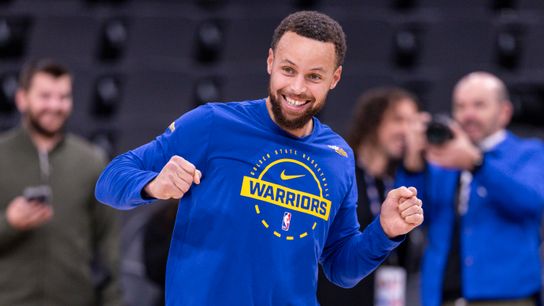
Stephen Curry #30 of the Golden State Warriors dances on the court during warm ups before an NBA basketball game against the LA Clippers, Monday January 5, 2026 in Inglewood, Calif.
And I watched him hit one shot. Just one. Shot number 4,000 from behind the arc — a number no human being had ever reached — and the whole building came apart at the seams.
Here's the thing nobody tells you about greatness: it looks exactly like failure until the very last second. The documentary knows this.
Gotham Chopra knows this. And if you're honest — really honest, the kind of honest that keeps you up at 3 a.m. staring at the ceiling — you know it too.
Because you have a number you're chasing. And you have a moment you'd rather die than replay.
So does Steph. So do I.
I. THE CALLING
On a screen larger than life, Steph Curry spills off the margins.
That's the first thing Chopra noticed, and it's the first thing you notice. One of the opening shots of Portrait of an Artist: Steph Curry — Chopra's new IMAX documentary, acquired by ESPN and Disney+ — is Curry alone on that massive canvas, and somehow the frame can't hold him.
"Steph is finding a way to spill outside the margins of it," Chopra told me.
The filmmaker is a self-described film snob who named his documentary after James Joyce.
He built the whole thing on Joseph Campbell's hero's journey.
Five acts: the calling, the work, the doubt, the flow, the return.
But the documentary is only half the story. This is a dual narrative. This is also about a writer named Eric Lambkins II — me — who watched the same film and saw my own face in it.
Curry's journey begins with a ball placed in his hands at the exact right moment. Mine begins the way too many Black men's stories begin: with a door slammed shut and a record that follows you like a shadow.
All you need is one.
One chance. One open door. One yes.
As I sat there watching Curry dodge top-lock defense like a man slipping between raindrops.
"Too small. Can't defend. Not athletic enough."
I related.
THE ARREST
Sleep is the closest thing a journalist has to innocence, and they kicked it out of me.
I was in my aisle seat on Delta Flight 1471, folded into that thin, purgatorial exhaustion that comes after a night of chasing other men's destinies — Kansas City to Salt Lake City to Los Angeles, my body in three time zones, my mind still interviewing picks.
I had just done something no one at USC Annenberg had ever done: organized five sports journalists into the belly of the NFL Draft and pulled live coverage out of it.
Every pick analyzed. Every moment chronicled. Our stream watched by the school, by our parents, by our friends. Our story, written and canonized.
I was asleep before the plane filled. I woke to a shoe striking the bottom of my foot.
Not a tap. A kick.
A police officer with a buzz cut was standing over me like a man who had already decided what I was and was simply collecting the evidence.
He asked if I was a colleague. I said no and pointed toward my fellow journalist. He asked if I was Eric. I said yes.
He told me to stand. I stood, hauling up my gray sweatpants, confused and half-drowned in sleep, and asked why.
"You're being arrested for burglary."
Burglary. The word landed like a verdict in a trial I hadn't known I was attending.
I inventoried my crimes against Kansas City in real time: the Draft, a Best Buy for a livestream cord, Slaps BBQ — criminally overrated — and my Homewood Suites room.
That was the whole indictment. A cord. Some ribs. A hotel key card.
I put my hands behind my back before I was told to, the way you instinctively protect your face, and felt the metal close around my wrists — cold, final, procedural.
They marched me up the aisle of that full, silent plane, every face turned toward me, some pitying, some satisfied, all of them certain.
Certainty is the first cruelty. The handcuffs are just the paperwork.
They put me in a converted dog kennel that reeked of urine. A cage built for an animal, holding a man.
I did not bark. I did not bite. I had done nothing, and nothing is what they fed me.
In the holding cell, they handed me a paper-thin blue smock and told me to sit.
The air carried feces and despair in equal measure. So I lay on my concrete bed with my brown paper-bag pillow and counted, because counting is what the mind does when it cannot scream.
Seconds. Minutes. Hours. The rings of the phone. The footsteps of detectives passing my bars — never stopping, never once stopping. The tiles. The white bricks and their ugly protrusions.
I counted into eternity and eternity kept collecting.
I thought about my mother. I asked God why, and got back only the sound of my own breathing, and learned something that night about the acoustics of prayer.
Langston Hughes found me in that cell, the way he always finds a Black man in a cage.
What happens to a dream deferred? Does it dry up like a raisin in the sun? Fester like a sore — and then run? Crust and sugar over, syrupy sweet?
I watched my dream explode. There was no sound. That's the part they never tell you.
Dreams don't go out with thunder. They detonate silently, inside the chest, while you're sitting very still in a blue smock, trying not to give the cameras of your mind anything else to keep.
Bail came, and freedom arrived wearing the mask of a deeper exile.
No phone. No laptop. No key back into the digital world that decides who exists.
I was analog in a society that treats analog as invisible.
A stranger — a Samaritan, and I will call her that forever — let me use her phone to call a cab to the station for my belongings.
The first thing I did, sick with the sickness of my profession, was search my own name.
One local story. Contained, I thought.
A wound with clean edges. Then I saw the mug shot.
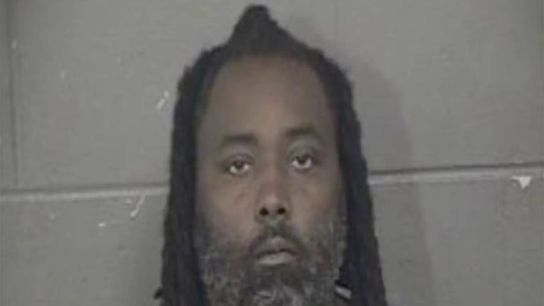
Jackson County Detention Center
Eric Lambkins II was arrested after allegedly stealing $1,000 worth of jerseys after the first round at the 2023 NFL Draft.
I have seen that face in photographs my whole life — just never wearing my own features. The crestfallen eyes. The mouth that doesn't know whether to plead or stay silent.
I stared at myself the way America stares at me, and I understood, with the clarity of a bone breaking, that this image would outlive every correction, every dismissal, every truth.
The internet doesn't forgive. It archives.
Seventy-two hours. That's all it took to learn the census of my love.
Classmates evaporated. Mentors discovered busyness. Professors rerouted their belief to safer investments.
"Friends" and "family" performed the quiet arithmetic of distance — subtraction disguised as concern.
The scarlet letter of a misunderstanding rewrote me in their eyes before they heard a single fact, because a mug shot is a story people think they already know.
Trolls found me through the articles like rats finding a pantry. They taunted. They jeered.
They built a man out of headlines and sentenced me to live inside him.
Unscrupulous. Dangerous.
That man does not exist. They invented him, and they need him, because he makes their certainty comfortable.
I had spent my whole life dodging penitentiary chances––seeking penitentiary cell thrills to prove that I'm "real" just didn't hold any appeal.
I was raised on one gospel: freedom, singular, sacred, nonnegotiable.
And freedom took me to Kansas City with five students and a livestream. Freedom put me in the aisle seat. Freedom is what they put in the dog kennel.
And still — after the evidence, after the dismissal, after I tried to make things right — it all came to no avail.
The charge was erased. The impression is permanent.
This country keeps two ledgers. One is called the record. The other is called the rumor.
I live in both, and I did not write a word of either.
My 2023 arrest looms over me.
Too Black. Too much trouble. Too risky. Too much.
II. THE WORK
What the documentary understands — what most sports documentaries are too cowardly to show — is that the artistry is in the repetition.
The boredom. The brutal, beautiful grind.
Curry's "natural shot," by his own admission, was trash. Rebuilding his release at Davidson took three months of missing everything.
"It was so bad that I almost quit the game altogether," Curry says in the film. His mother, Sonya, a former athlete, wouldn't let him.
Chopra frames this the way a painter frames a self-portrait: the hero doesn't arrive.
The hero is built, rep by rep, "hundreds of thousands of reps, over and over and over, until it's automatic."
Then the NBA doubted Curry the way the world of journalism has doubted me. Too small. Can't defend. Won't survive 82 games against bigger men.
Two point guards — Ricky Rubio and Jonny Flynn — were drafted ahead of him in 2009. Rubio became a journeyman. Flynn left the league in four years.
Curry became the reason 30 teams rewrote their playbooks.
"The more I play, the more I started to see it differently," Curry says.
"There's a freedom to it, a sense that it can become whatever you make it. A way to express yourself. For me, it's never just been a game. This always felt more like an art."
Chopra didn't just interview athletes. He assembled a chorus — Rick Rubin, Nina Simone, James Baldwin — people who may not know a pick-and-roll from a pickpocket, because, as he put it, "they all speak a similar language."
Baldwin's ghost hangs over the film the way it hangs over my words: the vulnerability, the ache, the refusal to let anyone else write your story.
"The specific details change," Curry says. "But the journey usually begins the same."
A guitar placed in Jimi Hendrix's hands. A piano stool pulled out at the right second for Beethoven.
A basketball in the hands of a 9-month-old in South Charlotte, Dell's son, already famous before he could walk.
THE REBUILD
Since my arrest, I have done what the caged do.
I sat. I reflected. I read until the sentences blurred and wrote until they sharpened. And somewhere in that silence I found my assignment, the one God apparently wrote for me before Kansas City: I would write for those born without vision — the blessed ones, spared from seeing how drab and ugly this world can be; I would write to humanize those whose lives are played within the margins of playing surfaces.
I would make my prose a pair of eyes. I would paint pictures in the mind's eye, force color into darkness, let the blind see what I feel, what I see, what I think.
If nobody would give me a platform, I would become one.
Meanwhile, the doors performed their usual choreography.
The ABC 7 internship went elsewhere. The 247Sports follow-up calls sailed into the void, unreturned, my voicemails piling up like unanswered prayers.
Each silence said the same thing in a different dialect: too risky.
So I made a vow with the fury of the ignored — whichever outlet gave me a chance, whenever the chance came, I would unleash everything I had.
Every drop. They would get the version of me that only devastation can distill.
But talent means nothing in a vacuum, and the aftermath felt like one.
The industry looked at my file and saw a liability wearing a young man's face. I remember one exchange in particular, a producer whose voice had the temperature of a filing cabinet: they'd seen the story, they'd "considered" me, and the consideration died mid-sentence.
"Given everything, we're going to go in another direction."
Given everything.
Two words performing the work of a wall.
Not one of them asked what actually happened. Not one of them cared that the evidence had spoken and the case had been dismissed. My mug shot had already testified, and its testimony is the only one this business accepts.
Where doors close, I erect my own.
I wrote because I didn't know anything else to do. There is nothing else.
I wrote about doubt. I wrote about shame. I wrote about what athletes endure in the hours after their lowest decisions, when the highlight reels stop rolling and the demons clock in — because I now knew that terrain intimately, had walked its 3 a.m. corridors while demons bombarded my mind, mocking what I lost, tormenting me with itemized lists.
Remember the internship. Remember the plane. Remember their faces.
Doubt became a companion. Shame shared my slumber. I slept with one eye open and both ears ringing.
And in those hours, when the appeal of ending the noise entirely — the thought of tickling the back of my brain with a bullet — came sidling up to me like an old friend with bad intentions, my phone would light.
Mandatory Credit: Kirby Lee-Imagn Images
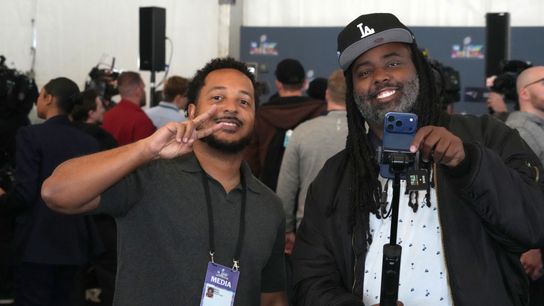
Culver City News correspondents Mykell Mathieu (left) and Eric Lambkins II pose during Super Bowl LX press conference at Santa Clara Marriott.
Mykell Mathieu. A journalist from an upbringing like mine, a community like mine, a man who knows what it costs to be presumed guilty of your own existence.
He called to check on me. Not for updates, not for content, not for the story — genuine wellness checks, the kind that ask how you're doing and wait for the real answer.
Some nights, those calls landed like a hand on a ledge. I am alive to write this sentence because of a friend who refused to let the silence win.
We podcast now. We collaborate. We joke about the experience the way soldiers joke about the war — carefully, darkly, with the gallows humor of the spared.
And somewhere in all that laughter, we made a decision: my worst day would become our ministry. We would use it to humanize athletes, to drag a measure of empathy into an industry that commoditizes human beings for profit, that consumes a man's lowest moment, sells the footage and calls it coverage.
We would become Misfits.
I have been the footage. I refuse to be the camera.
So I kept writing in the dark, rep by rep, hundreds of thousands of words, until it became automatic—because that is what Curry and I share: the obsessive nature, the thread you pull forever once you start pulling.
He rebuilt a jump shot. I rebuilt a voice.
Both of us were told the original was trash; both of us almost believed it.
The counting in the cell taught me patience. The demons at 3 a.m. taught me vigilance. Mykell taught me that community is not a luxury — it is load-bearing. And the silence of all those unreturned calls taught me the most brutal lesson of all: the world will not hand you your medium.
You take it. You carve it out of whatever they throw at you.
I stopped waiting for the door. I became the hallway.
III. THE ORDEAL
The third act of any honest hero's journey is when the hero almost doesn't make it.
For Curry, it was the ankle. Again and again and again — sprains stacked on sprains until 2012, when the whole thing gave way and surgery became the only door left.
"Your mind starts going to some dark places," Curry admits in the film. "What if I'm not strong enough, big enough, good enough? What if this isn't what I was meant to be?"
Chopra could have cut that. He didn't. That's what makes this documentary something rarer than sports cinema: it's a portrait of imposter syndrome wearing a jersey. "I know the language of the artist," a voice tells us. "Someone's gonna find me out."
Curry, with four championships and the all-time three-point record, still speaks that language fluently.
Then, out of nowhere, the picture shifted — the way it does. Mark Jackson was out in Oakland. Steve Kerr walked in, "with nothing but support," and trusted Curry from day one.
The Warriors bet four years and $44 million on an ankle nobody believed in.
"Even with all the doubts around my health, that contract showed the team believed in me," Curry says. "And I wanted to show that I believe in them, too."
That's when the film starts whispering about the principle of wu wei.
IV. THE FLOW
There is a special humiliation reserved for the desperate — the pitch you send into the void and then refresh, refresh, refresh, as if reloading the page could reload your worth.
I know that humiliation intimately. After the arrest, I became a rower. I rowed with everything: every outlet, every editor, every DM, every open call, oars bleeding into an ocean that never once changed direction.
Send. Refresh. Silence. Repeat.
I was rowing so hard I never noticed the water was already moving.
The afternoon I stopped rowing, I was staring at chemtrail clouds strewn across the face of the sky, and I decided — with the flat, final clarity of a man done negotiating — that I didn't care.
Alan Mittelstaedt
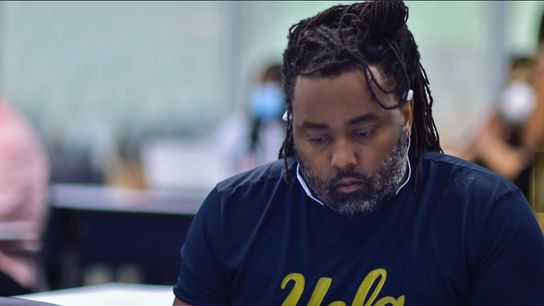
Eric Lambkins II works inside the USC Annenberg Media Center.
One reader or none. An audience or an abyss.
I would tell stories because it is what I was purposed to do, and the purpose would have to be its own reward. That was the whole prayer. No conditions attached.
That same afternoon, the tide came in.
An approval email from the Los Angeles Lakers: credentialed for 2023 Media Day.
A rush of euphoria moved through me like electricity through a dead wire. I was going back — back to the privileged rooms, back to the access the world assumes was never in question for me.
I prayed prayers of thanksgiving on the spot, my heart loud with praise, and I promised God I would never take the gift for granted. I'd honor it. I meant it then, and I mean it now.
I arrived an hour before the presser started, took an aisle seat, and watched.
LeBron James. Anthony Davis. The whole roster ushered to and fro, handlers in tow.
I took mental snapshots — the sights, the smells, the sounds.
Championship banners sagged from the rafters like the flags of a small, wealthy nation. The names of NBA greats plastered on the walls. And above the practice court, in Jeanie Buss' office window, an army of Larry O'Brien trophies sat in the light.
I perched in silence among the same journalists Mykell had told me mocked me and laughed at me when the stories ran.
They sat in amazement at the room; I sat singularly focused, because amazement is a luxury, and I was there on business: I would be better than they could ever imagine.
Some of them, trembling in their wonder, offered me empty platitudes. I accepted them the way you accept a handshake from a man you watched load the gun.
Snakes try to speak out of both sides of their mouths.
But a lamb's blood produces antibodies to a snake's venom over time.
It's in my name; I am a lamb.
My late father told me I'd never amount to anything. He was wrong about me the way the courts were wrong about me, and both verdicts are being appealed in the same venue: the work.
I sat there relishing what they really thought, letting spite do what spite does — in my ADHD mind, spite is a major motivator, a single point of focus sharper than any medication.
Kirby Lee-Imagn Images
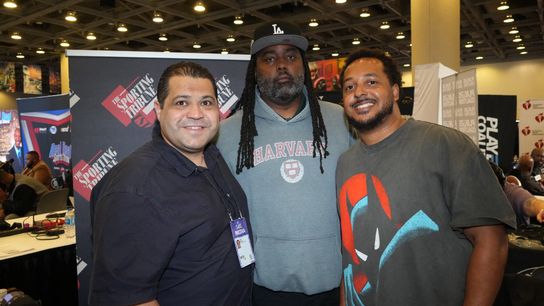
The Sporting Tribune co-founder Arash Markazi (left) and Culver City News correspondents Mykell Mathieu (center) and Eric Lambkins II pose at the Super Bowl LX media center at the Moscone Center.
And then Arash Markazi walked over, held out a business card, and said two words that changed several worlds at once: "Let's talk."
He told me he had heard the accusations, and that the more he thought about them, the less sense they made. He apologized for his reticence — for not reaching out, for not offering support when the story was fresh and support was scarce. He shared a little of his own story. And then he told me he wanted to give me a chance.
That's the tide.
THE SURRENDER
Alan Watts calls the whole principle wu wei — the art of sailing rather than the art of rowing. Shakespeare says it plainer: there is a tide in the affairs of men, and fortune belongs to those who stop thrashing long enough to read the water. I spent a year rowing against an industry that had already filed me under liability, and the afternoon I finally stopped—the afternoon I decided the work itself was the point—the water carried me somewhere no oar could have forced: a press credential, a business card, two words.
This is what Curry knows at 37 that the box score can't hold. You cannot chase the flow state.
The harder you grab for it, the more it slips.
He stands at the top of the key with 18,000 people begging for history, and he does the most terrifying thing a competitor can do — he stops forcing it.
He trusts the hours. He lets the craft take over.
And the shot, when it comes, looks like a miracle to everyone who wasn't watching the years.
The ease is an illusion built on exhaustion. The effortlessness was earned in rooms nobody filmed.
I have told all types of tales and written all types of news stories, and when I send in my copy for publishing, I hear a familiar sound.
Swish.
V. THE RETURN
The splash comes from the right wing.
One dribble, one breath, one shot — and the record belongs to him alone.
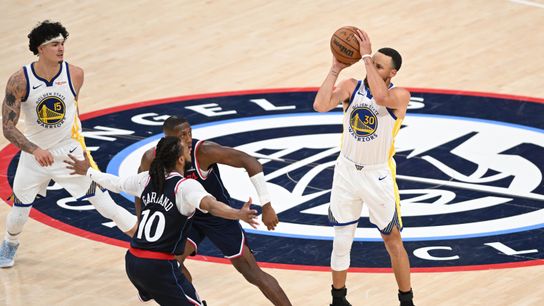
The final score: Warriors 130, Kings 104. Curry finishes with 38 points on the night he hits 4,000, adding to a ledger that already includes 30,000 career points, a 73-9 season, the league's only unanimous MVP and four rings.
Edwin So - The Sporting Tribune
Golden State Warriors guard Steph Curry (30) shoots a three-pointer during a game between the Los Angeles Clippers and Golden State Warriors on Wednesday, April 15, 2026 at Intuit Dome in Inglewood Calif
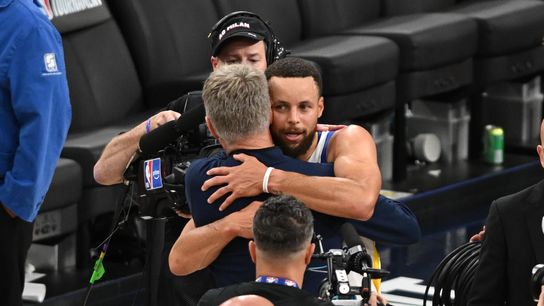
And tucked inside the box score, almost unnoticed: Steve Kerr's 557th win, the most in Warriors franchise history.
But Chopra doesn't end on the shot. He ends on the question.
"I've been asking this question pretty much continuously since I was 17 years old," Curry says. "Why am I doing this? And what difference does it make to the world?
That's the knife twist of Portrait of an Artist. It uses the world's most famous athlete to ask about you.
Democrats and Republicans. Citizens and the undocumented. The conventional and the alternative.
Curry doesn't transcend the sport because of the shots. He transcends it because his purpose, as the film says, "is not what you do. It's what happens to people when you do what you do."
"What is your medium?" Chopra asks, and the question lands in your chest like a screen pass. "What is your art?"
The little boy in Watts doesn't need to shoot 4,000 threes.
He needs to hear one thing: be you, be prepared to fail, and get up.
Chopra told me exactly what he wants that kid to feel when the lights come up: "Inspired. Just be you. Attack the thing you're passionate about, and be prepared to fail. The real gift is the willingness to get up."
Curry knows about getting up. I know about getting up. Maybe you do too.
CODA
The film ends where it began: with the work.
No retirement. No final curtain.
"The art journey never ends," Curry says. "As long as we have a heartbeat, the beat goes on."
He hits 4,000 and goes home to his family.
Practice is tomorrow.
Edwin So - The Sporting Tribune
Golden State Warriors guard Steph Curry (30) hugs coach Steve Kerr after a game between the Los Angeles Clippers and Golden State Warriors on Wednesday, April 15, 2026 at Intuit Dome in Inglewood Calif
And me? I left the theater and did what life taught me to do. I wrote.
I wrote because I don't know anything else to do. There is nothing else.
Slow motion captures the fleeting moments Steph has remaining — and those we have with him; those we have with each other.
The screen goes dark, the margins empty, and one question keeps spilling off the edge:
What is your medium?
What is my medium?
Painting with words. Creating worlds with prose.
I am a landscape artist whose only canvas is the mind's eye of whoever is generous enough to read — and I paint in full color for people who were promised the world was gray.
What did 2023 cost me?
Everything. Name a thing.
My ego — gone, shredded on the floor of an airplane aisle in front of strangers.
My reputation — archived, annotated, served to anyone who ever Googles me before they meet me.
My identity — the journalist, the leader, the young man who had just pulled off something his school had never done. Executed at cruising altitude.
I lost the version of myself I had spent decades constructing, and the state of Missouri handed me a blue smock to replace him.
But here is the part the trolls will never understand, the part that doesn't fit in a comment section: I gained a voice. I gained a mission. I gained empathy — the expensive kind, the kind you can only buy with everything.
Past tense: I sat in that cell in a paper-thin smock, counting floor tiles and ceiling minutes, certain my career had detonated in front of a full cabin. I had no idea the demolition was renovation.
Present tense: I write before dawn now, in the dark on purpose, with a podcast beside me and a partnership with Mykell that came from friendship, not force. I write for the blind and the dismissed and everyone born without vision into a world that shows its ugliest colors first.
When my copy goes in, I hear the same sound Curry hears.
Swish.
He spent seventeen years and two rebuilt ankles to make one shot look easy. I spent one arrest and everything I owned to make one sentence sound true.
The price was obscene. The painting is mine.
They took everything I had. They left the one thing they couldn't hold––freedom.
Portrait of an Artist: Stephen Curry releases exclusively in IMAX theaters on October 9, 2026.