
INGLEWOOD, Calif. — The most significant changes at SoFi Stadium this season might not be obvious when fans walk through the gates. They are behind the images on the Infinity Screen, the game information displayed throughout the stadium and the sound moving around the seating bowl. They are upgrades designed to make an already immersive venue feel even more connected to the action.
SoFi Stadium and Hollywood Park announced an extensive overhaul of their broadcast and production infrastructure, including a new control room, expanded video capabilities and a spatial audio system. The improvements give production crews more tools to present Rams and Chargers games, concerts and simultaneous events across the nearly 300-acre development.
For Josh Mark, vice president of broadcast operations and production for SoFi Stadium and Hollywood Park, the reason for investing in new technology was straightforward: give the people producing the show more possibilities and the fans watching it a better experience.
“Everyone wants more information, more data, more stuff in their presentation, so this system enables us to do that and spend more time with them to create a better game experience for the fans,” Mark said in an interview with The Sporting Tribune.
The centerpiece of the expansion is Production Control Room 3, a new, 17-position auxiliary control room designed to support multiple events at the same time. The project also includes expanded fiber and internet protocol infrastructure, giving the production team additional capacity to bring video feeds and other content into its presentations.
The upgrades reach across SoFi Stadium, YouTube Theater and Hollywood Park, where the demands of football games, live music and other events can overlap. According to the stadium’s announcement, the work positions the venues for Super Bowl LXI and the 2028 Olympic and Paralympic Games, along with their regular sports and entertainment schedules.
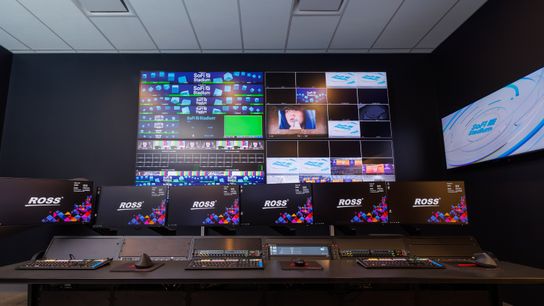
Fans will see much of the result on the stadium’s signature Infinity Screen. Its production system received a complete refresh through an engineering effort that took nearly two years in coordination with Ross Video and systems integrator Diversified. Two identical, independent graphics systems provide an immediate backup for critical game-day functions.
The technology also allows the production team to build more detailed presentations across the screen’s different sections. Mark pointed to the Rams’ graphics and the additional information available to fans, including scoring and drive details after touchdowns, as examples of how those capabilities translate into the experience inside the stadium.
The goal is to give spectators the information and close-up views they expect from a television broadcast while preserving everything that makes attending a game different.
“You have a broadcast that’s as good as what you get at home, but then you come here and you get your 70,000 best friends and fans enjoying it with you,” Mark said. “And you get the whole experience, you get the halftime show, and you get all sorts of fun.”
Sound is another major part of the overhaul. The stadium installed the d&b audiotechnik Soundscape system, which allows engineers to position and move sound around the seating bowl. Rather than simply increasing volume, the system gives the production team greater control over where fans perceive a sound to be coming from.
Mark said those changes can register subtly, with sounds arriving from different directions and helping draw fans into the presentation. Combined with updated lighting controls, the system also expands what the stadium can do during performances and other entertainment between plays.
The lighting upgrades include grandMA3 and grandMA Replay systems installed by Kinetic Lighting. SoFi Stadium also said it became the first venue to install Ross Video’s TD5L switching panels in its PCR1 and PCR2 control rooms, expanding the tools available to technical directors managing the show.
For Mark, each improvement creates an opportunity to think about the next one. A new capability might allow the team to add another layer of information, introduce a different visual element or better coordinate music, video and lighting.
“Everything we do is sort of a step,” Mark said. “So you take one step and you’re like, ‘Ooh, we can take another step and we can add this to this and make it that much better.’”
Ultimately, he measures the work by what fans remember when they leave. The stadium’s architecture may draw the first reaction, but the presentation helps shape the impression that lasts.
“When they say it’s a great stadium, it’s not just the building,” Mark said. “It’s the whole experience.”