
International tournaments are a fantastic way to begin watching League of Legends. The first global event begins Monday in São Paulo, Brazil, as eight teams from six League of Legends regions compete for First Stand.
The event runs through Sunday, with teams competing for a share of the $1 million prize pool and an automatic berth into the playoffs of the Mid-Season Invitational in Korea later this year. Fans can watch live on the Riot Games Twitch channel.
These events feature high-level competition and diverse playstyles from around the world, including some of the best players from Korea and China.
But how does one actually watch League of Legends? Luckily, I had a chance to sit down with LCS casters Joshua “Jatt” Leesman and Isaac “Azael” Cummings-Bentley to break down exactly what new viewers should be watching when they tune into a match.
Here is what they suggested.
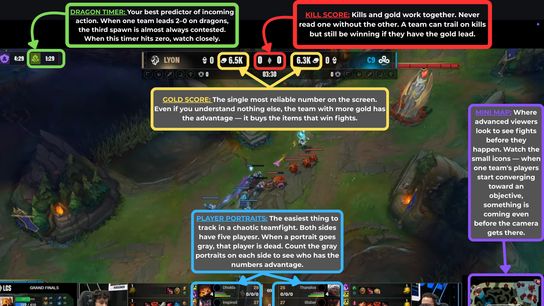
Start With the Scoreboard
If you’ve never watched a League of Legends match before, the on-screen HUD — the heads-up display showing game information across the top and bottom of the screen — can feel overwhelming. Numbers are scattered across the screen; character portraits are stacked along the bottom; something resembling a map sits in the bottom right corner; and timers count down in the top left.
Leesman’s advice cuts through it all: start with the gold, found next to the coin icons in the top bar, typically measured in the thousands.
“The gold is the closest source of truth to who’s winning in a game,” Leesman said. The gold score tells you which team has accumulated more resources, and resources buy the items that decide fights. Paired with the kill score, both displayed prominently in the center of the top bar, those two numbers give viewers a reliable read on the game’s current state without needing to understand everything happening off camera.
Leesman offered one more beginner tip: watch the player portraits along the bottom of the screen. Each portrait represents one of the ten players in the match. When a portrait goes gray, that player is dead. During a teamfight — the all-out skirmishes where all five players on each side engage at once — the main screen becomes a blur of colors and special effects. The portrait strip is the easiest way to track who is still standing.
Objectives Are Where Fights Happen
Once the scoreboard makes sense, start watching the objective countdowns in the top left corner of the HUD.
Teams compete for dragons throughout the game because collecting four grants a Dragon Soul, a permanent power-up that strengthens the entire team. Cummings-Bentley noted that while not every dragon will be contested, the third dragon is almost always a flashpoint. If one team leads two dragons to zero, the trailing team knows they have to fight or risk falling into a nearly unwinnable deficit.
“Almost always you will have a fight at that third dragon,” Cummings-Bentley said, “because that is kind of getting them dangerously close to that dragon soul.”
Baron Nashor, the other major neutral objective on the map, works the same way. When either timer is counting down, a fight is likely coming.
Understanding the Draft
For viewers ready to go deeper, the draft — the champion selection phase before the match begins, where teams take turns picking and banning playable characters — is where a lot is already decided.
Both casters acknowledged that evaluating a draft is genuinely subjective.
“Both coaches will tell you that they absolutely slam the draft because people have different priorities,” Cummings-Bentley said. “People have different opinions on what is valuable and what’s important in League.”
Leesman offered a useful framework from his time coaching Team Liquid: a winning draft has two winning lanes and better scaling, meaning the composition grows stronger as the game progresses and players accumulate gold and items.
Cummings-Bentley added the layer of champion interaction. Certain compositions are built to fight. Tthey have engage tools, the abilities used to initiate combat, and want to force teamfights. Others are built to scale, survive the early game, and overwhelm opponents later. Understanding which style each team is playing helps viewers follow the strategic logic unfolding on screen.
Champion pools matter too. With more than 160 playable characters available, a player who is comfortable on many champions gives their coaching staff far more flexibility. Teams can build around that player, or slot them into a flex pick — a champion selected early in the draft that can play multiple positions, keeping the opponent guessing about the team’s strategy.
Cummings-Bentley compared it to basketball: if your player can shoot, drive, defend, and pass, you can run almost any scheme.
Leesman, however, pointed out that a narrower but elite champion pool carries its own value. It forces opponents to burn bans — the pre-game phase where teams remove specific champions from the match entirely — on those known picks, which can open up better options elsewhere in the draft. A small pool, in the right hands, still shapes the whole game.
The Real Entry Point Is the Players
Knowing the rules and strategies helps,n but Leesman argued they are secondary to finding someone or something to root for.
A new NBA fan doesn’t start with the rulebook. They start with LeBron James or Luka Dončić. They pick a team. A new League viewer is best served the same way: find a player or team to connect with first, and the rest follows.
“That’s the real gateway into League of Legends,” Leesman said. “Trying to get a team or fan affiliation” before worrying about the intricacies.
The rules come naturally once someone cares about the outcome.
Paul Delos Santos covers the Fighting Game Community and Riot Games ecosystem for The Sporting Tribune and Inside Esports, a newsletter publishing every Tuesday and Friday. Subscribe at insideesports.media.