
LOS ANGELES -- A storied program. A one-loss regular season. A national championship caliber team. Yet UCLA women’s basketball head coach Cori Close is uncertain about her future. In her office, a short walk from Pauley Pavilion, where the Bruins went undefeated at home this season, Close remains candid. “I’ve considered going to the WNBA. I’ve had opportunities and I’ve said, “not yet.” Her hesitation comes from her commitment to her players, but the pressures of coaching in modern collegiate sports are making the choice complicated.
The introduction of NIL (Name, Image, and Likeness) has upended collegiate sports. A head coach’s responsibilities have grown, regulations loosened, and virtually no guardrails exist. The line separating outsiders, agents, representatives and even bettors from the players themselves are nearly invisible. “People are recruiting my players from my team right now. Right now, and there are no rules, no accountability, no nothing,” Close says, her irritation clear.
The strain doesn’t stop there. “I am struggling with all that’s expected of us — recruiting, class checks, game management, the transfer portal, dealing with agents, marketing, brand building. All of it,” Close said. “Suddenly, you have no life. Zero.”
Close, 54, is tough, passionate, and outspoken. This time, her unfiltered honesty turns inward. “I’ve been honest with myself. I’m single. I never thought I would not be married by this point in my life. I’ve poured everything into building this program and this profession, and I’m realizing I can’t let my why get squeezed out. If I’m trying to serve people while my cup is empty, I’m not going to be able to live out my why.”
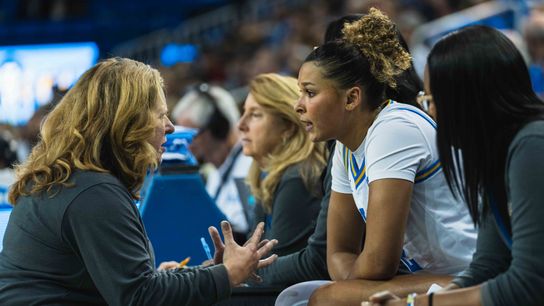
John Panganiban-The Sporting Tribune
UCLA Bruins Coach Cori Close breaking down the game for Avary Cain (2) during an NCAA basketball game against Colgate, Sunday November 10th, 2024 in Los Angeles, California.
Close’s belief in the impact of sports on young adults remains the single most powerful force, helping her push through what she describes as the most challenging time in her career. “Name a better training ground for young people in leadership, self-esteem, work ethic, attention to detail. The stats are staggering about people in C-suite positions, especially women. Over 50% of them played sports in college. 75% played sports in high school or below. It’s equipping. I believe in it so deeply, but I can’t keep this pace up.”
For Close, “pressure is a privilege.” But when that privilege becomes a burden, coaching her players — who are navigating their own off-court battles — becomes twice as hard. “I am fighting for their attention and for their hearts. Coach Tasha (UCLA assistant coach Tasha Brown) always has them write down what’s vying for their attention today. We start with a circle, then another inner circle. On the outer rim we write down all the things vying for our attention that are out of our control. In the inner circle, we write things that are under our control and what we want our attention to be on. It’s a discipline.”
The discipline Close seeks to instill in her players mirrors what she demands in herself. In her office, a shovel and a broom hang on her wall as reminders when her focus wavers. “The broom comes from a book, Legacy, in which the team’s executives and captains swept the sheds every day. A reminder to always be a servant leader. That shovel reminds me to invest in people below the surface. If I do those things well, then the buy-in comes.” Together, these tools form the foundation of her approach to building an elite program.
Close’s program prioritizes culture over talent. Talent is a prerequisite, but alignment is the requirement. Players who cannot meet her halfway in her mission-minded program — built on three core values: a growth mindset, gratitude, and being lifestyle givers — are unlikely to thrive at UCLA.

Nico Alba - The Sporting Tribune
UCLA coach Cori Close calling a play during a free-throw during an NCAA women's basketball game against Southern University, Friday March 21, 2025 in Los Angeles, Calif
Close recalls early conversations with recruits that often reveal whether they’re the right fit for her program. “If you are averaging 20 and 10 and you go, ‘community service, like why would I do that? I don’t have much time. I only want to make more money,’ it’s clear what they want from their experience isn’t the same thing that we teach. We have to be competitive financially, period, but if that’s the only thing you value, this is not the right place.”
Student-athletes now face a constant struggle between their long-term development and immediate financial opportunity. The lure of money, amplified by agents and other representatives, often carries costs not spelled out in any handbook.
“I am in favor of NIL. We should have done it a long time ago, especially for the opportunities our women are getting right now. It’s wonderful. But without boundaries, without structure, without character and tools, we are all bankrupt in different ways,” Close says.
That awareness of what truly matters is rooted in her upbringing. She jokes that her family never stayed in hotels without a number. “So Super 8s and Motel 6s and whatever else,” Close recalls. Yet she always felt loved, supported, and secure. That grounding informs how she helps her players navigate pressures on and off the court.
Even amid the complexities of NIL and outside noise, Close doesn’t lose sight of her priorities. “My job is to win a lot of basketball games. That’s how my administration will judge my performance as the head coach of UCLA.”
Winning, she explains, is not the mission, it’s the access point. “I have to win enough games that I keep getting to execute my mission. My mission has to do with coaching people’s hearts and giving them tools for after the ball goes flat. I am much more interested in how these four years affect the rest of their lives than how many games I win.”
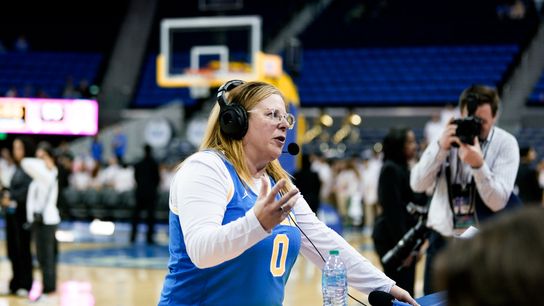
Jessica Cryderman - The Sporting Tribune
UCLA Head Coach, Cori Close, responds to post-game interview questions on the court after their NCAA Womens' Basketball game win against the University of Illinois, February 20, 2025 in Los Angeles.
After finishing the regular season 28-1 and undefeated in Big 10 play, No. 2 UCLA enters March as a true national title contender with the best women’s basketball team in program history. For Close, an NCAA Championship would mean more than a trophy, it would honor the trust and loyalty of the players who bought in from day one. “I think about Kiki (Rice) a lot, she came here, took a chance at UCLA, has stayed loyal for four years, and she’s not the only one, Gabs (Gabriela Jaquez) is the same way. They really wanted to bring UCLA its first national title in the NCAA Era and had the courage to say, ‘I believe we can do it at UCLA.’ For me, achieving that would just be honoring the chance they took on us.”
“In the end, I love the game of basketball. I’m a total hoop head. I love to compete, I love to learn, and I love to impact people.”
Often, success and burnout go hand in hand and pushing yourself to the limit is part of realizing your full potential. For Close, that drive is fueled by an unshakable love for the game and her commitment to shaping young adults. Even amid uncertainty and the pressures of modern collegiate coaching, the culture she’s built, the discipline she instills, and the lives she touches remain the truest measure of her success and legacy.