
PARIS -- The day began for me at around 9:30 a.m. I had been in Paris long enough to realize that this jet lag isn’t going anywhere anytime soon. Might as well find out what the 2024 Paris Olympic Games are all about.
I gathered my belongings, you know, the kind of essentials you need when traveling and covering media: microphone, portable charger, wallet and the most essential product you will ever need in a city renowned for pickpockets, a fanny pack.
Never mind the fashion faux pas, form follows function.
I left my hostel,The Generator, located in the Place du Colonel Fabien, an area known for its young nightlife just steps away from the vibrant Canal Saint-Martin, where young people gather to eat and drink every evening.
I took the 15-minute walk to the Gare du Nord, the busiest train station in all of Europe. The train station has beautiful architecture alongside modern large glass door entrances that embody Paris, a city known for its rich history but one innovating for the future.
At this point, I had no idea where to go. The train station was so overwhelming with different stores, photo-ops and screens.
That was until I saw my saving grace: A group of individuals wearing bright colored shirts – purple, turquoise and red with badges around their neck. Some of them had large signs while others had foam fingers directing people to whatever train they were searching to find.
After an attempt at what might be considered the most broken sentence of the French language ever spoken on this side of the Atlantic Ocean, a woman spoke to me in English.
She asked, “Where do you need to go?” I said “Stade de France” in English with a bit of a French tone as if that was going to help her understand me better. She directed me to the kiosk and helped me purchase the correct tickets.
Subway stop
France has two major forms of transportation. They have their Metro subway that will get you to point A to point B throughout the city. And they have the RER., trains that take passengers to destinations outside Paris.
It’s important to know the difference. A train ticket might also work on the Metro. The Metro ticket will not work on the trains. And there are fines involved.
With the help of multiple transportation officials, I was able to find my RER entrance.
I waited about five minutes and at this point I was constantly feeling my pockets because they say the Metro and train stations are the places pick-pockets target. I’m good, nobody has touched my pockets.
The good news is, the Stade de France was at the next exit. The bad news is, all of Paris seemed to have tickets to the same event as I did. Our train arrived and we were jam packed into this thing that seems to be well over any respectable capacity any government travel authority would dare to set.
I crammed myself into the train and the first thing that came to my mind was air conditioning. The train was so full of people I have no idea as to whether or not they had any air blowing into the individual train carts.
As I hung on with my right hand gripping the metal pole, I soon realized a lot of these individuals must not like to utilize deodorant. The smell of body odor hung in the air for what was, thankfully, a short train ride. Individuals all around me had sweat stains on their shirts.
I made a mental note that Daily Shower No. 2 was in order when I returned to The Generator.
But there was something beautiful about that train ride that not even the smell of sweating bodies could disrupt. It was the diversity I saw.
There were individuals and groups of people from all around the world representing their country with flags, jerseys and costumes. One group of young guys were wearing a beret with foam baguettes affixed to them.
Classique!
The train stops at the Stade de France, the venue hosting the athletics competition where individuals like Noah Lyles and Sydney Mclaughlin hope to add more hardware to their trophy cases.
Rugby time
But today it’s all about rugby.
Paris has truly made an effort to secure safety in these Games and it’s evident. Everyone must go through a bag check followed by a metal detector scan before they can even enter the fan zone outside of the venue. The police officer gives me the nod, and I continue to walk.
It’s as if someone flipped a switch as I enter the buzz of the atmosphere outside the stadium.
There is a DJ playing the Black-Eyed-Peas at full blast. People are lined up at food and beer stations. My mind is thinking: “Content, content, content!”I pull out my phone and begin to record what I think the average viewer would want to see behind the scenes. As I walk around, I can hear several different languages spoken as fans gather with beers in their hands bumping their heads to the rhythm of the song.
I check my watch and I have a solid hour until my event starts. I go through one final security checkpoint before I scan my ticket and enter the stadium.
I couldn’t believe it.
I was steps away from entering into my first Olympic event. I took one quick video of an outside shot of the stadium. I kept telling myself to relax before I geeked out like the little kid inside the reporter, the one who fell in love with sports 16 years ago in the fourth grade.
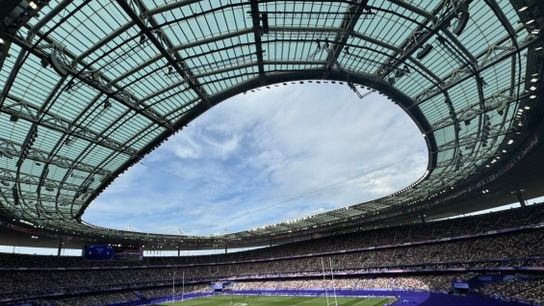
I go straight to the middle of the stadium and take a look. It was one of the most beautiful sporting sights I have seen in my life: thousands of fans cheering before the start of the game, waving their flags. The stadium was decked out in purple, Olympic themed images and graphics throughout. The grass was pristine, and the skies were as clear and bright blue as can be.
Heaven?
Maybe, because the cherry on top was the representation of all the nations with flags hanging side by side in solidarity with one another.
After taking in that moment, I went to find my seat and found myself getting emotional. I thought about all the hard work and sacrifices my parents made for me to make this moment possible.
When the hour I had before the matches began was up, I sat in my seat. For the first 30 minutes, I barely paid any attention to the match. I kept looking to my side and behind me to see the fan interaction.
Then I figured it was time to be a fan and said, “Okay, let's try to enjoy some of the game.” After a quick five minute Google search on how rugby was played, I was locked in.
My favorite fan base is any nation that is representing the Pacific Islanders. Fiji, Samoa, and New Zealand all had fans cheering them on with their signature chant to support their country. The Rugby Sevens matches were structured so that fans coiuld see multiple games at one sitting.
Up next: the United States.
As the red, white, and blue clad players sprinted out of the tunnel, all around me Americans stood, waved their American flags and chanted, “U-S-A, U-S-A”. Of course, I had to get tha on camera. Back into reporter mode.
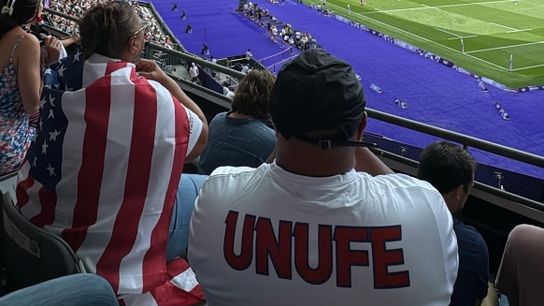
Right in front of me were two individuals who had custom Samoan-themed USA jerseys with the last name UNUFE. I asked them where they were traveling from. The two had come from Utah to support the men's rugby squad. Turns out they were the mother and uncle of Maka Unufe, who was competing in his second Olympics.
I sat as I saw them sitting on the edge of their seats. Leslie Unufe, Maka’s mother, had a U.S. flag wrapped around her. She cheered and shouted, supporting her son and the rest of the U.S. men's rugby team.
It was her Olympics, too. I thought about the money spent, the countless hours at practices, the traveling and the meals she must have put into his pursuit of a dream. She was making sure to enjoy every moment of it.
Team USA won their match and, as is traditional, the winner of the match gets to ring the victory bell. George, who is Maka’s uncle, cheered alongside Leslie as the players began to walk to the team tunnel.
Shortly after Team USA played, it was time for Les Bleus to take the field – the Blue.
The French.
The stadium absolutely erupted. Thousands of French spectators stood and waved their flags as their team took the paddock. It didn’t stop there, as the fans began to synchronize a clap to keep the energy going. A large group of fans in the north-side middle section of the stadium began a cheer and initiated the wave.
This wave must have lasted at least a solid four or five cycles before it ended. This happened at least three times throughout the day
It was time for a snack. To be honest, the concession stands at the Olympics have been rather underwhelming.
They have your typical fruit cups, croissant, and cheeseburger but nothing that really immerses you in the culture like you would find at Dodger stadium. I could go for a Dodger dog.
Instead, I order a bottle of water and the cashier pulls out the Coca-Cola Olympic cup and pours my water into the cup. I decided to go for a walk around the stadium to soak in the atmosphere.
The Stade de France does not have any special forms of technology to brag about, but it doesn’t need it. I walked by the designated media station and journalists from all around the world entered and exited the lobby as the matches continued.
I return to my seat for the final two matches of the day and just enjoy it as a spectator.
Following the completion of the matches thousands of us walked towards the RER stop where it looked like a crowd large enough to fill the entire mall area of L.A. Live.
The travel attendants rushed us into our designated train to maintain as much traffic control as possible. After about 30 minutes, I went through the gates and we were at our train stop. I enter the train and head toward the Grande Du Nord.
After the adrenaline settled, I thought to myself: “We haven’t even had the opening ceremony yet.”
Francisco Molina is a journalism student at California State University-Fullerton taking plart in a study abroad program covering the 2024 Paris Olympic Games.