
INGLEWOOD, Cali. — The Chargers spent the offseason telling everyone this was supposed to be different.
The expectations were different. The offense was supposed to be different. Justin Herbert was supposed to be different.
And then Sunday happened.
In front of a home crowd at SoFi Stadium of 70,540 fans, with sky-high expectations and a roster that looked, on paper, significantly more complete than the one that finished last season, the Chargers walked into Week 1 as an 8.5-point favorite and walked out having been thoroughly embarrassed by the Arizona Cardinals, 26-14.
Darwin Walker - The Sporting Tribune
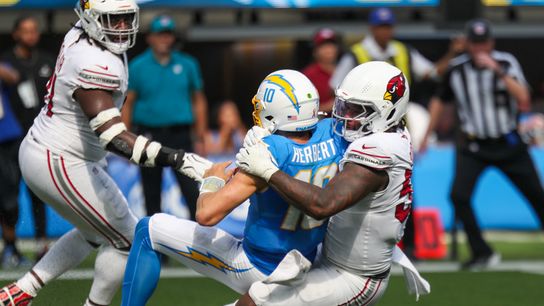
Los Angeles Chargers QB Justin Herbert (10) is sacked for a loss by Arizona Cardinals defenders during an NFL game between the Los Angeles Chargers and Arizona Cardinals on Sunday, September 13, 2026 at SoFi Stadium in Inglewood, California.
Arizona came into the season with just three wins in 2025 and entered the year with the longest odds to win the Super Bowl.
The Chargers were supposed to be one of the teams making noise this season.
Instead, they became the story.
“How we respond is what I’m thinking about right now,” Jim Harbaugh said afterward.
Because the Chargers didn't simply lose.
They looked sloppy. They looked disjointed.
And, at times, they looked like a team that had no business carrying the expectations that followed them into this season.
Harbaugh used the word “sloppy.” He called the performance “uncharacteristic.” When asked about the offensive line, his assessment was blunt: “Lots to improve, lots to get better at.”
That was perhaps the most jarring part of Sunday.
The Chargers had both starting tackles healthy. They had spent the offseason constructing an offense around Herbert. They had added David Njoku at tight end. They had paired Herbert with offensive coordinator Mike McDaniel, a marriage that was supposed to unlock a more explosive, creative version of this offense.
And they scored 14 points.
Against a Cardinals defense that had not exactly entered the season carrying the reputation of an elite unit. That is the part that will sting Monday morning.
How did this happen?
The offense never found its rhythm
Herbert finished 17-of-27 for 209 yards, one touchdown and one interception. He was sacked three times and added 29 rushing yards.
Those numbers aren't disastrous in isolation.
The performance was.
The Chargers couldn't consistently stay on schedule. Third down was a problem as they were 2-for-8 and 0-for-3 on fourth downs. Turnovers were a problem. The running game never created enough momentum. And when opportunities presented themselves, the Chargers repeatedly found ways to squander them.
“We didn’t execute on third down and we had too many turnovers,” Herbert said.
Darwin Walker - The Sporting Tribune
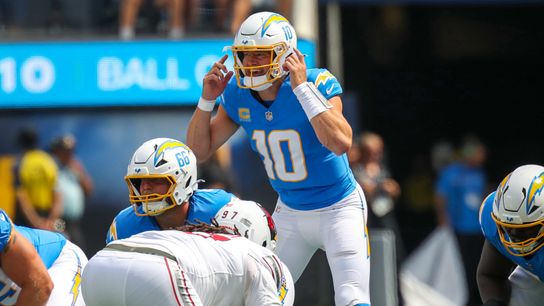
Los Angeles Chargers QB Justin Herbert (10) calls signals at the line of scrimmage during an NFL game between the Los Angeles Chargers and Arizona Cardinals on Sunday, September 13, 2026 at SoFi Stadium in Inglewood, California.
That was essentially the story of the afternoon.
The Chargers had chances.
They didn't capitalize.
Ladd McConkey was one of the few bright spots, catching five passes for 82 yards and Herbert's lone touchdown before leaving the game with an injury. Njoku caught five passes for 58 yards.
But the offense needed more than isolated production.
It needed an identity.
Instead, it spent much of Sunday searching for one.
The decision before halftime will be debated
Then came the sequence that perfectly captured the afternoon.
Trailing late in the first half, the Chargers had an opportunity to tie the game.
Instead of taking the field goal, Harbaugh elected to go for it on fourth-and-goal.
The gamble failed. Herbert was sacked.
Rather than walking away with three points and a tie game, the Chargers gave the Cardinals another opportunity.
The Cardinals took advantage, hitting a last-second field goal to make it 13-7 at halftime.
Harbaugh defended the decision afterward.
“Go for the touchdown, get the seven, if we didn’t get it we got them backed up,” he said.
The logic was understandable. The execution was not. And that's becoming the uncomfortable theme of this loss.
The Chargers didn't necessarily lose because every decision was wrong. They lost because too many decisions were followed by poor execution.
Then came the special teams mistakes
The offense wasn't alone.
Special teams contributed its own collection of problems, including a punt block that helped swing momentum Arizona's way.
Harbaugh didn't hide from it.
“Better job coaching, better job practicing, better job executing, all of those things need to be elevated,” Harbaugh said.
That's as much an indictment of preparation as it is performance.
Penalties were another issue.
Harbaugh called them “uncharacteristic.”
There were too many mistakes in too many phases.
“Too many mistakes that need to be fixed,” Harbaugh said.
That's the kind of sentence coaches make after a loss like this because there isn't one convenient explanation.
The problems were everywhere.
By the second half, the game had become a battle between a team trying to establish itself and a team trying to figure out why it wasn't playing like the favorite.
The Chargers never solved it.
“We just didn’t execute,” Herbert said of the second-half offense. “We can’t expect to win like that.”
Herbert's pressure just got heavier
For Herbert, this loss carries another layer. There is no mystery surrounding the expectations anymore. The Chargers have invested heavily in surrounding their franchise quarterback with the infrastructure necessary to win.
The offensive line is supposed to protect him. The coaching staff is supposed to maximize him. The weapons are supposed to give him answers. The offensive coordinator is supposed to help turn that talent into production.
And Herbert is supposed to be the quarterback who takes the Chargers where they have been trying to go.
That is why a Week 1 loss like this feels bigger than one loss.
It doesn't mean the season is over. It doesn't mean the Chargers aren't a good football team. But it does mean the margin for excuses has gotten considerably smaller.
Nobody hurt the Chargers more than the Chargers
Perhaps Daiyan Henley summed it up best.
“No one can hurt us more than ourselves.”
That was the strange thing about Sunday. The Cardinals came into SoFi and took advantage of every opportunity they were given. But the Chargers gave them plenty.
Turnovers.
Penalties.
A blocked punt.
A fourth-down failure.
A crucial fumble.
A sputtering offense.
And, ultimately, 14 points.
“We can fix some things from the front to the back, and make sure we don't have the same mistakes,” Henley said.
That's the challenge now. Because Harbaugh is right: the Chargers got punched.
There is a long season ahead. One ugly Sunday does not erase an entire offseason of work. But expectations don't disappear after one loss, either. If anything, they become louder.
The Chargers were supposed to be better. They were supposed to be deeper. They were supposed to be more explosive. They were supposed to have the quarterback, the coaching staff and the offensive infrastructure to make games like this a thing of the past.
Instead, on their own field, against a team almost nobody expected to contend, they looked like the team that had more to prove.