
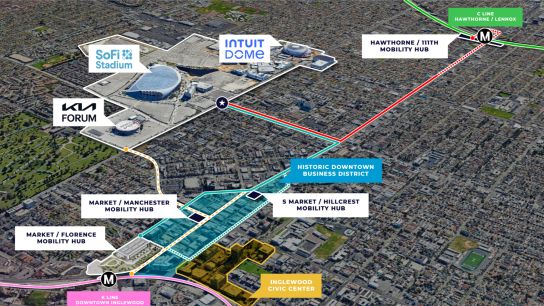
INGLEWOOD, Calif. — The Inglewood City Council has approved a $261 million public-private partnership to construct three mobility hubs, rebuild major downtown streets and improve transit connections to the city’s sports and entertainment district.
Construction is scheduled to begin this fall, with roadway work starting in November. The project is intended to reduce congestion created by events at SoFi Stadium, Intuit Dome and Kia Forum while improving daily transportation for Inglewood residents and workers.
More than 60 major events are held annually across Inglewood’s sports and entertainment district, regularly bringing tens of thousands of visitors into a city with approximately 100,000 residents. That traffic is expected to increase when SoFi Stadium hosts major events during the 2028 Los Angeles Olympics.
“Inglewood has proven what can be accomplished when we set our sights high,” Mayor James T. Butts Jr. said in a statement. “This agreement caps our cost, and construction is funded through a partnership with the State and Metro — using grant dollars we competed for and won, and not a dime from the General Fund.”
The design and construction budget will be covered entirely by grants from California’s Transit and Intercity Rail Capital Program and Metro. City officials said no General Fund money or new taxes will be required to build or operate the system.
Elevate Inglewood Development Corporation was selected through a competitive procurement process. The consortium is led by Plenary Americas, with Swinerton serving as the design-build contractor and Walter P. Moore as the architect of record.
The agreement is structured as a Design-Build-Finance-Operate-Maintain contract, placing the project’s design, construction, financing, operations and maintenance under one fixed-price agreement. The developer will assume the cost and schedule risks associated with the work.
“This agreement gives Inglewood one contract, one team, one fixed price and one deadline,” Councilmember Eloy Morales Jr. said. “The developer carries the cost and schedule risk, which protects Inglewood taxpayers.”
The plan calls for Market Street, Manchester Boulevard and Queen Street to receive new sidewalks, landscaping, irrigation, traffic controls, signs, street furniture and pedestrian lighting. The work will be completed block by block, with each block expected to take approximately two months.
Three mobility hubs will add more than 1,000 parking spaces. A pedestrian bridge over Florence Avenue will also connect downtown directly to the Metro K Line’s Downtown Inglewood Station.
The largest of the three hubs, at Market Street and Florence Avenue, will include retail space, parking, a bus plaza and a passenger drop-off area. The work is being coordinated with Inglewood’s Destination Market Street program, which is funding improvements to storefronts and tenant spaces along the corridor.
“Downtown Inglewood is the heart of this city, and this vote is an investment in it,” Councilmember Alex Padilla said. “New sidewalks, lighting and mobility hubs will give our small businesses the foot traffic and the front door they deserve.”
The city said relocation advisors have been assigned to work with businesses and tenants displaced by construction of the Market and Florence mobility hub. In addition to benefits required under state law, Inglewood is offering grants of up to $250,000 to help affected businesses reopen elsewhere within downtown.
The project will also establish dedicated event-day shuttle lanes running from the northern and southern portions of Inglewood to the sports and entertainment district. Synchronized traffic signals will give buses priority, while expanded commuter shuttle service will connect the Metro K and C Lines with destinations throughout the city.
City officials pointed to the transportation plan used during the 2026 FIFA World Cup as evidence that a shuttle-based system can move large crowds to and from SoFi Stadium. Metro used dedicated bus lanes, signal priority and expanded shuttle service during the tournament.
The project preserves the right-of-way at Market Street and Manchester Boulevard for the potential construction of a high-capacity automated people mover in the future.
Under the agreement, Elevate Inglewood Development Corporation will operate and maintain the Market and Florence hub and pedestrian bridge for 20 years. The streetscape improvements and two other hubs will be turned over to the city after they are completed and accepted.
Payments during the operating period will be tied to standards governing availability, cleanliness, safety, security and upkeep.
“This transformative investment in Downtown Inglewood will improve mobility, support local businesses and create lasting benefits for the community,” said Dale Bonner, executive chairman of Plenary Concessions.
The agreement includes a 35% local hiring commitment for construction, operations and maintenance, along with a goal of awarding 20% of the work to local and small businesses. It also includes a Community Workforce Agreement and apprenticeship programs intended to prepare Inglewood residents for careers in construction and transit.
The city is working with labor unions and the Inglewood Unified School District on programs that will introduce students to careers connected to the project.
“A project this size is only as good as the careers it leaves behind,” Councilmember Gloria Gray said. “With a 20-year operating term, these jobs do not vanish when the barricades come down.”
According to the city’s analysis, the program is projected to generate approximately $210 million in tax revenue, produce $1.5 billion in total economic activity and support hundreds of jobs in Inglewood and across Los Angeles County during construction and operations.
Roadway construction will take place primarily at night, while work on the mobility hubs will be conducted during the day. The city said access to businesses will be maintained, although residents and visitors should expect temporary lane closures, sidewalk detours, parking changes and modified traffic patterns.
Other portions of the first phase are proceeding under separate contracts. Lot T at Prairie Avenue and Manchester Boulevard has been completed, while construction of the event-day bus lanes and intelligent transportation systems is expected to begin in 2027.