
LOS ANGELES –– The video was posted to his X account a little past 11:00 this morning.
Russell Westbrook announced his retirement from the NBA in a narrated, poetic and beautiful video uploaded to his X account.
It talked about the kid from Los Angeles who dreamed of playing in the NBA. The narration talked about the accolades, the awards, the unbridled fury he brought to every possession. The announcement highlighted his beginning, his journey, about who he is away from the game––a husband, a father, a philanthropist, a cultural icon. Without him saying a word, the video encapsulated Westbrook's pride and the essence of who he is––himself.
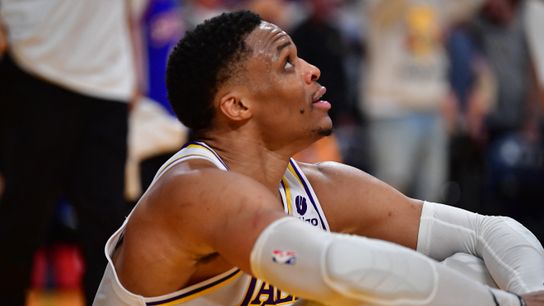
Gary A. Vasquez-USA TODAY Sports
Los Angeles Lakers guard Russell Westbrook (0) reacts following the loss against the Philadelphia 76ers at Crypto.com Arena.
But it was nothing more than a shared link in a group chat. No one was discussing Westbrook.
The news dropped Thursday morning like a hammer on a glass table.
Mark Walter — the billionaire who had purchased the Los Angeles Lakers from the Buss family in June 2025 for a record-shattering $10 billion — had agreed to sell the franchise to Josh Kushner and Bob Iger for $12.5 billion.
Fourteen months. Two and a half billion dollars in profit. And a federal investigation into Walter's sprawling financial empire that suddenly looked a lot more urgent than anyone wanted to admit.
The Lakers were changing hands for the second time in little more than a year. And the man who had been the face of Los Angeles basketball for the better part of a decade — the kid from Los Angeles who came home, who proudly wore the jersey of his childhood favorite team with pride and distinction, who gave everything he had to every franchise he played for, that sometimes didn't deserve it — was an afterthought before his video ended.
That's the thing about Los Angeles. It eats its heroes for breakfast and forgets them by lunch.
THE MATH
Let's start with the numbers, because numbers don't lie; they just often lack nuance or tell the whole story.
Walter purchased a controlling stake in the Lakers from the Buss family in a deal unanimously approved by the NBA Board of Governors in October 2025.
The price tag: $10 billion, a record for any North American sports franchise.
Fourteen months later, Kushner and Iger agreed to pay $12.5 billion.
That's a $2.5 billion profit in just over a year. A 25% return. The kind of return that makes Wall Street hedge fund managers weep with envy.
On the surface, it looks like the greatest flip in sports history.
Buy low, sell high, walk away with a fortune.
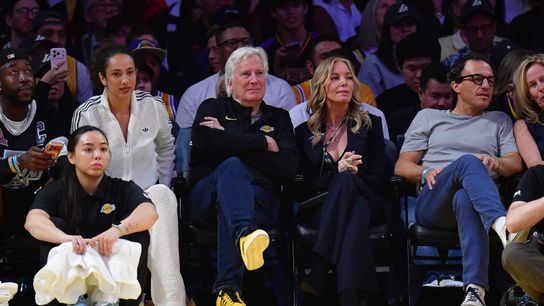
Gary A. Vasquez-Imagn Images
Los Angeles Lakers majority owner Mark Walter and team executive Jeannie Buss in attendance at Crypto.com Arena.
But Walter didn't buy the Lakers to flip them. He bought them because he wanted to own the Lakers — the same way he owns the Dodgers, the same way he owns Chelsea, the same way he owns a piece of the Sparks.
"He didn't buy it to sell it," ESPN's Ramona Shelburne reported. "He didn't think the Lakers were a high-priced condo that he could flip."
So why sell?
THE FEDERAL PROBE
The answer, according to multiple reports, is sitting in a federal prosecutor's office in Manhattan.
In July 2026 — just 13 months after Walter bought the Lakers — Bloomberg reported that the Securities and Exchange Commission and U.S. prosecutors were investigating potential financial improprieties at two insurance companies controlled by Walter and at Guggenheim Partners, the sprawling financial firm he co-founded.
The investigation reportedly focused on approximately $16 billion in private-credit transactions involving Walter's insurance companies. Authorities were examining whether loans supporting other portions of Walter's business empire were properly identified as related-party transactions.
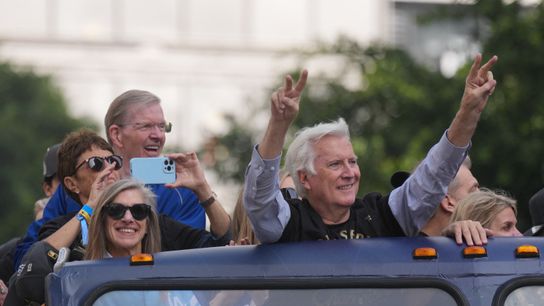
Kirby Lee-Imagn Images
Los Angeles Dodgers owner Mark Walter waves to fans during the World Series championship parade and celebration.
Translation: The feds were looking at whether Walter's insurance companies had made loans to other parts of his empire without properly disclosing them — a potential conflict of interest that could constitute fraud.
"Federal prosecutors in the Southern District of New York and the SEC have been examining approximately $16 billion in private-credit transactions involving insurance companies controlled by Walter," the New York Post reported. "The investigation reportedly began after an internal whistleblower questioned how Guggenheim Investments recorded revenue received through dealings with the insurers."
Walter has not been charged with a crime. Investigations of this nature can conclude without enforcement action. But the timing of the Lakers sale — coming just weeks after the investigation became public — raised eyebrows across the sports world.
"The news comes amid a federal law enforcement probe into the financials of Walter and his companies," the Miami Herald reported.
THE POLITICAL CONJECTURE
Here's where the story gets complicated. And speculative. And, frankly, a little uncomfortable.
Josh Kushner, the buyer, is the younger brother of Jared Kushner, who is married to President Donald Trump's daughter Ivanka. Bob Iger, the other buyer, is the former CEO of Disney — a man who has spent decades cultivating relationships with the NBA and its commissioner, Adam Silver.
The Kushner and Iger ownership group came together in days, not months. According to Ramona Shelburne, who has covered the Lakers for years, "this all came together in the last couple of days."
That's remarkably fast for a $12.5 billion transaction. Remarkably fast for any transaction, really.
Here's the conjecture — and let me be clear, this is pure speculation, not reporting:
Walter is under federal investigation.
The investigation, started by former Attorney General Pam Bondi, is being conducted by the Department of Justice under Attorney General Todd Blanche, a Trump appointee. The buyer is the brother of the president's son-in-law. And the Trump administration has a documented history of dropping or scaling back investigations into wealthy allies and political donors.
Consider the case of Gautam Adani, the Indian billionaire. In May 2025, the DOJ moved to dismiss bribery and fraud charges against Adani after his legal team added a former personal lawyer of Donald Trump. A federal judge later dismissed the case but slammed the DOJ's conduct as "highly unusual". Court filings showed that if charges were dropped, Adani would be willing to invest $10 billion.
Consider the ProPublica report from March 2026, which found that the DOJ quietly closed more than 23,000 criminal cases in the first six months of Trump's second administration — abandoning hundreds of investigations into terrorism, white-collar crime, drugs and other offenses as it shifted resources to pursue immigration cases. In February 2025 alone, nearly 11,000 cases were declined, the most in a month since at least 2004.
"The number of declinations under Bondi marks a striking departure not only from the Biden administration but also the first Trump term," ProPublica found.
The DOJ declined over 900 cases of federal program or procurement fraud. It declined more than 1,000 terrorism cases. It declined 25 Foreign Corrupt Practices Act cases — more than the combined number dropped by the prior three new administrations.
"It told me that decisions were going to be based on political appearances and not based on the merits of where investigative resources should be placed," retired federal prosecutor Joseph Gerbasi said.
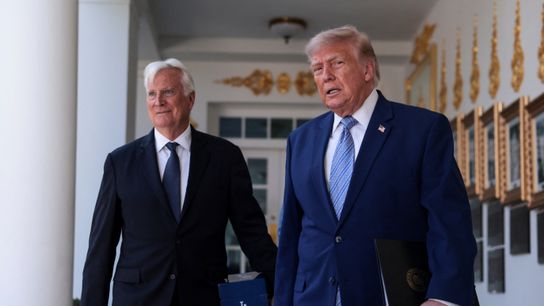
REUTERS/Evelyn Hockstein
U.S. President Donald Trump, flanked by Mark Walter, CEO of Guggenheim Partners, walks as he hosts a reception for the reigning Major League Baseball (MLB) World Series champion Los Angeles Dodgers in the Rose Garden at the White House.
So here's the conjecture: Is it possible that Josh Kushner — the brother of the president's son-in-law — brokered a deal behind the scenes? A deal where if Walter sold him the Lakers, the investigation would quietly disappear? A deal where Walter would make $2.5 billion in profit, fund a pro-Trump investment or cause, and walk away from federal scrutiny?
It's not impossible. In our modern political landscape, where proximity to the president is all that matters, where the line between public service and private enrichment has blurred beyond recognition, where the Department of Justice has become a tool of political favor rather than impartial justice — it's not impossible.
It's also not proven.
And it's important to say that. Walter has not been charged with a crime.
The investigation may conclude without enforcement action. The sale may be exactly what it appears to be: a savvy businessman making a quick profit.
But the questions linger. And they won't go away.
THE BASEBALL EXCEPTION
There's another angle to consider, one that has nothing to do with federal investigations or political favor. And it starts with the Dodgers.
Walter is not selling his ownership stake in the Dodgers. He's not selling his interest in the Sparks, either. He's selling the Lakers and only the Lakers.
That distinction is crucial.
Why would Walter keep the Dodgers but sell the Lakers?
The answer might be simpler than conspiracy theories suggest: the economics of baseball versus basketball.
In Major League Baseball, there is no salary cap. No salary floor. No second apron acting as a hard cap to deter owners from outspending their counterparts.
If you have the money, you can spend it.
And Walter, through the Dodgers, has spent plenty — the franchise has won three World Series since 2020.
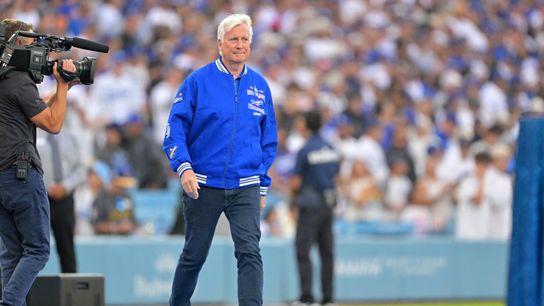
Jayne Kamin-Oncea-Imagn Images
Los Angeles Dodgers majority owner Mark Walter walks to the field for the teamÕs ring ceremony prior to the game against the Arizona Diamondbacks at Dodger Stadium.
In the NBA, the second apron is a different beast entirely. It's a hard cap in everything but name, designed to punish teams that exceed certain spending thresholds.
The Lakers, with Luka Dončić as their centerpiece, are facing a future of luxury tax bills that would make even a billionaire wince.
Consider the roster.
Dončić averaged 33.5 points, 7.7 rebounds, and 8.3 assists last season. He's a generational talent, a top-five player in the world. But he's also expensive — and he's about to get more expensive.
Austin Reaves, the undrafted guard who became a cult hero, will make $41.24 million next season.
Walker Kessler, the center Los Angeles traded two first-round picks and two first-round pick swaps for, is on the hook for $30.1 million.
The Lakers have no athleticism and no cap flexibility.
LeBron James is gone — finally, off to Philadelphia to pad his legacy.
The NBA's opening night TV schedule? The Lakers are not on it.
For the first time in eight years, the NBA bailed on the Lakers. T
Think about that.
The Lakers, the most iconic valuable franchise in basketball, was left off the opening night schedule.
Could Walter have looked at the Lakers and seen a franchise with a ceiling? A franchise that would require hundreds of millions in luxury tax payments just to compete? A franchise that, without LeBron, without the star power that made them appointment viewing, might not be worth the investment?
It's possible.
The Dodgers, by contrast, are a cash cow.
No salary cap. No hard apron. Unlimited spending power.
If you're going to keep one asset and sell another, you keep the one that lets you spend without restraint.
THE LUKA QUESTION
And then there's Dončić.
The Lakers built their future around Dončić. They traded for him, they paid him, they made him the face of the franchise. But there's a pattern emerging — one five different successful people in the NBA have recognized.
Mark Cuban, a pretty shrewd businessman, sold the Mavericks with Luka as the centerpiece.
Rick Carlisle, a championship head coach, quit after year three with Luka.
The Mavericks traded him — and not for a big package.
Jeanie Buss, who loved and still loves the Lakers, sold the team with Luka as the centerpiece.
And now Mark Walter is selling the team, probably because of the feds.
Is there something about Luka that makes people want to sell? Something behind the scenes that's chaotic, something that doesn't show up in the box scores?
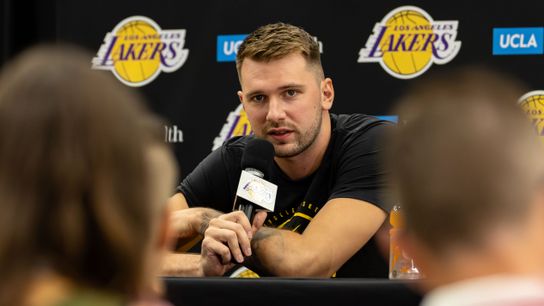
Jordan Teller - The Sporting Tribune
Luka Doncic #77 of the Los Angeles Lakers takes questions from the media during Lakers Media Day at UCLA Health Training Center on September 29, 2025 in El Segundo, California.
Dončić's numbers and abilities are undeniable.
He's a walking triple-double, a one-man offense, a player who can single-handedly win games. But he's also a player who has had five different successful people in the NBA bail on him.
Cuban. Carlisle. The Mavericks front office. Buss. Now Walter.
It's conjecture. It's speculation. But it's worth asking: If Dončić is so great, why does everyone keep bailing?
THE KUSHNER-IGER DYNAMIC
The new owners bring their own complexities.
Josh Kushner is the founder of Thrive Capital, a venture capital firm that has invested in some of the biggest tech companies in the world. He's also the brother of Jared Kushner, the president's son-in-law. That connection alone makes him a figure of intense scrutiny.
Bob Iger is the former CEO of Disney, a man who spent two decades at the helm of one of the most powerful media companies on Earth. He's also a longtime friend of NBA Commissioner Adam Silver.
The Kushner-Iger partnership is unusual. They've been business partners before — Iger joined Thrive Capital earlier this year.
But buying a basketball team together? That's a different kind of partnership.
And it's one that came together remarkably fast.
According to reports, Kushner and Iger had previously expressed interest in buying an NBA expansion team in Las Vegas. That interest was serious enough that they were considered front-runners for a Vegas franchise. But when the Lakers became available — when Walter needed to sell, and fast — they pivoted.
Days, not months; that's how quickly it happened.
What does it mean for the Lakers?
Kushner and Iger said in a joint statement:
"As lifelong NBA fans, we are deeply honored for the opportunity to become stewards of the Los Angeles Lakers, one of the most iconic sports franchises in the world. We have immense respect for the leadership and vision of Jerry and Jeanie Buss. Our long-term commitment is to build on that foundation, compete at the highest level, and serve this extraordinary team, its fans, and the city of Los Angeles."
It's a nice statement. It's also the kind of statement every new owner makes. The question is what happens next.
Will Kushner use his proximity to the president to benefit the Lakers? Will Iger use his media connections to boost the franchise's profile? Will they spend the money necessary to build a contender around Luka? Or will they treat the Lakers like a trophy asset — something to show off at parties, something to increase in value, something to sell when the time is right?
THE RETURN ON INVESTMENT
Let's not forget the simplest explanation: Walter made $2.5 billion in 14 months.
That's not a bad return by any measure.
It's a spectacular return.
It's the kind of return that makes you the envy of every investor on Wall Street. It's the kind of return that allows you to fund whatever you want — a pro-Trump super PAC, a new business venture, a foundation, a yacht, a fleet of yachts, a company that makes yachts.
Walter purchased the Lakers from the Buss family in June of 2025 for roughly $10 billion," the Sporting News reported. "The Lakers are now valued even higher".
The sale has not been finalized and still requires approval from the NBA's Board of Governors.
But assuming it goes through, Walter will walk away with a fortune. And he'll do it without selling the Dodgers, without selling the Sparks, without selling Chelsea.
Just the Lakers.
Just the team he bought 14 months ago; just the team he never intended to sell.
Walter may just need the money. If so, the $2.5 billion he made is the template we all should follow.
THE LEGACY
Westbrook was born in Long Beach. He learned the game at Leuzinger High School. He sharpened it at UCLA.
He is Los Angeles basketball royalty in the truest sense — not imported, not manufactured, but grown from the soil lodged between the 405 and the 110.
And on the day he retired, the city that raised him will not remember it.
Not because he was unworthy. Not because the moment lacked poetry. But because on that same day, the Los Angeles Lakers were sold.
Again.
For $12.5 billion.
While Westbrook walks away from the game that made him, and a career that typified the love of the game, in a league in which he left his mark, and on a franchise in which he moonlit, it now belongs to Bob Iger and Josh Kushner.
That is the cruelty of timing. That is the mathematics of modern power.
Westbrook's farewell was supposed to be a moment.
A celebration. A recognition of everything he accomplished.
Instead, it was an afterthought. A footnote. A blip in the news cycle while the real story dominated the airwaves.
But maybe that's fitting.
Maybe Westbrook, of all people, would understand.
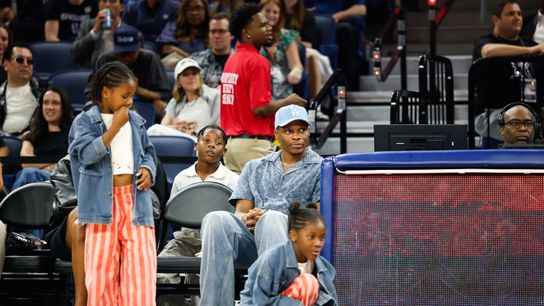
Kamil Krzaczynski-Imagn Images
Sacramento Kings guard Russell Westbrook looks on from sideline during the 2026 State Farm WNBA 3-Point Contest at Wintrust Arena.
He spent his career being overlooked, underestimated, undervalued. He was the kid from Los Angeles who wasn't supposed to make it.
The player who wasn't supposed to be great.
The kid who wasn't supposed to make the NBA or win an MVP.
He did it anyway. He did it his way. And when he walked away, he walked away with his head held high.
The Lakers, meanwhile, are entering a new era.
An era of Kushner and Iger. An era of federal investigations and political connections. An era of questions about why the last guy sold — and what the new guys will do.
It's a lot to process. It's a lot to digest. But if there's one thing Los Angeles knows how to do, it's move on.
The Lakers will be fine. They always are. The fans will show up.
Games will be played; championships will be chased.
And Russell Westbrook will be remembered. Not for the day he retired. Not for the press conference that got overshadowed. But for everything he did before. The triple-doubles. The fury. The kid from Los Angele who came home.
That's the thing about Los Angeles. It eats its heroes for breakfast and forgets them by lunch.
But it never really forgets.
THE FINAL WORD
"Does it matter who win or lose?" Jerry West once asked. "Yes, it does," he answered. "Yes, it does."
For Walter, winning and losing take on a different meaning.
He won the bidding war for the Lakers; he may lose a federal investigation.
He won $2.5 billion in profit; he lost the chance to be the owner who brought the Lakers back to glory.
For Kushner and Iger, winning means something else entirely.
It means navigating the politics of the Trump administration. It means managing the expectations of a fanbase that demands excellence. It means building around Dončić — a player who, for all his brilliance, has seen five different successful people in the NBA bail on him.
For Westbrook, winning meant something simpler. It meant playing the game he loved. It meant coming home. It meant giving everything he had, even when it wasn't enough.
He retired on a Wednesday in August. The Lakers were sold the same day. And in the chaos of it all, in the noise of the headlines, in the rush of the news cycle, one thing became clear:
In Los Angeles, the show must go on.
It always does.