
Whisper the name Faker to any fan of esports, and they’ll know immediately who you’re talking about.
He’s the face of esports and the embodiment of the potential of an industry that can scale so much further.
But how did this relatively unassuming League of Legends player from Korea gain the gravitas needed to join the likes of other star athletes in other spaces? Esports Foundation CEO Ralf Reichert has a theory.
“He still feels close to the people who follow him. That is partly the nature of a digital-first sport: fans do not only watch their heroes from a distance. They can play the same game, compete on the same maps, and experience the same moments themselves,” Reichert said. “Faker represents the highest possible level of that shared experience. Fans admire him, but they also understand the world he comes from. That combination of greatness and closeness is incredibly powerful.”
Faker, who joined chess legend Magnus Carlsen and star footballer Cristiano Ronaldo as an Esports Foundation’s Ambassador, is a living legend in the world of esports. It’s just another accolade to a career filled with them.
So, how did Faker go from a 16-year-old League of Legends phenomenon to a global icon that can stand alongside the likes of Ronaldo and other star traditional athletes?
That’s where we explore and it starts in Seoul.
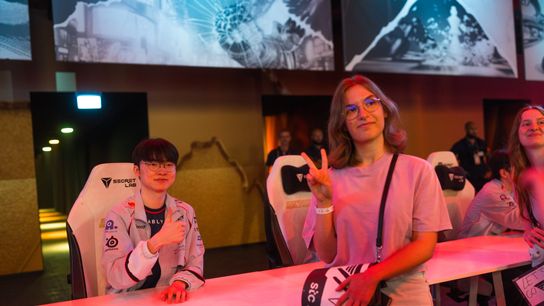
The Person
Before he became known to the world as Faker, he was merely Lee Sang-hyeok, born on May 7, 1996, in Gangseo District of Seoul, South Korea. He enjoyed games, particularly Warcraft III, before discovering the game that would change his life in December 2011 when League of Legends launched its servers in Korea.
He attended Mapo High School in Seoul, along with future rival Kim "Deft" Hyuk-kyu. Faker didn’t graduate from Mapo High School, but he still joked during the two’s meeting at the 2022 World Championship that his goal was to become the “most popular person from the Mapo area.”
The reason why he didn’t graduate? He signed with SK Telecom T1 at 16 years old to join its second League of Legends team, opting to become a professional player.
Much of Faker’s life from age 16 onward was dominated by League of Legends and professional play, so bits and pieces of his human side come out at various times.
Whether it’s admitting to listening to Taylor Swift in the Players Tribune, displaying an interest in health management and sciences, and enjoying other board and digital games, Faker attempts to excel in other areas of his life.
“He’s pretty good at swimming and chess,” former teammate Lee “Gumayusi” Min-hyeong said.
For now, Faker is focused on being a professional at the highest level and trying to win more tournaments around the world.
“I am not really thinking about my life after my career at the moment," he said.
The Athlete
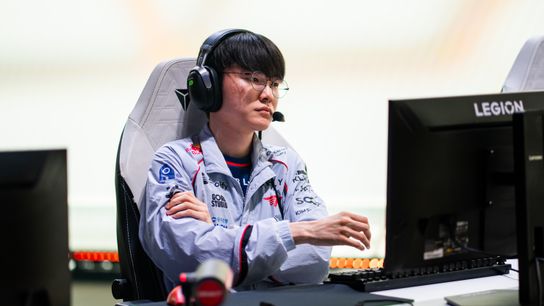
When cameras focus on Faker before matches, his eyes are closed, as if he’s entering a space to become what fans have known him as, “The Unkillable Demon King.”
Faker wins. Plain and simple.
Faker climbed to the top of the League of Legends in his rookie season, helping SK Telecom T1 win its first World Championship in 2013.
He added another in 2015 and 2016, before securing the first three-peat in the game’s history from 2023-25. Faker has two Worlds MVP awards (2016 and 2024), along with a pair of Mid-Season Invitationals (2016-17), and 10 League of Legends Championship of Korea domestic titles.
That also doesn't include a Korean eSports Association Cup in 2025 and silver and gold medals in League of Legends at the Asian Games — the gold coming in 2023, though Faker was sidelined by illness and didn’t play in the final his team won.
“[He’s] a player who consistently proves himself with his skills,” Hanwha Life Esports mid-laner Kim “Zeka” Geon-woo said.
But even as a player who has won everything possible, Faker remains focused on adding more trophies to his already impressive resume.
“If there is a core trait shared by global sports icons in every field, I believe it is an ‘endless passion for learning and an unbreakable resilience,’” Faker said. “It is the mindset of not becoming complacent when at the top and never giving up when at the bottom. The most important thing is being entirely immersed in the process of self-improvement rather than just the results, while maintaining a deep respect for the game, teammates, and the fans who support us.”
It’s exactly that belief that contributed to making Faker into a global icon.
The Icon
It’s easy to point to winning as the sole reason why Faker’s become a global icon.
Society loves winners, but it doesn’t automatically equal legendary status. He views it as a three-headed effort by himself, his teammates, and his fans.
“If it were solely about victories and championship trophies, the bond with my fans would have faded during my difficult times and slumps,” he said. “They have been by my side through it all – not just when I was standing at the peak rejoicing, but also when I fell into slumps, faced frustrations, and constantly worked to overcome them. Also, because I have stayed with one team ever since my debut, I think we've been able to build a deeper, more solid relationship of trust.”
While his athletic successes, which also include a Cheongnyong Medal of the Order of Sport Merit (the highest achievement an athlete can earn in South Korea), are impressive, it’s his honest, earnest demeanor that earns him much more.
“No one, actually. I've never seen or known anybody who hates Faker,” said Marel Martin, a fan who attended MSI in Daejeon, South Korea.
Faker’s face appears on a variety of platforms, ranging from bowls of instant ramyun to commercials with K-Pop idols for Samsung. He’s raised T1’s profile so much that fans of the team come to their PC Bang in Seoul and consider it like visiting stadiums of popular football (soccer) clubs.
“If you're a Barcelona fan when you go to Camp Nou,” Longtime League of Legends fan Jose Valencia said. “If you're a Real Madrid fan, if you go to their stadium, the Bernabeu."
Faker earned a spot on TIME Magazine’s inaugural TIME100 Sports list. He slotted into the Icons tier, joining other living legends in traditional sports, such as LeBron James and Lionel Messi.
Valencia called him greater than Messi, placing him in the same tier as fellow one-named legend Pele.
But for Faker, being on the list holds little personal value. Sure, they’re a massive accomplishment, but for him, it’s much larger than merely being named to a list. It’s what being next on the list means.
“I see them as a milestone for the entire field of esports. The very fact that the profession of ‘pro gamer’ can be mentioned alongside figures like Pelé, Messi, and LeBron James is proof of how much the public perception of gaming has evolved,” Faker said. “That is what makes me the happiest. Therefore, rather than focusing on my personal fame, I want to keep focusing on the game itself and on how I can continue to improve, just as I always have.”
Faker may be considered an Icon in esports, but, to himself, he’s an ambassador to a larger general audience.
The Ambassador
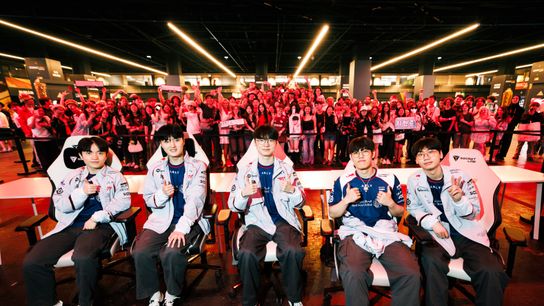
Faker’s appointment as the Esports Foundation and Esports World Cup Game Ambassador was a given. It wasn’t a case of if it would happen, but rather when and who he would be next to.
Faker joined Carlsen and Ronaldo as the event’s ambassadors.
“For the Esports Foundation, and for the sport itself, that matters because great sports need both icons and institutions. Icons inspire people, carry the sport beyond its core fan base and give every generation someone to believe in,” Reichert said. “Institutions create the stages, pathways and recognition that allow those icons, and the athletes who follow them, to emerge and endure. Our role is to build that system for esports through the Esports World Cup, the Esports Nations Cup and the wider ecosystem around players, Clubs and national teams.”
It’s a role Faker has already been working in for a long time. His goal is to change the public's perception of esports athletes.
They’re not just people who sit at computers all day. They’re high-level athletes whose discipline and ability rival those in the traditional space.
“Rather than being conscious of my status, I feel a much greater sense of responsibility,” Faker said. “Because so many people look up to me as an icon representing esports, I believe I need to be more mindful of my every action. I want to show performance and behavior that live up to the support I receive. My goal is to continue proving that esports players, like traditional athletes, are professional, disciplined, and highly deserve respect.”
It’s this reason why the EF opted to put Faker alongside Carlsen and Ronaldo to be the ambassadors of the events and foundation.
“Faker is bigger than League of Legends,” Reichert said. “He has become a symbol of esports itself.”
The End?
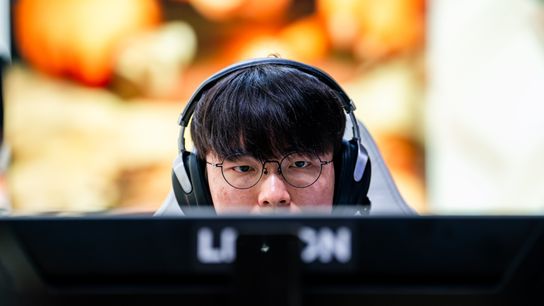
At 30, Faker’s career has seen people come in and go. Former rivals have moved on to coaching or just flat-out retired. Players who grew up watching him are now playing against him or playing alongside him.
“People often think that the career span of a professional gamer is very short,” Faker said. “However, I want to continue proving firsthand that if you maintain thorough self-care, mental training, and healthy habits, you can sustain a long and healthy career.”
His T1 teammate Ryu "Keria" Min-seok said that he idolized Faker, but as they continued working together, he’s learned to stop treating Faker as untouchable and start treating him as a colleague open to discussion.
“He's still my idol, and I still learn a lot from him,” Ryu said. “If there are any differences, I think while I keep that respect for him, perhaps I’ve become more comfortable with him.”
Faker considers this the circle of athletic endeavor. He called it an honor to play against and with people who viewed him as an idol.
"I am thankful that they think highly of me, but since I have been doing this for so long, I consider playing alongside such players to be a natural occurrence,” Faker said. “I do think about doing my absolute best so that those players can continue to receive a positive influence from watching me."
But Father Time remains undefeated. Tom Brady inevitably lost. So did Kobe Bryant. James and Messi will too.
It’s part of the game.
But Faker will do what he can to fend off exchanging the gaming mouse for something more suited for daily life.
“Honestly, I don't remember the past that well, so speaking about recently, I think there are good times and bad times,” Faker said. “There are times when my performance is good, but occasionally my concentration drops. Because of that, the longer I am active as a professional, the more I feel I need to manage myself better. I think that if I control myself well enough, I will be able to continue playing good matches in the future."
There will be a time when Faker isn’t on the screen. When it happens, only he knows.
But until then, he will help shape what he envisions esports to become.
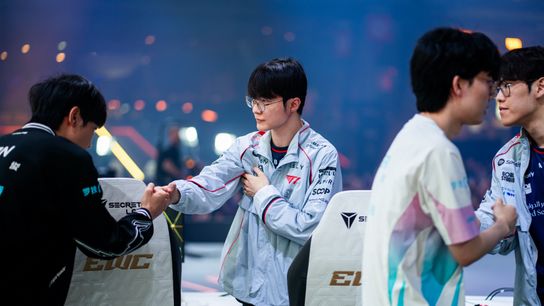
His Vision
Faker predicted in 2016 that esports would grow exponentially over the next 20 years.
But even he didn’t predict the scope it would evolve into over the first half of that prediction, which included a month-long event like the Esports World Cup and the eventual Esports Nations Cup to be realities.
“To be honest, when I made my professional debut back in 2013, I never imagined that esports would grow to such an immense scale,” he said. “At the time, I was just busy focusing on the small stages right in front of me. The idea of so many diverse gaming communities gathering in one place to celebrate a weeks-long global festival was completely beyond my imagination.
“Seeing this festival actually come to life is deeply moving.”
That’s just one part of his larger vision for esports though.
He wants more teams to invest in creating a healthy athlete, ranging from self-care instruction, mental training, and the promotion of healthy emotional and physical habits. He wants players playing into their 30s and beyond to be the norm, not the exception.
Healthy athletes aren’t the only area he wants to see grow to also the fans.
“I also hope that esports become a culture that is naturally respected and loved by people of all generations, young and old,” Faker said. “I hope we build a solid foundation of sportsmanship and mutual respect, where both players and fans deeply care for one another. Ultimately, I want esports to transcend mere entertainment and firmly establish itself as a healthy, wonderful sport that gives positive inspiration and energy to people worldwide.”
Faker anticipates that the next 10 years will be another massive growth spurt for esports.
Whether Faker is still part of the industry when it happens is only for him to know.
He’s done his part, however.
And lot more.
Disclosure: Travel and accommodation for this event were provided by the Esports World Cup. The Esports Foundation had no editorial input into or approval over this article or any future content.
Paul Delos Santos covers esports for The Sporting Tribune. You can also find interviews with individuals from esports on this YouTube channel @TheLoad-InGG.