
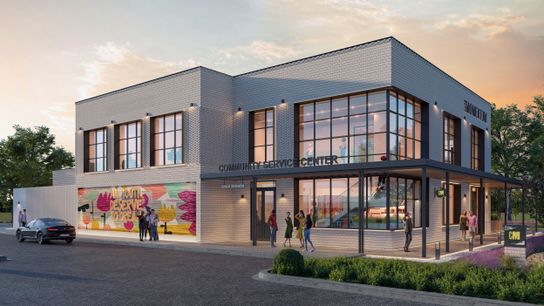
DALLAS––The DART line glides along the rails that gird it, past a storefront with sprawling windows that welcome sunlight like the warm faces that greet you inside.
Silver and orange. Small. Unassuming. Modern and simplistic.
The sign reads Café Momentum. Beside it, Chef Chad Houser has taken pictures with family, celebrities, guests and people given a second chance.
The gallery is not vanity; it is testimony.
The door does not open; it yields.
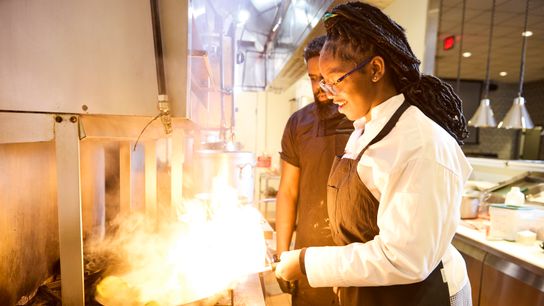
Courtesy of Café Momentum
It gives way to the sweet aroma of a pastry kitchen, to the clatter of pans, to the murmur of voices that do not sound like the voices of inmates. The glass towers above you, sprawling and welcoming, sunlight pouring through like an apology for every dark room this kid has ever known.
Kenzo Sohoue was 19 years old, still serving his sentence. He spent five years in and out of juvenile hall — five years of thin mattresses and cold showers and correction officers stripping him naked in front of strangers.
Five years of being told, implicitly and explicitly, that he is disposable.
That he is dangerous. That he is done.
Then a chef handed him a knife.
Not a plastic spork. Not a monitored utensil.
A knife. In a kitchen. At a pop-up dinner in downtown Los Angeles with the Rams.
Around him, the clink of wine glasses. The hum of conversation. The smell of something being created rather than something being survived.
"In my mind, I couldn't believe that someone could actually trust me in the kitchen to grab a knife and be around other people," Sohoue said.
His voice still carries the wonder of that first moment five years prior.
"Knowing that I am looked at as a criminal. Knowing that I'm still incarcerated. To have that type of freedom — I couldn't believe someone had that type of heart.”
That heart belongs to Chad Houser, a chef who walked into a juvenile detention center 18 years ago to teach eight young men how to make ice cream and walked out a different person.
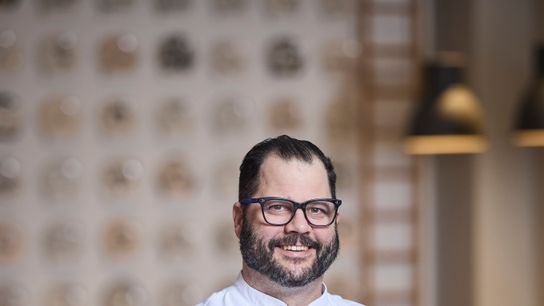
Courtesy of Café Momentum
Houser had the awards. He had the buzz.
He had a rising-star restaurant in Dallas and the kind of life that food magazines photograph. Then he met eight Black and brown kids in jail clothes standing beside college culinary students in chef coats and tall paper hats.
One of them won the whole competition. Beat the college students with cantaloupe-and-basil ice cream. And when he did, he told Houser something that would alter everything: "I just love to make food and give it to people and put a smile on their face.”
Houser drove home that day excited, then frustrated, then inspired, then sad, then motivated, then angry. Because he realized the kid was never going to make it to a Wendy's or a Chili's.
The system would see to that. The system was designed to see to that.
In a voice steady with the weight of reckoning, Houser describes the impact of choices on lives.
"Our lives had been dictated by choices that were made for us before we were born," Houser said. "Because of the color of our skin. Because of the socioeconomic class we were born in. Educational resources, healthcare resources, food resources that I was given abundance of and he was given inaccessibility to.”
So Houser did the only thing he knew how to do.
He went back. He listened. He cooked.
And eventually, he built something that should not exist: a fine-dining restaurant that is also a juvenile justice program.
A place where the food has to be excellent, the service has to be impeccable, and the kids have to rise to whatever expectations are set for them — because the community has finally decided to set one.
Café Momentum.
The name is physics and philosophy.
Momentum is mass times velocity. It is the measure of how hard it is to stop a moving object.
Everyone here is moving forward from the dishwasher to the founder.
From the kid who walked in with a record to the kid who walked out with a career.
The Kid Who Kept Going
Sohoue's story does not begin in that kitchen. It begins in Cameroon, where he was born, and in the shelters of Los Angeles, where he landed at 10 years old with a mother who would eventually abandon him.
It begins in the foster care system. In the streets. In his anger, Sohoue directed it at himself for wanting to fit in, for chasing money and girls, and for the cool-kid lifestyle that had built him into nothing.
"I was mad at myself for a really long time," Sohoue said. "But then I let go because I have to let go and let God every single time. I needed to be around those people. I needed to make those mistakes. I needed to experience not going to school and not doing that, to now be able to guide out the young people like myself who walked their shoes.”
Getting incarcerated, he says, was one of the best things that happened to him.
Not because jail was good. Jail was horrible.
The mattresses were thin. The food was inedible. The showers were cold. The programming was not uplifting — it was only a pastime. The correction officers stripped him of his identity, his privacy, his dignity.
"It is very cold," Sohoue said. "Plenty of doors. Very isolated. It looks like schools. It has a structure to keep you tied down. Three meals a day. Food and clothes provided. Almost like a jungle. So many different young men and women that are not focused, that really don't care that much about their life because we're all young. The fights. The drugs. The lack of trauma-informed practices. The lack of accountability. The same clothes every single day. The showers are so cold. Sometimes you don't even want to shower. Correction officers stripping you down naked. Right in front of another man. You're stripped of your whole identity. I couldn't believe that is really something that's happening.”
Sohoue describes juvenile detention with visceral detail.
But jail gave him something the streets never did: focus.
"If I would have never went to jail, I would have never graduated high school," Sohoue said. "I had to push through mental trauma. My freedom is no longer in my hands. I am in another country where now I have to build through everything that I'm facing. So it was perseverance. I have to now focus, keep my mind focused, and stay through. Because I didn't have nothing else. I didn't have family members to reach out to. I didn't really have friends to come visit me.”
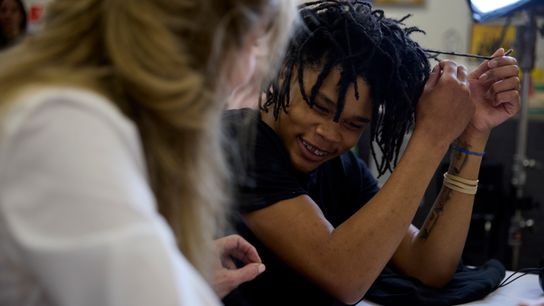
He graduated from high school behind bars. He started college courses. He learned to cut hair and became the best barber in the unit.
He kept pushing, kept elevating, kept seeking purpose. And then Café Momentum came along, and it got even better.
"I felt free because I was open to do anything, cook anything I wanted," Sohoue said. "It felt good to do something for myself that was good and healthy. I knew that this is a decision. I'm choosing to do this. So if I'm choosing to do this, there's a purpose for it.
People trust me to find my purpose, follow my purpose. That was the freedom that I was finding and seeking.”
The freedom to choose. The freedom to be trusted. The freedom to be seen as capable rather than criminal.
"When somebody trusts you for the first time in your life, it is very healing," Sohoue said. "Trust means I take you and appreciate you and love you as you are. I don't want you to be any different. I want you to be yourself and become better. I want to see you win. I want to see you at your best. And that is the best feeling ever.”
The Chef Who Listened
Houser did not set out to save anyone. He set out to listen. And in listening, he learned that the system was not broken — it was working exactly as designed.
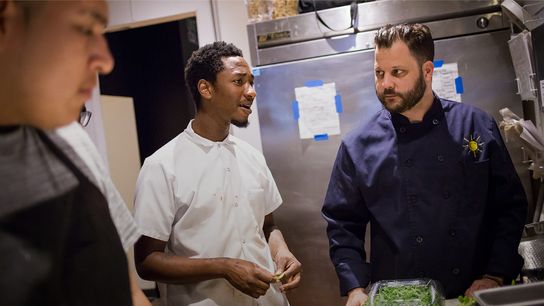
Courtesy of Café Momentum
"A system that is actually not designed for them to leave," Houser said. "Kids come into this program and they'll tell you the visceral feeling of walking out of the facility and somebody saying, 'I'll see you in six months.' What message that sends to a child. The fees and the check-ins. So many of our kids have a probation check-in at 2 o'clock on a Wednesday. Where is a 16-year-old supposed to be at 2 o'clock on a Wednesday? School. So if I skip school to show up for my probation check-in, I've violated probation. And as a result, I'm going back to jail. But when I do skip school to show up for my probation check-in, I've now violated my probation by being truant at school.”
The trap is elegant in its cruelty.
The system is not designed for exit. It is designed for return.
Nationally, somewhere between 60 and 80 percent of adult prisoners started with a juvenile record. The pipeline is not accidental. It is infrastructure.
Houser's response was not to build a better prison. It was to build a better question.
Do we believe people can change?
And more importantly, do we help them prove it?
"We believe in you and will continue to do so until you believe in yourself." That is the phrase at the heart of Cafée Momentum.
It is not charity. It is not pity.
It is patience. It is presence.
It is the radical act of showing up, day after day, until the kid finally believes what you have been saying all along.
"Consistency and grace and a lot of love," Houser said. "Unconditional love. I think that's grace. Change is hard. Change is messy. And a lot of times it doesn't feel great in the process. We believe a lot in grace. Grace does not lack accountability. It removes blame and shame.”
The restaurant is the mechanism. The food is the language.
But the therapy happens in the doing — in the discipline of perfecting a sauce, in the confidence of cooking a steak to medium rare, in the connection of waiting tables and being seen by the community.
"I can't think of a single intern that's ever come through the doors of Cafée Momentum that was excited about waiting tables," Houser said. "Yet when you ask them what was their favorite thing they did, they'll always say waiting tables. That connectivity with the community breeds a certain level of confidence of feeling seen and feeling valued.”
The model is not a soup kitchen. It is a top-tier restaurant.
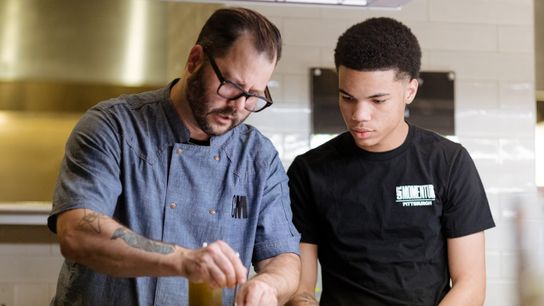
Courtesy of Café Momentum
In Dallas, Café Momentum has consistently been ranked among the top restaurants in the city for 11 years.
In Pittsburgh, it was named one of the 27 best restaurants in all of Western Pennsylvania.
In Atlanta, it was listed as one of the most anticipated restaurant openings of 2025 and received a glowing review in Atlanta Magazine.
"Our kids can and will rise to whatever level of expectation is set for them," Houser said, "as long as we as a community provide them with the tools, resources and opportunities necessary to do so.”
Only a third of the money comes from selling food. Two-thirds comes from donations, from individuals, from foundations.
Houser has essentially asked the community to invest in a belief. And he has found that skeptics are the best targets.
"If you're going to change the attitudes and behaviors towards our kids, you don't need to talk to people that agree with you," Houser said. "It starts with humility. I'm quick to point out that I had stereotypes and labels and judgments on the kids. And this is what I've learned. People begin to listen and open their minds and open their hearts. And ultimately, when you can get them to actually meet the kids, everything changes.”
In 2025, Houser was awarded the James Beard Humanitarian Award.
The recognition is nice. But the work is the point. The 60,000 children in jail in this country right now — that is what keeps him up at night.
"Café Momentum should be the beginning of a movement," Houser said. "A call to action that we need to stop incarcerating our children and start investing in them.”
The Village
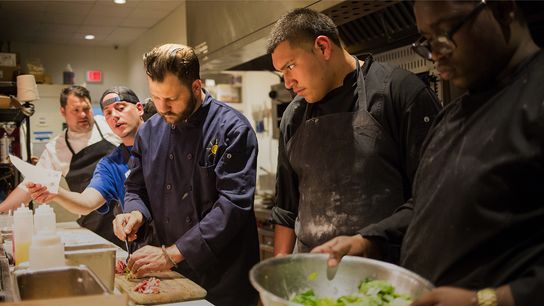
Café Momentum is not just a restaurant. It's a 12-month paid internship.
It's group therapy. It's parenting classes. It's house checkups. It's case managers. It's trauma-informed staff.
It's a village.
CORTESY OF CAFÉ MOMENTUM
"What that village gave me that I didn't know I needed was community," Sohoue said. "Was a family. What I had with Café Momentum is a real family. I didn't think that I would see so much growth within this community that I have. I didn't think that I would have so much trust and love and belief in me so much in which I am not used to. I wouldn't have thought that it was actually there somewhere in the world. I thought I was seen as a criminal forever, and nobody would really care to see me for who I am or the best that I can be.”
Houser built the restaurant with intention.
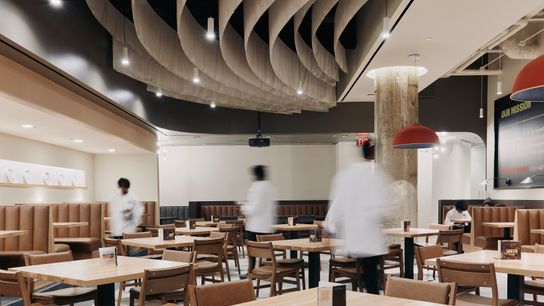
There are no doors between the kitchen and the dining room. The pastry kitchen is wide open. The pass-through where food comes out is completely exposed.
"We want even our kids in the kitchen to connect with our guests," Houser said. "We want them to see our guests enjoying their creation that they work so hard cooking.”
The kitchen has 12 burners. A flattop griddle. A grill. A fryer. A smoker.
Three chefs work each line with two to three interns per station. The kids are required to work in two of the four stations — pantry, sauté, grill or pastry.
But the real magic happens at the family meal.
Every Thursday at 3 o'clock, everyone gathers.
Staff. Youth. Adult mentors.
They break bread together. They have lessons. They talk about what's going on in the community.
"When there's an uptick in gun violence and the kids are feeling a certain way, we're going to talk about it," Houser said. "Like a family would talk about issues at a dinner table.”
Then there is the Thankful Plate Project. Each young person designs a plate. The only requirement? Put something they're thankful for.
"Thankful for a second chance at life." "Opportunities to become a better man." "Challenges continue to make me stronger." "I am built for this life." "I have been chosen.”
One plate belongs to Adolfo Martin, one of the very first interns. Houser would pick him up at his grandmother's apartment and drive him to a commissary kitchen. They'd prep, cater dinners, build something from nothing. His plate still hangs on the wall today.
Houser has a phrase: "We believe in you and will continue to do so until you believe in yourself.”
Sohoue believed him.
"Chad spoke to me the first day that we met at a correctional facility," Sohoue said. "I know that that relationship was going to go for life. And he's been my brother, my mentor, my role model ever since. The thing was the follow-through. Actually making it happen. Reaching out. Coming back. Presenting me numerous opportunities.”
The Football Player Who Showed Up
Miles Killebrew does not need to be here. He is a special teams ace for the Tampa Bay Buccaneers. He has a career to maintain, a body to preserve, a shelf life that every NFL player understands is shorter than they want it to be.
The league's unofficial motto is not just "No Fun League." It is also "Not For Long.”
But Killebrew is here.
Since being introduced by the philanthropic organization Stand Together, he has been here for two years, through the NFL's My Cause My Cleats initiative, pop-up dinners, kitchen shifts, and conversations with kids who have never met a professional athlete who saw them as people rather than projects.
"I was first introduced to Café Momentum when I was in Pittsburgh," Killebrew said. "I was looking to get connected in the community. I came across them and I fell in love with what they were doing with the youth. I have a heart for youth. When I got to see that this area was being addressed in such an effective way, I was hooked.”
He did not write a check and disappear.
He rolled up his sleeves. He showed up. He gifted an intern named Nico a pair of custom cleats with Nico's likeness painted on the side. He convinced teammates to adopt the cause. He turned "my cause" into "our cause.”
"If you want to go fast, you go alone," Killebrew said. "If you want to go far, you go together.”
His motivation is personal. He has family members who have been incarcerated. An uncle who served decades in prison. A father who made sure he understood the reality of the carceral system. He himself never spent a night in jail, but he knows the distance between his life and theirs is thinner than most people want to admit.
"If not for one or two mistakes, it just as easily could have been me," Killebrew said. "One of the determining factors for my success is that I had a support system at home that was never faltering. My parents were always there. I feel a responsibility to be a support system to those who don't have it.”
When he looks into the eyes of these young people, he sees what the rest of the world often misses.
"I see hope. I see dreams. I see excitement for what they can be, for who they already are. A lot of times I see a desire to just elevate themselves. They want to get to where — and it's so cool because you see that spark, man. That spark has not left their eyes. They know what they're capable of. They know who they want to be. And sometimes they just need a little extra step, just a few more tools.”
Killebrew's ambition is massive.
He wants Café Momentum in every NFL city.
Courtesy of Café Momentum
He wants football stadiums connected to restaurant kitchens.
He wants the league to be not just an entertainment delivery system but a social change delivery system.
"The professional athlete to the young aspiring youth — it's a very organic relationship," Killebrew said. "I have yet to meet a player who doesn't want to get involved with youth. I have yet to meet a youth who doesn't want to meet a famous football player. The guys got to eat and we want to serve. It's just a really natural relationship.”
He imagines a future that keeps him going through the physical grind of another NFL season. A future where he walks into a restaurant and is greeted by a former intern who tells him: "If it were not for you, I would be in jail. This is my restaurant now. This one's on the house.”
"That lights me on fire, man," Killebrew said. "I want that. I want to affect as many as I can.”
The Walking Testimony
Kenzo Sohoue is not that future. He is the present.
He went through Café Momentum's program and kept moving.
He became a case manager. A policy advocate. A youth ambassador in Los Angeles.
He works with young people coming out of juvenile detention centers, guiding them into the community, speaking life into them the way Chad Houser spoke life into him.
"When I look at a young man or woman that I've been in their shoes, I tell them: You may not be where you want to be, but you are not what you used to be," Sohoue said. "This can either build you or break you. But this is never the end of your life. You are more than capable. You're not going to go through it. You're going to grow through it.”
He is at the gym every day. He meditates. He prays.
He takes care of himself so he can take care of others. And he knows that ultimately, the choice is theirs.
"I can speak to them all day long, but they still have to make that choice," Sohoue said. "Speaking to them and consistently speaking life, they start thinking about how do I get there. And that's where the motivation comes in.”
His empathy is not theoretical.
It is forged in experience.
Sohoue knows what it is to be hungry and steal to eat.
He knows what it is to be abandoned by a mother who tried until she couldn't try anymore.
He knows what it is to sit in a jail cell and wonder if the world has forgotten you exist.
"You don't help someone by putting them in a cage," Sohoue said. "You don't help someone by neglecting them. Treating them like a piece of garbage doesn't heal anyone. If they have nobody — like foster youth, I was in the foster care system myself — then where else are they going to go? Some young people don't have anybody but us.”
He has become a walking testimony. And he never tires of it.
"Testimonies like mine change lives," Sohoue said. "Empower other people. Change hearts. Build programs. Shift perspectives. I will continue to live my testimony and be proud of what I've been through, because without that, I will never be in a position to fulfill the purpose that I'm living every single day.”
He has worked with the LA Rams in a fellowship program, learning football operations, partnership sales, marketing, community impact.
He has produced a short film called "Redefined" and wrote the original song for it.
He is building businesses — music production, community programming, housing initiatives.
He wants to create jobs for young people, to build a legacy that extends beyond his bloodline to the entire world.
"A lot of people build businesses," Sohoue said. "But what I'm trying to do is create more businesses to be able to hire people. Young people. To create more jobs. We come from uncertain, underproduced communities. The people that are focused and pushing through life need to start thinking how we can develop more opportunities to have a stronger foundation in the community.”
When he looks in the mirror, Sohoue does not see the kid from Cameroon. He does not see the foster child. He does not see the inmate. He sees a king.
"In this very moment, I am the son of God and I am a king," Sohoue said. "I come from royalty. My ancestors have traveled and walked through this earth. I am here to fulfill the mission to give back the life that I've been given by my Lord. I am a walking testimony and a host of empowerment, upliftment, inspiration, of life.”
The Last Supper
I asked Houser a hypothetical––a good one.
“Café Momentum has been chosen to host the Last Supper. What is served? Who cooks? Who serves?”
He laughs. But then he gets serious.
"One of my favorite things about Café Momentum is that our entire program was literally built by the young people that we serve. It was designed by them. Through myself and others truly listening and reacting accordingly. Our kids truly designed the program — which is the way it should be.”
He pauses.
"If this is going to be the Last Supper, I think I would let the kids lead this. Let them say, 'This is what's going to be important to break.' Let them dictate it. But I sure hope I could at least get a little bit of input in and get some good old-fashioned steak fajita nachos. Because if I had to have a last meal, that's exactly what I'd want to eat.”
The Unification
In a country divided by red and blue, by city and county, by what we watch and whom we vote for, there are only three things that truly bring us together. Food. Music. And sports.
Houser uses one of them to heal the other.
"Food is communal," Killebrew says. "Food is a universal language that everyone speaks. Everyone understands. It is a medium that is often taken for granted. If perfected, if done well, it can escalate you into the upper echelons of society. It gives these youth a certain level of confidence in learning new skills. It broadens their horizons in ways they weren't considering before.”
Houser agrees.
Courtesy of Café Momentum
"I think far too often in our society, it's us versus them," Houser said. "Food has historically played a significant role in creating connectivity. When you are watching our kids walk in their greatness, you have nothing left but to challenge yourself as to why you may have thought differently about them before you came in.”
That's the question at the heart of Houser's work.
Not about cooking. About redemption.
Do we believe people can change?
And more importantly, do we help them prove it?
The Math That Matters
25,000 –– that is the number of youth held in juvenile justice facilities in America on any given day.
65 percent. That is the recidivism rate for formerly incarcerated people released from the California prison system within three years.
60 to 80 percent. That is the percentage of adult prisoners who started with a juvenile record.
The numbers are crushing. They are designed to be crushing.
They are the architecture of a system that invests in confinement rather than cultivation.
But there are other numbers.
100 percent of Café Momentum youth are enrolled in school and achieving academic progress.
Almost 40 percent of Dallas youth went on to post-secondary education last year.
The recidivism rate for Café Momentum graduates is a fraction of the national average.
These numbers are not accidents.
They are the result of a whisk handed to a kid in handcuffs.
A cleat painted with a stranger's likeness.
A chef who listened.
A football player who showed up.
A former inmate who decided his past would not be his future.
Redemption, Chad Houser has learned, is not a moment. It is an iterative process. And you cannot put it on a child's shoulders; you have to put it on the community’s.
"It's not just redemption," Houser said. "It's also reclamation. Reclamation of the trajectory of your life. Reclamation of your hopes and dreams. Reclamation of your future.”
Kenzo Sohoue is living that reclamation.
Every day. Every meal. Every young person he pulls aside and tells: "I believe in you. And I will continue to do so until you believe in yourself.”
The door at Café Momentum does not open; it yields.
And on the other side, a kid with a knife in his hand is not a threat; he is a promise.
The held breath is over.
Now comes the hard part: breathing.
And at Café Momentum, they're breathing in the aroma of something new.
Something hopeful. Something that tastes like possibility.