
The sun doesn't set in Los Angeles; it surrenders.
It bleeds orange and violet across the Hollywood Hills, painting the sky like a canvas left out in the rain.
And on Wednesday, as the sun headed to kiss the horizon into darkness, something else bled through the cracks of the Hollywood Athletic Club — a pulse, a rhythm, a whisper of something foreign and familiar all at once.
Paris. In Hollywood.
Not the Paris of cobblestones and cathedrals, though there is reverence.
This is Paris distilled — concentrated, curated, weaponized for wonder.
This is La Maison. The House. And the house is open.
Last summer, Paris Saint-Germain tested the waters. London. Tokyo. Shanghai. A pop-up here, a collab there. But this year? This year they brought the whole damn bakery.
"Before it was more off the beach," Fabian Allègre, PSG's chief brand officer, said. "Now it's also on the beach."
Allègre grinned like a man who just pulled off a heist.
He stood in front of a DJ booth, with block letters to his right that shouted: "The World is watching. Leave your mark."
Purple. Bold. Impossible to ignore. Just like the club itself.
Ici c'est Paris. Here is Paris.
The phrase hangs in the air like smoke, like promise, like the last note of a jazz solo that refuses to die. It is plastered above the entrance in bold, unapologetic purple — the color of royalty, of bruises, of victory parades.
The words don't ask for attention. They demand it.
And PSG has left marks. Deep ones. The kind that don't fade with time.
Consider the numbers, because numbers tell stories too.
Consider 45 goals in 17 Champions League matches — an average of 2.65 per game, a barrage of brilliance that left Bayern Munich dazed (5-4 on aggregate in the semifinals), Chelsea demolished (8-2 over two legs) and Arsenal broken on penalties in Budapest.
Consider 61% possession, 89.48% passing accuracy, a team that didn't just win but played with the arrogance of artists and the precision of surgeons.
Consider the sextuple: six trophies in one calendar year, a feat so rare it sounds mythical; that in December 2025, PSG became world champions for the first time, beating Flamengo on penalties in the FIFA Intercontinental Cup.
Or, that Khvicha Kvaratskhelia, the Georgian wizard with feet like flickering flame, was named the Champions League's best player; that Ousmane Dembélé, the Ballon d'Or winner, stepped to the penalty spot in Budapest with the weight of a city on his shoulders and sent David Raya the wrong way — calm as a cathedral, cold as winter.
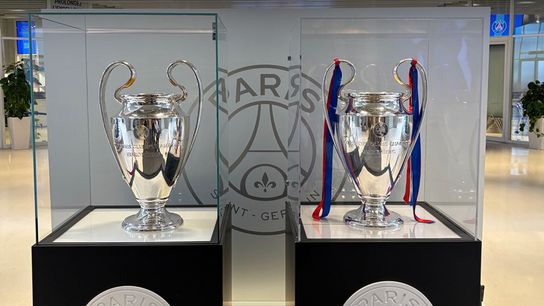
Two Champions League trophies in two years.
That's the kind of success most clubs spend decades chasing. PSG spent seasons building, then spent 90 minutes in Budapest proving it was no fluke.
But here's the thing about PSG in 2026: they're not just celebrating. They're expanding. They're not just winning. They're welcoming.
Richard Heaselgrave doesn't do patience.
Chief Revenue Officer. Numbers guy.
But also — and this is the part that throws you — a romantic. Heaselgrave is sitting at the rear of the ground-floor concept store, surrounded by denim shoes stitched together by a cobbler who clearly has no respect for traditional footwear boundaries.
Jeans turned into boots.
Football shirts turned into art.
Patches waiting for your name.
"You can like PSG," Heaselgrave said. "I'm just looking at a very strange collaboration — shoes out of old pairs of jeans. There's many ways for you to actually touch and feel the magic."
But Heaselgrave knows the truth about those trophies. That kind of winning? It's not sustainable. Nobody wins the Champions League every year.
"If you just depend on winning that Champions League, it's going to be tricky," he admitted. "We're not going to be able to do that every year."
So instead of waiting, instead of resting on silver medals, PSG did something most football clubs wouldn't dare. They looked at America — before the 2026 World Cup was even announced — and said: We're coming.
Some would call that a little bit premature, I said.
"I'd love to say we were prescient," Heaselgrave laughed. "No, look. Forty-eight million people visit Paris every year. Top is the UK. Next is America."
He pauses. Lets it land.
"So when we're looking at a market to grow? It makes a lot of sense."
The Hollywood Athletic Club is a building with bones.
Old bones.
Bones that creak with the memory of golden-age boxers and silver-screen stars. But today, those bones are wearing new skin.
The ground floor breathes with the concept store — a cathedral of commerce where denim becomes footwear and cobblers stitch stories into leather.
Upstairs, the Beyond Developments Wellness Room hums with the quiet intensity of a training ground, a space where recovery is ritual and the body is temple.
But it's the spaces between that seduce you.
"The Playground" — a game room where a silhouette of an illuminated PSG pitch hangs overhead like a moon.
You can play FIFA against a friend, pop shots at a basketball game, pose in picture booths that capture the moment before the moment fades.
There is a French coffee bar where the pastries sit like sculptures, light and fluffy and aromatic, each bite a passport stamp to the Marais.
You taste Paris. You don't just eat it.
But the real trick? The one nobody sees coming?
The speakeasy.
"Visit Rwanda" is etched into a wall that barely announces itself. You walk through, and suddenly you're somewhere else.
Dim lights. Cherry-colored leather.
Two stools on a small stage, two Shure Elvis microphones waiting for someone brave enough to grab them.
Poetry. African Drums. Dancers that could make you forget your location.
"You come with your kids, you have activities for the kids," Nadia Benmokhtar, the club's diversification and merchandising director, said. "If you just want to enjoy an EA Sports game for free and just visit us, you have a way to connect. If you want to buy something at the end, that's cool. But that's not the unique goal."
She says this like it matters. Like she actually means it.
"Football fans are a bit tired sometimes of being seen only as consumers," Benmokhtar continued. "We never speak about consumers. We speak about fans. Friends. Family."
It's a line. Sure. Every brand has lines. But walking through La Maison — feeling the weight of the fabric on the exclusive shirts, watching the patch maker sew something permanent onto a fan's kit, hearing the espresso machine hiss in that French coffee bar — you start to believe it.
Here's what separates La Maison from every other football pop-up you've seen: they actually did the homework.
Benmokhtar calls it "mixing with the local fandom." Not as a buzzword. As a strategy.
"We always try to mix it with the local fandom," she explains. "If you look at our retail store, you'll find collaborations with local brands. Local artists. Local DJs. Sometimes French, sometimes from California.
Tokyo got one version. Shanghai got another. London? Different still.
"Same concept," Benmokhtar says. "Same Parisian framework. But always a local adaptation."
That's the trick, isn't it? You can't just drop Paris on top of Los Angeles and expect it to stick. Paris is croissants and cobblestones and centuries of attitude. L.A. is highways and hideaways and reinvention every fifteen minutes.
But PSG isn't trying to replace L.A. They're trying to sit next to it.
"I think the best thing we can hear when we're in this house," Benmokhtar says, "is 'Only PSG can do that.'"
Gregory Van Der Wiel remembers the first time.
The first time he walked into that PSG locker room. 2012. Fresh from Ajax. A kid from Amsterdam with a father from Curacao and a dream that hadn't quite caught up to reality yet.
"For me as a kid from Amsterdam, playing with young guys at Ajax and then stepping into that dressing room at PSG? I remember very clearly there were only stars sitting there," he says. "Shaking hands with Zlatan. Tiago Silva. It was a surrealistic moment. I had to almost pinch myself."
Twelve trophies in four years. That's what Van Der Wiel left Paris with. Twelve. Not bad for a kid who grew up on the other side of the Dutch border.
He arrived right when Qatari ownership took over. The club was spending money like it had a printing press in the basement.
I asked what the locker room felt like.
Van Der Wiel's eyes go somewhere distant. Somewhere with floodlights and chanting and the weight of expectation.
"Walking into that locker room with the biggest stars in the world as a young guy from Amsterdam? I was proud. Proud moment for myself and my achievements."
Some players chase money. Some chase fame. Van Der Wiel?
"I always been a winner. I always wanted to win prizes. Always wanted to be the best."
He says it simple. No flash. No flex. Just fact.
He talks about evolution — the club's, his own, the sport's. And he talks about touch points, too, though he doesn't use the word.
"Nowadays, to grow as a fan, as a club, it's important to have different touch points. Not only football, soccer for the Americans, but more tap into culture, more tap into lifestyle, so you connect on different ways with the club," Van Der Wiel said.
Connection. That's the currency here. Not euros. Not dollars. But connection.
Pär Helgosson runs PSG Labs. Which sounds corporate until you hear him talk.
"PSG has always been curious," Helgosson said. "Like to be first."
The Labs division is where technology meets culture meets capitalism meets crazy ideas. VR experiences that put fans closer to the pitch. AI integrations that have yet to be named. Partnerships with founders who want to go global and need a club with 660 million followers to help them get there.
"We don't build the magic," Helgosson said. "They do. We just help them reach it faster."
He's sitting in a space that didn't exist three years ago. PSG Labs didn't exist three years ago. Now they're running four days of master classes in Los Angeles. Founder presentations. Legal tracks. Fundraising sessions.
"We're building an advisory council of who's who over here in L.A.," he says. "Then we go to New York next week."
But here's the kicker. The stat that stops you mid-sentence.
"When QSI came in and took over the club in 2011-2012," Helgosson says, "92 percent of the fan base was inside of France."
He lets the number hang.
"Two years ago? A little more than a decade later? Ninety-two percent of the fan base is outside of France."
That's not growth. That's a complete inversion. That's the world showing up for a club that decided to show up first.
Heaselgrave is still talking. I can't stop listening.
"What does Paris smell like?" I ask him.
He doesn't hesitate.
"In New York, we're turning the basement of our Fifth Avenue store into a cafe. I want you to smell the croissant. I want you to go, 'Oh that coffee smells good.' I want you to feel like you can sit down and — for a moment — lose yourself. You're no longer on Fifth Avenue. You're in the Marais."
He leans back.
"You're feeling something just a little bit different."
That's the whole thing, isn't it? That's the entire operation. PSG isn't selling football shirts. They're selling the feeling of being somewhere else. Somewhere older. Somewhere cooler. Somewhere historic. Somewhere the coffee is stronger, the pastries are lighter and the art on the walls makes you want to text an ex you haven't thought about in years.
"We want you to smell it," Heaselgrave said. "Touch it. Eat it. Consume it. Chew it. Buy something — or don't. But I think you can leave our shops —"
He stops. Corrects himself.
"Leave our experiences — and go, 'Ahh. That was magical.'"
Van Der Wiel hears the criticism. Of course he does.
Some supporters say PSG's rise isn't organic like Liverpool's.
He shrugs. Not defensive. Just... honest.
"There are always people who have their opinion on the rise of a club or not. I think they've been growing steadily over the last however many years. Ever since I arrived, they started building the team. Now they're reaping the benefits of that long process."
Back-to-back Champions League titles tend to silence skeptics. But the chatter never fully disappears. Too much money. Too many stars. Too flashy. Too Parisian for a sport that still romanticizes rainy nights in Stoke.
Van Der Wiel doesn't have time for it.
"I played with the biggest stars in the world. That was my dream. That was what I worked for," Van Der Wiel said.
He says it like a man who's already answered this question a thousand times. A man who's comfortable with his answer.
Before I leave, I find the shoe cobbler again. He's still working. Still turning discarded denim into something wearable. Something you can't find anywhere else.
That's the metaphor, I realize. That's PSG in 2026.
Taking scraps. Taking expectations. Taking a French football club with a Qatari bank account and a reputation for extravagance — and turning it into something the world actually wants to wear.
The PSG Jordans? Lines around the block. The KD collaboration? Sold out before most people knew it existed.
I asked Benmokhtar how PSG balances scarcity with access.
She doesn't flinch.
"As the city of Paris, we want to play elasticity between lifestyle, streetwear, luxury. If you look at the PSG store, you can find a product for every budget. The KD collab was super exclusive — hand-designed by a luxury brand. High price points. But you can also find unbranded products that are super cool at low prices," Benmokhtar said.
She gestures toward the crowd filtering through the space.
"Look at the images of the celebration PSG had in Paris. It's young cool kids who cannot afford a jacket for $500. So we have to be accessible for the full realm. But if you're a healthy person and you want something expensive? We'll design that too."
Paris speaks to every kind of family. That's the claim. That's the promise.
Walking through La Maison, watching a father teach his daughter how to play FIFA while a singer warms up the speakeasy and a cobbler builds boots out of old jeans in between — you start to believe it might actually be true.
Heaselgrave gets the last word. Not because I planned it that way. Because he earned it.
"Love isn't a spreadsheet," I tell him. "How do you measure heart?"
He thinks about it. Actually thinks. Not a rehearsed answer. Not a PR deflection.
"The honest answer?" he says. "You can't."
Pause.
"We track fan growth. We track revenue. Everything we do is designed to generate revenue so we can pay our players to win the Champions League. That's just a virtuous circle."
"But when you're talking about fan growth? We're not trying to make you support PSG. That's a very nuanced message."
He looks around the room. The sun's rays beaming through windows on Sunset Boulevard. The croissant crumbs. The kid laughing at the pop-a-shot. The speakeasy waiting for its next intimate moment.
"You can like PSG," he says. "I honestly don't mind."
That's the twist, isn't it? The thing nobody expected from a French football club with back-to-back Champions League titles and a store on Fifth Avenue.
They're not trying to convert you.
They're just inviting you to stay awhile.
The evening descends. The speakeasy softens to a murmur.
The Playground empties slowly, friends lingering over last shots and last laughs.
The coffee bar closes, but the smell of croissant and espresso lingers — a ghost of Paris in a city that never sleeps.
I walk out onto the Hollywood street, the purple letters still burning behind my eyelids. "The world is watching. Leave your mark."
PSG has left marks. Forty-five goals in Europe. Seventy-four in France. Six trophies in one year. Two Champions Leagues back-to-back. A world championship. A sextuple.
But the marks that matter most tonight aren't on a scoreboard. They're in the memory of a kid who played FIFA under an illuminated pitch. In the taste of a pastry that transported someone home. In the voice of a jazz singer in a cherry-colored room. In the promise that this isn't a raid, not a pillage, not a one-night stand.
This is a home. La Maison. The House.
And the door, for now, is open.
Ici c'est Paris.
Here is Paris.
Even on Sunset Boulevard.